



Compare locomotives
Add a locomotive
New South Wales class D55
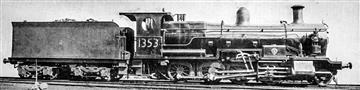
The class D55, designated K1353 before 1924, was a 2-8-0 „Consolidation” goods locomotive introduced by the NSWGR in 1918. It had the same boiler as the older class TF939 or D53 after this had been superheated . The m...
| New South Wales class D55Remove | |
|---|---|
| Variant | |
| Built | 1918-1925 |
| Manufacturers | Clyde Engineering |
| Wheel arrangement | 1D |
| Gauge | 1435 mm |
| Length | |
| Service mass | 74832 kg |
| Top speed | |
| Power | |
| Engine |
General
| Property | New South Wales class D55Remove |
|---|---|
| Built | 1918-1925 |
| Manufacturers | Clyde Engineering |
| Wheel arrangement | 2-8-0 (Consolidation) |
| Gauge | 1,435 mm |
Dimensions and weights
| Property | New South Wales class D55Remove |
|---|---|
| Wheelbase | 7.14 m |
| Total wheelbase | 15.99 m |
| Service mass | 74.8 t |
| Adhesion mass | 67.8 t |
| Rigid wheelbase | 4.65 m |
| Axle load | 17.6 t |
| Water capacity | 18,185 l |
| Fuel capacity | 10,910 l (oil) |
Boiler
| Property | New South Wales class D55Remove |
|---|---|
| Grate area | 2.671 m² |
| Firebox surface | 16.63 m² |
| Tube heating surface | 146.23 m² |
| Evaporative heating surface | 162.859 m² |
| Superheater surface | 33.817 m² |
| Total heating surface | 196.7 m² |
Power plant
| Property | New South Wales class D55Remove |
|---|---|
| Driver diameter | 1,295 mm |
| Boiler pressure | 11 bar |
| Expansion type | simple expansion |
| Cylinders | two, 559 x 660 mm |
Power
| Property | New South Wales class D55Remove |
|---|---|
| Power source | steam |
| Estimated power | 895 kW (1,217 PS) |
| Starting effort | 149.3 kN |
Calculated values
| Property | New South Wales class D55Remove |
|---|---|
| Factor of adhesion | 1 : 4.45 |
| Optimal speed | 37 km/h |
| Power-to-weight ratio | 12.0 kW/t |
| Heating Surface Equivalent | 313.6 m² |
| Cylinder volume/HSE | 1 : 1,032.77 |
| Adhesive weight/Total | 1 : 1.10 |
| Tractive force/Heating surface | 1 : 15.85 |
| Grate area/Heating surface | 1 : 73.63 |
| Firebox/Tube surface | 1 : 8.79 |
| Total/Superheater | 1 : 4.82 |