


Banner
Navigation

Navigation

loco-info.com
The reference for locomotives and railcars

Compare locomotives

Add a locomotive

North Eastern classes P, P1, P2 and P3
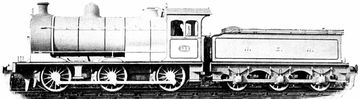
P2 No. 132

The North Eastern Railway classes P through P3 comprised a total of 355 0-6-0 locomotives which were produced between 1894 and 1923. They were created by William Worsdell, who had been employed as chief engineer at th...

North Eastern classes P, P1, P2 and P3Remove
Variant
P1
Built 1898-1902
Manufacturers Darlington;Gateshead
Wheel arrangement C
Gauge 1435 mm
Length
Service mass 42369 kg
Top speed
Power
Engine

General

Property North Eastern classes P, P1, P2 and P3
P1
Remove
Built 1898-1902
Manufacturers Darlington, Gateshead
Wheel arrangement 0-6-0 (Six-coupled)
Gauge 1,435 mm

Dimensions and weights

Property North Eastern classes P, P1, P2 and P3
P1
Remove
Wheelbase 5.03 m
Service mass 42.4 t
Adhesion mass 42.4 t
Rigid wheelbase 5.03 m
Axle load 16.1 t
Water capacity 13,809 l
Fuel capacity 5.1 t (coal)

Boiler

Property North Eastern classes P, P1, P2 and P3
P1
Remove
Grate area 1.598 m²
Firebox surface 10.034 m²
Tube heating surface 95.226 m²
Evaporative heating surface 105.259 m²
Total heating surface 105.3 m²

Power plant

Property North Eastern classes P, P1, P2 and P3
P1
Remove
Driver diameter 1,403 mm
Boiler pressure 11 bar
Expansion type simple expansion
Cylinders two, 464 x 610 mm

Power

Property North Eastern classes P, P1, P2 and P3
P1
Remove
Power source steam
Estimated power 429 kW (583 PS)
Starting effort 87.5 kN

Calculated values

Property North Eastern classes P, P1, P2 and P3
P1
Remove
Factor of adhesion 1 : 4.75
Optimal speed 31 km/h
Power-to-weight ratio 10.1 kW/t
Heating Surface Equivalent 155.4 m²
Cylinder volume/HSE 1 : 1,323.80
Adhesive weight/Total 1 : 1.00
Tractive force/Heating surface 1 : 17.37
Grate area/Heating surface 1 : 65.87
Firebox/Tube surface 1 : 9.49
Auf Deutsch umschalten

Settings

Your settings are retained for this browser session only.

Consent to cookies

We use cookies to save your display settings. If you decline, the settings are retained only for the current browser session.