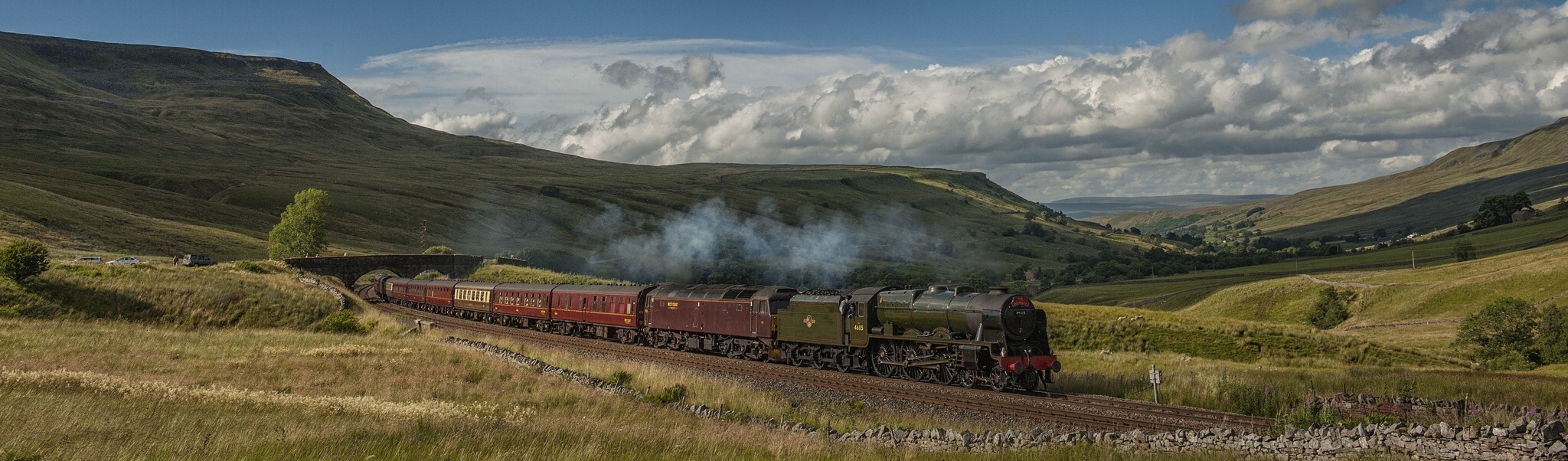
This was the first of the Prussian 4-6-0 express locomotives, which were grouped together in the class S 10. It was created in the first decade of the 20th century, since the existing locomotives with the wheel arrangement 4-4-0 or 4-4-2 were no longer able to cope with the increased requirements and a six-coupled express locomotive was therefore required. The basis was the 100 km/h passenger locomotive P 8, which had the same wheel arrangement and roughly the same dimensions. The new locomotive received the same boiler, but in a reinforced design, which allowed the pressure to be increased from 12 to 14 bars. The diameter of the driving wheels had been increased from 1,750 to 1,980 mm in order to increase the possible sustained speed.
A distinctive feature was the engine, which had four cylinders, but only simple steam expansion. The reason for this was the significantly smoother running of four-cylinder locomotives compared to two-cylinder ones. The greatest disadvantage of this engine was the fuel consumption, which was noticeably higher than that of the S 101 with a compound engine that was introduced a short time later. This actually made the S 10 one of the most uneconomical Prussian locomotives. With the original tender of the type 2'2' T 21.5, the range was correspondingly short, which is why the considerably larger 2'2' T 31.5 was later used.
Nevertheless, production of the S 10 continued at the same time as the S 101, so that the Prussian State Railways received a total of 202 until 1914. Another five slightly weaker locomotives were delivered to the Lübeck-Büchener Eisenbahn and were also designated S 10 there. The Reichsbahn took over 135, which were given the designation 17 001 to 17 135. Six had already been handed over to the Lithuanian State Railways in 1920. Due to the high consumption, all but three locomotives were finally retired by 1935. These three continued to be used as brake locomotives until the last of them was also retired in 1954.