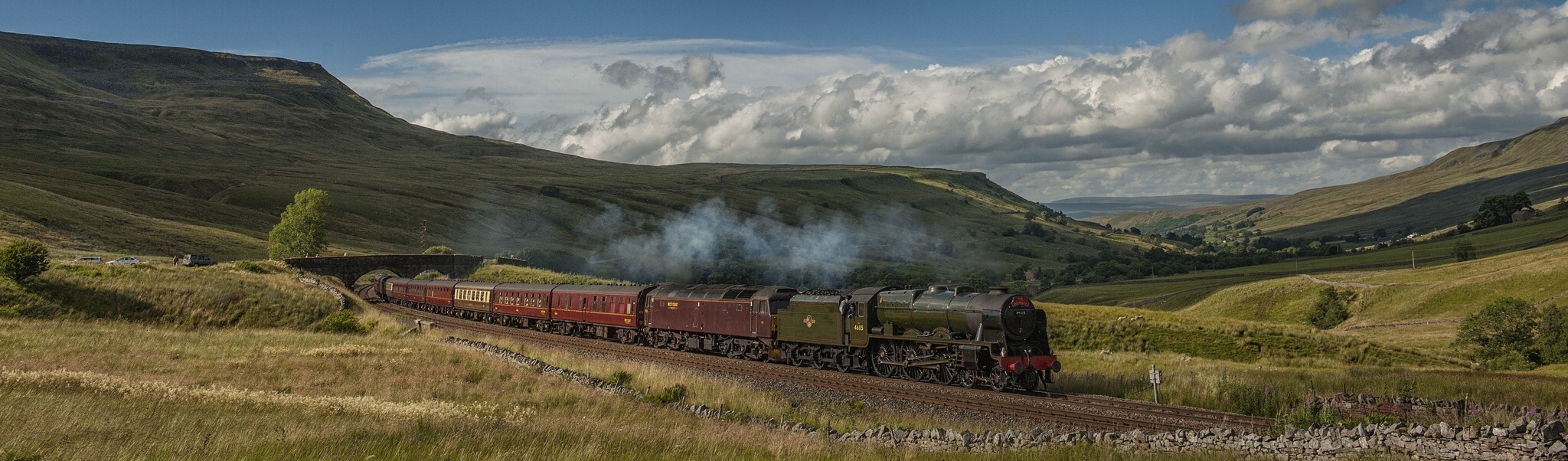



Imperial-Royal State Railways class 80
Austrian Federal Railways (BBÖ) class 57 and class 157, Polish State Railways Tw12, Yugoslav Railway class 28, and Romanian Railway class 50.0
The class 80 was created by superheating the class 180. At that time, however, Karl Gölsdorf generally designed the superheater surface to be small in order to be able to dispense with the expensive import of special lubricants for higher temperatures. Except for a slightly larger high-pressure cylinder, the differences to the 180 were limited.
The first production batch from 1909 to 1910 consisted of 36 locomotives, in which the high-pressure cylinder was controlled by a piston valve and the low-pressure cylinder by a slide valve. The next 104 from 1911 to 1915 only used piston valves. These two variants are known as 80.0 and 80.100 because of their running numbers.
Between 1911 and 1919 the class 80.900 was built in parallel, which had a simple engine. Both cylinders had the same diameter as the high-pressure cylinder on the 80.0 and 80.100. With 212 vehicles, it reached a significantly larger number than the compound variant. Among them were eight which went to the southern railway.
After the First World War, the BBÖ ordered further locomotives of the simple variant and classified them as class 80.300. Five others had Lentz valve gear and a small-tube superheater with a significantly larger area, with the evaporation heating area being reduced. These locomotives were listed as 80.600.
Other states from the former territory of the k.u.k. Monarchy subsequently ordered a larger number of identical locomotives. They were assigned to their fleet together with the locomotives taken over from pre-war production and given different designations. So they were called Tw12 in the PKP, class 28 in the JDŽ and series 50.0 in the CFR.
Since the BBÖ only had a few class 80 locomotives left, some of these were rebuilt into simple locomotives. When the Reichsbahn took over the BBÖ in 1938, the class 80 was assigned to the Reichsbahn class 57 according to the scheme. After the Second World War, the ÖBB took up this numbering and classified the compound locomotives as class 157 and the simple ones as class 57.
Technical data
General
| Property | 80.0, 80.100 | 80.600 | 80.900 |
|---|---|---|---|
| Built | 1909-1915 | ||
| Manufacturers | Floridsdorf, Wiener Neustadt, StEG, BMMF | ||
| Wheel arrangement | 0-10-0 (Ten-coupled) | ||
| Gauge | 1,435 mm (Standard gauge) | ||
Dimensions and weights
| Property | 80.0, 80.100 | 80.600 | 80.900 |
|---|---|---|---|
| Length | 17.28 m | ||
| Wheelbase | 5.60 m | ||
| Total wheelbase | 2.50 m | 4.20 m | |
| Empty mass | 62.7 t | 61.5 t | |
| Service mass | 69.4 t | 68 t | |
| Adhesion mass | 69.4 t | 68 t | |
| Total mass | 108.4 t | 107 t | |
| Axle load | 14.1 t | 13.8 t | |
| Water capacity | 16,000 l | ||
| Fuel capacity | 8.5 t (coal) | ||
Boiler
| Property | 80.0, 80.100 | 80.600 | 80.900 |
|---|---|---|---|
| Grate area | 3.42 m² | ||
| Firebox surface | 12 m² | ||
| Tube heating surface | 190 m² | 134.5 m² | 190.3 m² |
| Evaporative heating surface | 202 m² | 146.5 m² | 202.3 m² |
| Superheater surface | 26.8 m² | 67.1 m² | 26.8 m² |
| Total heating surface | 228.8 m² | 213.6 m² | 229.1 m² |
Power plant
| Property | 80.0, 80.100 | 80.600 | 80.900 |
|---|---|---|---|
| Driver diameter | 1,258 mm | ||
| Boiler pressure | 14 bar | ||
| Expansion type | compound | simple expansion | |
| Cylinders | two, HP: 590 x 632 mm and LP: 850 x 632 mm | two, 590 x 632 mm | |
Power
| Property | 80.0, 80.100 | 80.600 | 80.900 |
|---|---|---|---|
| Power source | steam | ||
| Estimated power | 950 kW (1,292 PS) | 1,000 kW (1,360 PS) | 950 kW (1,292 PS) |
| Top speed | 50 km/h | ||
| Starting effort | 140.4 kN | 208.1 kN | |
| Starting effort simple | 168.5 kN | ||
Calculated values
| Property | 80.0, 80.100 | 80.600 | 80.900 |
|---|---|---|---|
| Factor of adhesion | 1 : 4.85 | 1 : 3.21 | |
| Optimal speed | 42 km/h | 29 km/h | 27 km/h |
| Power-to-weight ratio | 13.7 kW/t | 14.7 kW/t | 14.0 kW/t |
| Heating Surface Equivalent | 315.6 m² | 340.7 m² | 315.9 m² |
| Cylinder volume/HSE | 1 : 1,115.66 | 1 : 1,014.31 | 1 : 1,093.93 |
| Adhesive weight/Total | 1 : 1.00 | ||
| Tractive force/Heating surface | 1 : 12.82 | 1 : 20.35 | 1 : 18.97 |
| Grate area/Heating surface | 1 : 66.90 | 1 : 62.46 | 1 : 66.99 |
| Firebox/Tube surface | 1 : 15.83 | 1 : 11.21 | 1 : 15.86 |
| Total/Superheater | 1 : 7.54 | 1 : 2.18 | 1 : 7.55 |