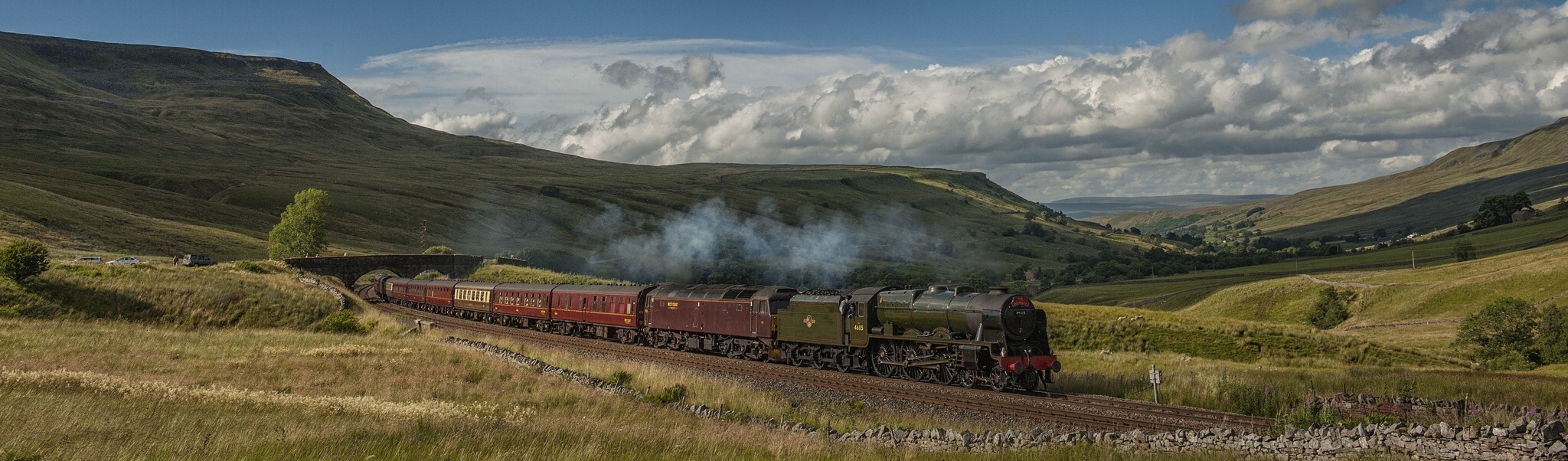



London, Midland & Scottish Horwich Mogul “Hughes Crab”
London, Midland & Scottish class 5MT
The Horwich Mogul takes its name from the LMS works in Horwich, formerly Lancashire, where the first batch of these locomotives was built. However, it is better known by the name “Hughes Crab” given to her by rail enthusiasts. In order to accommodate the large cylinders within the loading gauge, engineer George Hughes was forced to incline them and set the connecting rods a few degrees upwards. Since this gave the impression of a crab with its claws, it was given this name. It was designed taking into account the latest knowledge and planned with the most modern assemblies available in terms of brakes, valves, boiler and tender. The design was only implemented under Henry Fowler and it was initially questionable whether all the innovations could actually be put into practice.
Due to the technical progress, however, it was possible to implement a large part of the innovations, while standard parts of the LMS only had to be used for the brake system and the boiler attachments. A standard model from Derby Works was used as the tender. Since the locomotive itself made full use of the available loading gauge and this was not the case with the tender, the latter was noticeably narrower than the locomotive's cab. A total of 70 were built at Horwich and a further 175 at Crewe between 1926 and 1932. These engines were particularly popular in Scotland on the mountainous routes when used in front of heavy ore and coal trains without continuous brakes.
Over time, some locomotives have been experimentally upgraded with modern parts. In 1934, five received Lentz valve gear, which they also kept. However, it stayed with these five. In 1954 a new chimney including a new blastpipe was tested on one locomotive. This increased the boiler's evaporative capacity by 25 percent, but it remained a one-off. The locomotives were retired between 1961 and 1967 and three remain in existence today. 13065 was preserved in operational condition and operated until 2018 when several faults were discovered in its boiler.
Technical data
General
- Built
- 1926-1932
- Manufacturers
- Horwich, Crewe
- Wheel arrangement
- 2-6-0 (Mogul)
- Gauge
- 1,435 mm (Standard gauge)
Dimensions and weights
- Length
- 18.06 m
- Wheelbase
- 7.77 m
- Service mass
- 66.6 t
- Adhesion mass
- 56.4 t
- Total mass
- 109.5 t
- Rigid wheelbase
- 5.03 m
- Axle load
- 18.8 t
- Water capacity
- 15,910 l
- Fuel capacity
- 5.1 t (coal)
Boiler
- Grate area
- 2.555 m²
- Firebox surface
- 14.865 m²
- Tube heating surface
- 125.001 m²
- Evaporative heating surface
- 139.866 m²
- Superheater surface
- 28.521 m²
- Total heating surface
- 168.4 m²
Power plant
- Driver diameter
- 1,676 mm
- Boiler pressure
- 12.4 bar
- Expansion type
- simple expansion
- Cylinders
- two, 533 x 660 mm
Power
- Power source
- steam
- Estimated power
- 858 kW (1,167 PS)
- Starting effort
- 118.2 kN
Calculated values
- Factor of adhesion
- 1 : 4.68
- Optimal speed
- 45 km/h
- Power-to-weight ratio
- 12.9 kW/t
- Heating Surface Equivalent
- 271.2 m²
- Cylinder volume/HSE
- 1 : 1,088.15
- Adhesive weight/Total
- 1 : 1.18
- Tractive force/Heating surface
- 1 : 14.66
- Grate area/Heating surface
- 1 : 65.90
- Firebox/Tube surface
- 1 : 8.41
- Total/Superheater
- 1 : 4.90