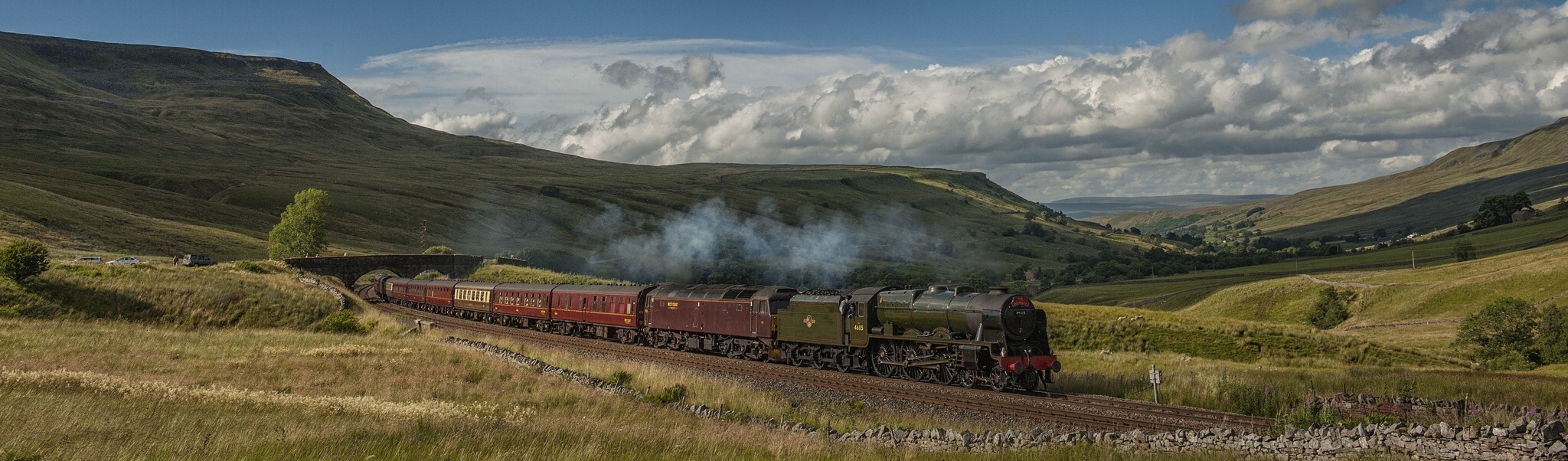



South African class 26 “Red Devil”
In the seventies, David Wardale developed a concept for a modern steam locomotive with increased power and reduced consumption of coal and water. In this way he hoped that the steam locomotive could see another renaissance and a large number would be rebuilt. He also based his work on the Argentine engineer Livio Dante Porta and his dual Lempor exhaust. The other main innovation was the Gas Producer Combustion System (GPCS) that worked with gasification of coal on a low temperature firebed. This would lead to an increased of amount of power generated per pound of coal, while the better combustion reduced the amount of black smoke.
As a first test for his modifications, he was allowed to rebuild the Krupp-built 4-8-2 class 19D No. 2644. As this was a success, the got the 4-8-4 class 25NC No. 3450 for a more thorough rebuild. This class had been designed by L.C. Grubb and this individual locomotive had been built by Henschel in 1953. Additional modifications were a feed water heater, a booster for the superheater and a lengthened, self-cleaning smokebox. The valve gear was completely revised with dimensions which had been calculated by computer and with improved lubrication.
As several SAR shops were specialized in several areas, individual parts were built at different locations. The rebuild was completed in 1981 and the locomotive was originally named “L.D. Porta”, but quickly got the official nickname “Red Devil” due to its color. Soon it became known as the world's most powerful narrow gauge steam locomotive. In the following years it was tested with passenger and freight trains.
Indicating equipment recorded an output of 3,350 kW or 4,490 hp, although some claim up to 5,030 hp. Compared to the class 25NC, this was a drawbar hp increase of 43 percent, while it consumed 28 percent less coal and 30 percent less water. It could haul freight trains of 900 tonnes over an incline of two percent, or a 650 tonne passenger train with 100 km/h over one percent.
The biggest problem of this locomotive was slipping due to its high power. As only four of eight axles were used for traction, it had a factor of adhesion of 3.24 what was low for a two-cylinder locomotive. Later “Red Devil” underwent some modifications which did not bring many improvements. In 1989 and 1990, one NG G16 Garratt each were rebuilt in a similar way, what greatly improved their performance. 3450 hauled excursion trains until 2003 and in 2018, it became operational again with Ceres Rail, but only runs in winter.
Technical data
General
- Built
- 1981
- Manufacturers
- SAR
- Wheel arrangement
- 4-8-4 (Northern)
- Gauge
- 1,067 mm (Cape gauge)
Dimensions and weights
- Wheelbase
- 11.58 m
- Total wheelbase
- 24.81 m
- Service mass
- 119.3 t
- Adhesion mass
- 75.4 t
- Total mass
- 235.7 t
- Rigid wheelbase
- 4.80 m
- Axle load
- 19 t
- Water capacity
- 47,734 l
- Fuel capacity
- 20.3 t (coal)
Boiler
- Grate area
- 3.437 m²
- Firebox surface
- 27.314 m²
- Tube heating surface
- 284.191 m²
- Evaporative heating surface
- 311.504 m²
- Superheater surface
- 94.232 m²
- Total heating surface
- 405.7 m²
Power plant
- Driver diameter
- 1,524 mm
- Boiler pressure
- 15.5 bar
- Expansion type
- simple expansion
- Cylinders
- two, 610 x 711 mm
Power
- Power source
- steam
- Indicated power
- 3,356 kW (4,563 PS)
- Starting effort
- 228.7 kN
Calculated values
- Factor of adhesion
- 1 : 3.24
- Optimal speed
- 90 km/h
- Power-to-weight ratio
- 28.1 kW/t
- Heating Surface Equivalent
- 636.5 m²
- Cylinder volume/HSE
- 1 : 652.19
- Adhesive weight/Total
- 1 : 1.58
- Tractive force/Heating surface
- 1 : 11.77
- Grate area/Heating surface
- 1 : 118.05
- Firebox/Tube surface
- 1 : 10.40
- Total/Superheater
- 1 : 3.31