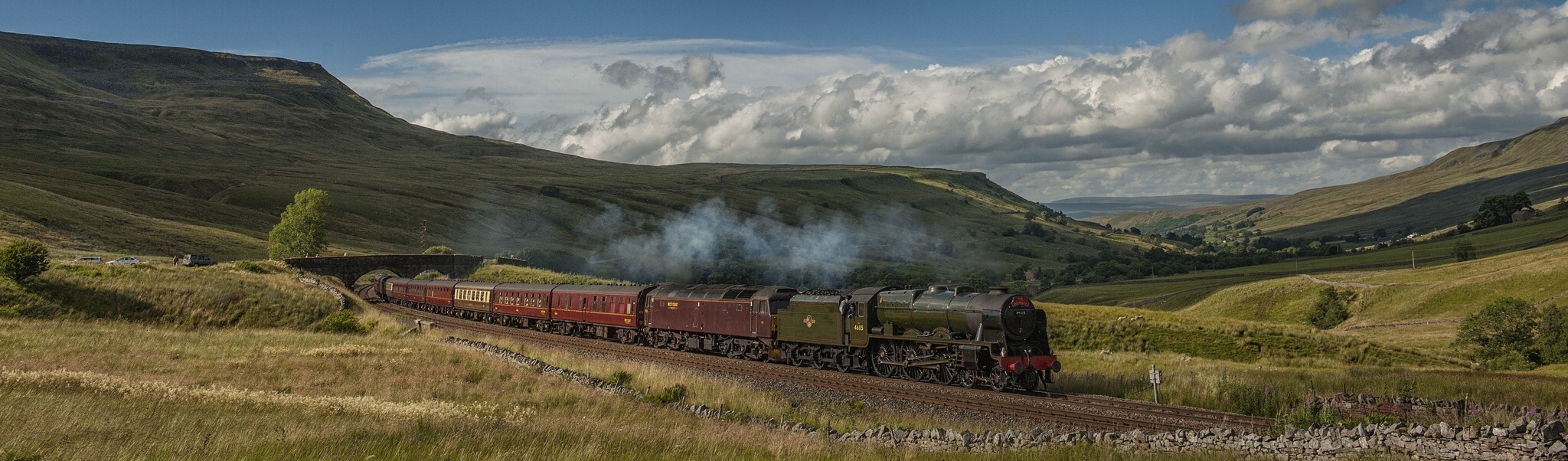



German Federal Railway class 23
After the war, both German railways developed a new steam locomotive from the prototypes of the advanced class 23 of 1941 in order to supplement their fleets, which had been decimated by the war, and to be able to replace the Prussian P 8 in the long term. While the variant of the Reichsbahn was first designated as class 2310 and later as class 035, the Bundesbahn variant was only given the designation 23.
Like its Eastern counterpart, modern technologies were used, such as a boiler with a combustion chamber, and most importantly, welding technology was widely used. Much attention was also paid to the chassis. The resulting locomotive showed a significantly increased power compared to the P 8 and immediately proved itself in use. It was one of the few locomotives with a tender that could also run backwards at maximum speed, even if this was limited to 85 km/h for safety reasons and the full 110 km/h was only permitted forwards.
In addition, with this class, great importance was attached to the working conditions of the crew, which made it one of the few German steam locomotives with a completely enclosed cab. Previously the cabs had been open at the back and partly on the sides, but in the class 23 there was a heated floor, a locker for clothes and even a possibility to heat food. In addition, 16 of the total of 105 examples were given push-pull train control for more efficient use in passenger transport with the control cars, which were still new at the time.
In spite of all these advantages, the end of the steam age was slowly approaching, and thus the class 23 did not survive the P 8 to be replaced by very many years. So it happened that the last P 8 was decommissioned by the Bundesbahn in 1974 for reasons of age, but the last 23 was also withdrawn in 1975 due to the changeover to the new types of traction.
Technical data
General
- Built
- 1950-1959
- Manufacturers
- Henschel, Jung, Krupp, Esslingen
- Wheel arrangement
- 2-6-2 (Prairie)
- Gauge
- 1,435 mm (Standard gauge)
Dimensions and weights
- Length
- 21.33 m
- Wheelbase
- 9.90 m
- Empty mass
- 74.6 t
- Service mass
- 82.8 t
- Adhesion mass
- 56 t
- Total mass
- 144.8 t
- Rigid wheelbase
- 2.00 m
- Axle load
- 18.9 t
- Water capacity
- 31,000 l
- Fuel capacity
- 8 t (coal)
Boiler
- Grate area
- 3.11 m²
- Firebox surface
- 17.1 m²
- Tube heating surface
- 139.18 m²
- Evaporative heating surface
- 156.28 m²
- Superheater surface
- 73.8 m²
- Total heating surface
- 230.1 m²
Power plant
- Driver diameter
- 1,750 mm
- Boiler pressure
- 16 bar
- Expansion type
- simple expansion
- Cylinders
- two, 550 x 660 mm
Power
- Power source
- steam
- Indicated power
- 1,325 kW (1,801 PS)
- Top speed
- 110 km/h
- Starting effort
- 155.2 kN
Calculated values
- Factor of adhesion
- 1 : 3.54
- Optimal speed
- 51 km/h
- Power-to-weight ratio
- 16.0 kW/t
- Heating Surface Equivalent
- 389.4 m²
- Cylinder volume/HSE
- 1 : 805.41
- Adhesive weight/Total
- 1 : 1.48
- Tractive force/Heating surface
- 1 : 14.08
- Grate area/Heating surface
- 1 : 73.98
- Firebox/Tube surface
- 1 : 8.14
- Total/Superheater
- 1 : 2.12