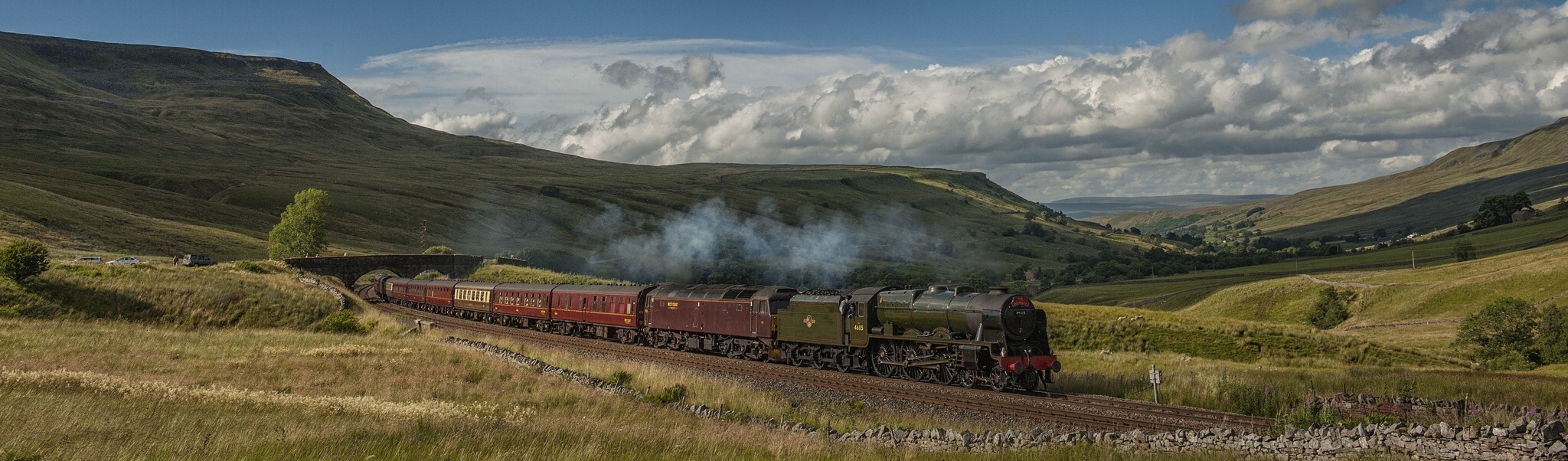




Midland class 700
London, Midland & Scottish class 1F
Great Britain 1869 315 produced

The Midland Railway's class 700 consisted of 315 0-6-0 goods locomotives designed by Matthew Kirtley. Most of the class was built by Dübs from 1869 onwards. Typical of this time, they had double frames and inside cylinders.
The Italian Rete Mediterranea bought 50 of these machines from the Midland, but they were only delivered after the FS was founded in 1905. There they were called gruppo 380 and were phased out in the 1920s at the latest. During the First World War, 78 Midland locomotives were put into military service. The last machines were taken over by British Railways and decommissioned by 1951.
Technical data
General
- Built
- 1869-1874
- Manufacturers
- Derby, Dübs & Co., John Fowler & Co, Kitson & Co., Neilson & Co., Vulcan Foundry
- Wheel arrangement
- 0-6-0 (Six-coupled)
- Gauge
- 1,435 mm (Standard gauge)
Dimensions and weights
- Wheelbase
- 5.00 m
- Service mass
- 36.6 t
- Adhesion mass
- 36.6 t
- Rigid wheelbase
- 5.00 m
- Axle load
- 12.2 t
Boiler
- Grate area
- 1.564 m²
- Firebox surface
- 9.569 m²
- Tube heating surface
- 92.253 m²
- Evaporative heating surface
- 101.822 m²
- Total heating surface
- 101.8 m²
Power plant
- Driver diameter
- 1,588 mm
- Boiler pressure
- 9.7 bar
- Expansion type
- simple expansion
- Cylinders
- two, 432 x 610 mm
Power
- Power source
- steam
- Estimated power
- 261 kW (355 PS)
- Starting effort
- 58.7 kN
Calculated values
- Factor of adhesion
- 1 : 6.11
- Optimal speed
- 27 km/h
- Power-to-weight ratio
- 7.1 kW/t
- Heating Surface Equivalent
- 149.7 m²
- Cylinder volume/HSE
- 1 : 1,192.90
- Adhesive weight/Total
- 1 : 1.00
- Tractive force/Heating surface
- 1 : 12.05
- Grate area/Heating surface
- 1 : 65.10
- Firebox/Tube surface
- 1 : 9.64