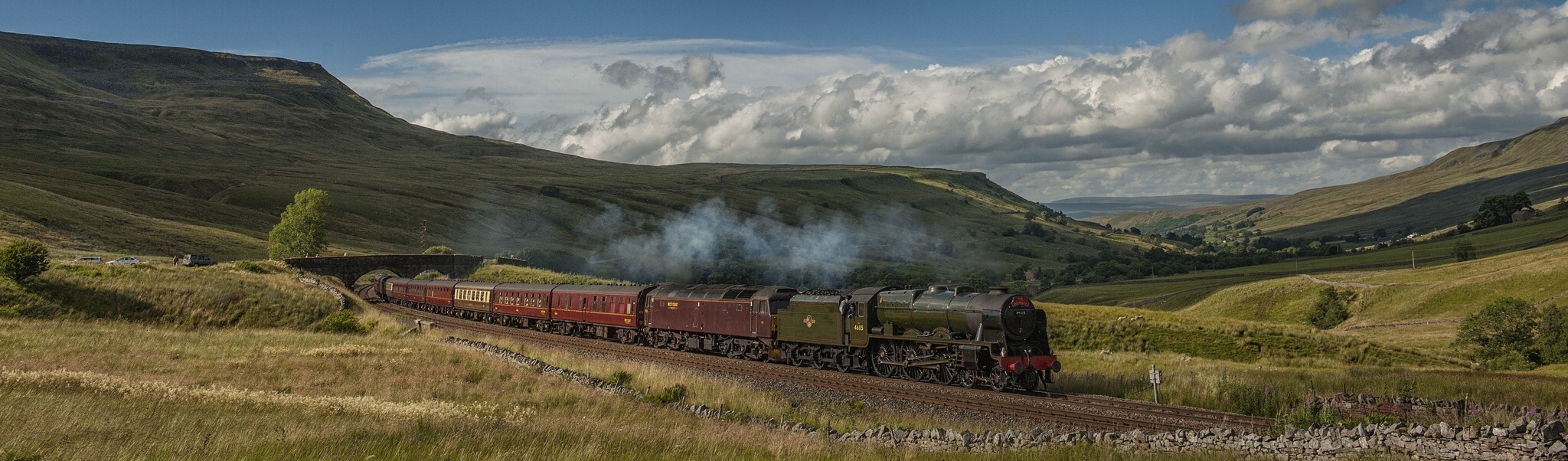



Prussian P 8
German Reichsbahn class 3810-40, Romanian Railway class 230, Polish State Railways Ok1, French State Railway 230 C, E, F and H, Belgian Railway type 64, and Austrian Federal Railways class 638

The P 8 was a passenger locomotive that was mainly developed as a successor to the P 6 and was later used as the basis for the development of the S 10. It is characterized by the fact that, with almost 4,000 built, it was the most numerous passenger steam locomotive of all time and was in use on both railways in divided Germany until the 1970s.
The Prussian head of construction, Robert Garbe, developed the P 8 as a relatively simple, but still powerful and economical machine, which, after eliminating a few teething problems, turned out to be a complete success. Garbe was already one of the pioneers of superheated steam technology in the last decade of the nineteenth century, which he also used in the construction of this locomotive as a means of achieving the required power.
It was originally intended that the new locomotive should be approved for speeds of 110 km/h and can therefore also be used for express trains. In operation, however, it turned out that an engine with two cylinders and a less than perfect mass balancing was not suitable for these speeds. This means that it was only approved for 100 km/h. The running characteristics remained the biggest point of criticism of the P 8. Above all, the somewhat loose coupling to the tender led to poor running characteristics when reversing, which is why the locomotive could only be expected to travel at a speed of 50 km/h in this direction. This only improved in later years, when the tub-type tenders of the war locomotives were used on the P 8 and now allowed reverse speeds of up to 85 km/h.
Otherwise, the locomotive was a successful design that was able to shine above all with the performance of the boiler. The firebox was already extended a little way into the boiler barrel, which partly acted like a combustion chamber and led to good steaming performance.
From 1906 to the end of the First World War, 2,350 were built, some of which were made for the Oldenburg, Baden and Mecklenburg railways. Since word of the good qualities of the locomotive had gotten around to the victorious powers as well, a total of 627 had to be handed in as reparations. Production continued until 1923 to replenish stocks. All German locomotive factories were involved, with the exception of Sächsische Maschinenfabrik Hartmann and Maschinenfabrik Esslingen. In total, the number of P 8 built was brought to 3,948.
In the period between the wars, the Reichsbahn used the P 8 with almost all train types, only heavy express and freight trains were reserved for better adapted locomotives. Passenger steam locomotives with the 4-6-0 wheel arrangement became the class 38, with the P 8 with the number range 3810-40 making up the largest part. Even after the war, both German railways could not do without the locomotives and thus their use by the Reichsbahn ended in 1972 and by the Bundesbahn in 1974. As early as 1941, two prototypes of the class 23 with a 2-6-2 wheel arrangement had been developed as a replacement for the P 8, which, however, did not go into series production. In the 1950s, a little more than 100 of the very similar classes 23 and 2310 were procured in both parts of Germany, but these were also taken out of service shortly after their predecessor.
Technical data
General
| Property | ca. 1910 variant | ca. 1921 variant |
|---|---|---|
| Built | 1906-1923 | |
| Manufacturers | AEG, BMAG, Borsig, Hanomag, Henschel, Hohenzollern, Humboldt, MBG Karlsruhe, Linke-Hofmann, Schichau, Union Königsberg, Vulcan, Wolf | |
| Wheel arrangement | 4-6-0 (Ten-wheeler) | |
| Gauge | 1,435 mm (Standard gauge) | |
Dimensions and weights
| Property | ca. 1910 variant | ca. 1921 variant |
|---|---|---|
| Length loco | 11.20 m | |
| Wheelbase | 8.35 m | |
| Empty mass | 63.6 t | 69.5 t |
| Service mass | 69.8 t | 76 t |
| Adhesion mass | 47.7 t | 51 t |
| Rigid wheelbase | 4.58 m | |
| Axle load | 15.9 t | 17 t |
| Water capacity | 21,500 l | |
| Fuel capacity | 7 t (coal) | |
| Length | 18.59 m | |
| Total wheelbase | 15.67 m | |
| Total mass | 127 t | |
Boiler
| Property | ca. 1910 variant | ca. 1921 variant |
|---|---|---|
| Grate area | 2.62 m² | 2.68 m² |
| Firebox surface | 14.7 m² | 14.75 m² |
| Tube heating surface | 135.9 m² | 130.38 m² |
| Evaporative heating surface | 150.6 m² | 145.13 m² |
| Superheater surface | 49.38 m² | 58.9 m² |
| Total heating surface | 200.0 m² | 204.0 m² |
Power plant
| Property | ca. 1910 variant | ca. 1921 variant |
|---|---|---|
| Driver diameter | 1,750 mm | |
| Boiler pressure | 12 bar | |
| Expansion type | simple expansion | |
| Cylinders | two, 590 x 630 mm | two, 575 x 630 mm |
Power
| Property | ca. 1910 variant | ca. 1921 variant |
|---|---|---|
| Power source | steam | |
| Indicated power | 868 kW (1,180 PS) | |
| Top speed | 100 km/h | |
| Starting effort | 127.8 kN | 121.4 kN |
Calculated values
| Property | ca. 1910 variant | ca. 1921 variant |
|---|---|---|
| Factor of adhesion | 1 : 3.66 | 1 : 4.12 |
| Optimal speed | 42 km/h | 43 km/h |
| Power-to-weight ratio | 12.4 kW/t | 11.4 kW/t |
| Heating Surface Equivalent | 322.9 m² | 336.7 m² |
| Cylinder volume/HSE | 1 : 1,066.97 | 1 : 971.80 |
| Adhesive weight/Total | 1 : 1.46 | 1 : 1.49 |
| Tractive force/Heating surface | 1 : 13.35 | 1 : 12.43 |
| Grate area/Heating surface | 1 : 76.33 | 1 : 76.13 |
| Firebox/Tube surface | 1 : 9.24 | 1 : 8.84 |
| Total/Superheater | 1 : 3.05 | 1 : 2.46 |