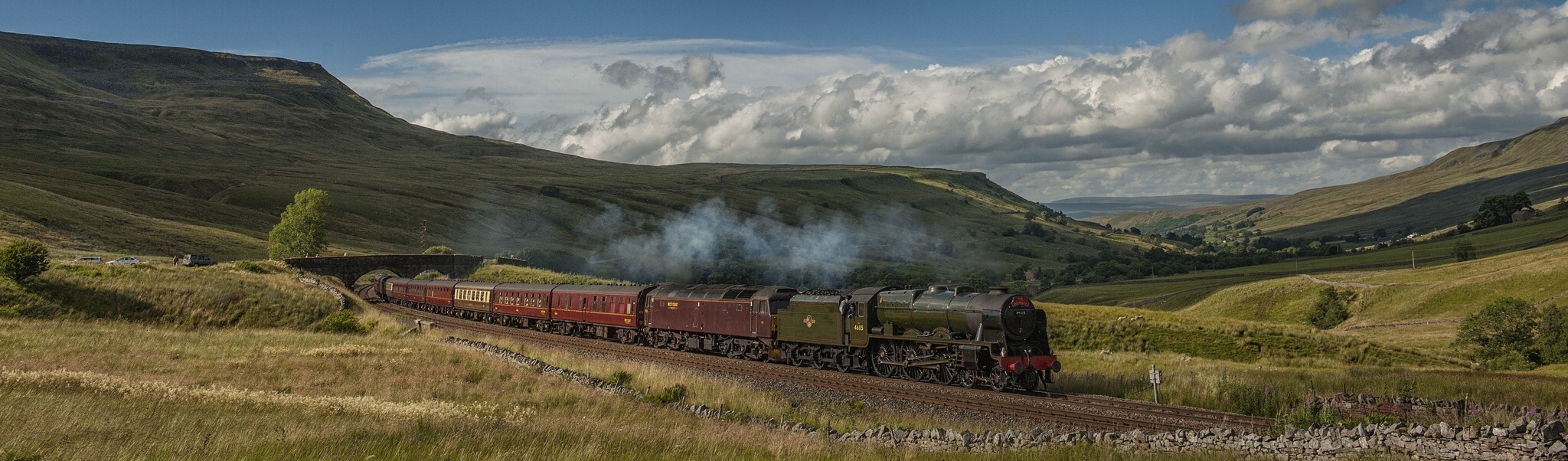



French State Railway (État) 231-501 to 783
French State Railway 231 C, D, F, G, H and J

In 1914, the État ordered the first batch of the locomotives which later carried the numbers 231-501 to 783. They were the successors to the Pacifics of the series 231-011 to 060. The new locomotives were also four-cylinder compounds, but were superheated from the start. The first batch comprised ten locomotives, of which only six had been delivered when the Germans marched into Lille. The other four locomotives were brought to Germany after completion. Other batches were built by different manufacturers, including the North British Locomotive Company.
When they were delivered, they were already state of the art that could also be found in other French express locomotives. This included a Du Bousquet-De Glehn type layout, in which the high-pressure cylinders were located on the outside and located far to the rear because they drove the middle driving axle. Meanwhile, the low-pressure cylinders were on the inside, driving the first driving axle. In addition, they had a cloverleaf-shaped blast pipe and a tender with a scoop for filling water at full speed. Between 1933 and 1949 the locomotives were rebuilt in various forms, resulting in a total of six variants. The changes affected different forms of valve gear, but some were also provided with feedwater heaters or a longer smokebox.
Among the total of 283 locomotives which had been manufactured until 1922 were some designated as “Pacific TP” which had been delivered to the PO and the Alsatian Railway during the war as relief. When the SNCF was founded, these and the six variants delivered to the État were designated 231 C, D, F, G, H and J. After some lines around Paris had been electrified from 1937, their service area shrunk. After modern diesel locomotives had also taken over the express service on non-electrified lines, the last journey of a 231 G took place in September 1968. One of these 231 G is still operational today.
Technical data
General
- Built
- 1914-1922
- Manufacturers
- Fives-Lille, North British, Batignolles-Châtillon, Schneider
- Wheel arrangement
- 4-6-2 (Pacific)
- Gauge
- 1,435 mm (Standard gauge)
Dimensions and weights
- Length
- 22.50 m
- Wheelbase
- 10.90 m
- Total wheelbase
- 19.59 m
- Service mass
- 96.5 t
- Adhesion mass
- 55.7 t
- Total mass
- 148.9 t
- Rigid wheelbase
- 4.10 m
- Axle load
- 18.6 t
- Water capacity
- 22,000 l
- Fuel capacity
- 6 t (coal)
Boiler
- Grate area
- 4.27 m²
- Firebox surface
- 16.37 m²
- Tube heating surface
- 195.6 m²
- Evaporative heating surface
- 211.97 m²
- Superheater surface
- 63.5 m²
- Total heating surface
- 275.5 m²
Power plant
- Driver diameter
- 1,960 mm
- Boiler pressure
- 16 bar
- Expansion type
- compound
- Cylinders
- four, HP: 420 x 650 mm and LP: 640 x 650 mm
Power
- Power source
- steam
- Estimated power
- 1,640 kW (2,230 PS)
- Top speed
- 130 km/h
- Starting effort
- 111.2 kN
- Starting effort simple
- 133.5 kN
Calculated values
- Factor of adhesion
- 1 : 4.91
- Optimal speed
- 90 km/h
- Power-to-weight ratio
- 17.0 kW/t
- Heating Surface Equivalent
- 420.8 m²
- Cylinder volume/HSE
- 1 : 924.89
- Adhesive weight/Total
- 1 : 1.73
- Tractive force/Heating surface
- 1 : 8.43
- Grate area/Heating surface
- 1 : 64.51
- Firebox/Tube surface
- 1 : 11.95
- Total/Superheater
- 1 : 3.34