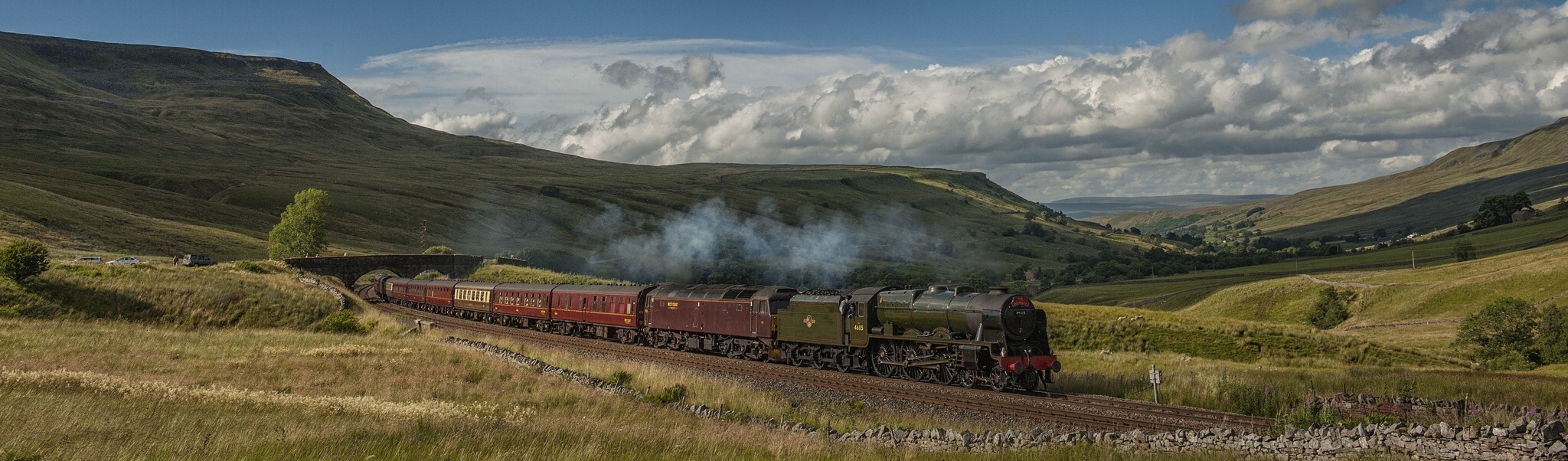



US Railroad Administration Light Pacific
United States 1919 106 produced
While the USRA Heavy Pacific was designed for express trains, the Light Pacific had a six inch smaller driver diameter and was primarily intended for passenger trains. With a maximum axle load of 54,000 pounds, it was also suitable for branch lines. Its usual services included hauling ten to twelve coaches at a speed of 70 to 80 mph (113 to 129 km/h). 106 of the original model were built, of which 70 went to the Atlantic Coast Line and were designated class P-5-A. 30 went to the Baltimore & Ohio and six to the Louisville & Nashville. Later copies also included 165 P-5-B for the ACL, while other railroads only procured smaller numbers.
Technical data
General
- Built
- 1919-1920
- Manufacturers
- ALCO, Baldwin
- Wheel arrangement
- 4-6-2 (Pacific)
- Gauge
- 1,435 mm (Standard gauge)
Dimensions and weights
- Wheelbase
- 10.59 m
- Service mass
- 125.6 t
- Adhesion mass
- 73.5 t
- Total mass
- 213.6 t
- Rigid wheelbase
- 3.96 m
- Axle load
- 24.5 t
- Water capacity
- 37,854 l
- Fuel capacity
- 14.5 t (coal)
Boiler
- Grate area
- 6.197 m²
- Firebox surface
- 24.248 m²
- Tube heating surface
- 285.398 m²
- Evaporative heating surface
- 309.646 m²
- Superheater surface
- 73.765 m²
- Total heating surface
- 383.4 m²
Power plant
- Driver diameter
- 1,854 mm
- Boiler pressure
- 13.8 bar
- Expansion type
- simple expansion
- Cylinders
- two, 635 x 711 mm
Power
- Power source
- steam
- Estimated power
- 1,976 kW (2,687 PS)
- Starting effort
- 181.3 kN
Calculated values
- Factor of adhesion
- 1 : 3.98
- Optimal speed
- 66 km/h
- Power-to-weight ratio
- 15.7 kW/t
- Heating Surface Equivalent
- 578.4 m²
- Cylinder volume/HSE
- 1 : 778.79
- Adhesive weight/Total
- 1 : 1.71
- Tractive force/Heating surface
- 1 : 9.87
- Grate area/Heating surface
- 1 : 61.87
- Firebox/Tube surface
- 1 : 11.77
- Total/Superheater
- 1 : 4.20