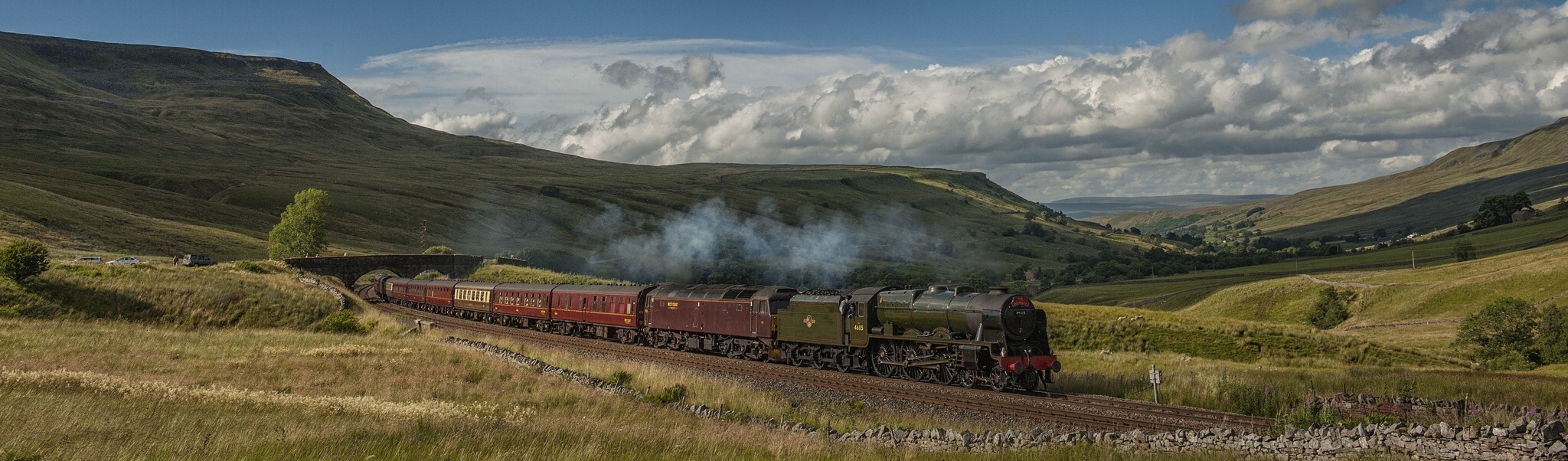



British Rail standard class 4 tank

The standard class 4 tank locomotive was developed to replace older tank locomotives for use with fast commuter and suburban trains. It was based on the LMS Fairburn 2-6-4T and had a similar driving wheel diameter of five feet eight inches. For a wider route availability, the loading gauge was reduced by slightly rounding off the cab and the water tanks. The smaller cylinders, which were compensated for with a higher boiler pressure, also contributed to this.
Most of the locomotives were made in Brighton with a total of 130. Another 15 came from Derby and ten from Doncaster. Another order for 15 locomotives was canceled in view of the dieselisation. The fact that only small detail changes were made to the locomotives during their career shows that the design itself was successful. It also served as the basis for the standard class 4 4-6-0 tender locomotive.
The locomotives were used almost all over the country. The only exception was the Western Region where the GWR Large Prairie was available in sufficient numbers, so that there was no need for the 2-6-4T. The first one was scrapped in 1962 after it suffered a broken frame. Since older classes were withdrawn first, the 2-6-4T was only withdrawn between 1964 and 1967. A total of 15 have survived to this day, some of which are used regularly.
Technical data
General
- Built
- 1951-1956
- Manufacturers
- Brighton, Derby, Doncaster
- Wheel arrangement
- 2-6-4T (Adriatic)
- Gauge
- 1,435 mm (Standard gauge)
Dimensions and weights
- Length
- 13.67 m
- Wheelbase
- 11.23 m
- Service mass
- 90 t
- Adhesion mass
- 53.9 t
- Rigid wheelbase
- 4.67 m
- Axle load
- 18.2 t
- Water capacity
- 9,093 l
- Fuel capacity
- 3.3 t (coal)
Boiler
- Grate area
- 2.481 m²
- Firebox surface
- 13.285 m²
- Tube heating surface
- 113.621 m²
- Evaporative heating surface
- 126.906 m²
- Superheater surface
- 22.297 m²
- Total heating surface
- 149.2 m²
Power plant
- Driver diameter
- 1,727 mm
- Boiler pressure
- 15.5 bar
- Expansion type
- simple expansion
- Cylinders
- two, 457 x 711 mm
Power
- Power source
- steam
- Estimated power
- 1,081 kW (1,470 PS)
- Top speed
- 121 km/h
- Starting effort
- 113.5 kN
Calculated values
- Factor of adhesion
- 1 : 4.65
- Optimal speed
- 58 km/h
- Power-to-weight ratio
- 12.0 kW/t
- Heating Surface Equivalent
- 237.9 m²
- Cylinder volume/HSE
- 1 : 981.49
- Adhesive weight/Total
- 1 : 1.67
- Tractive force/Heating surface
- 1 : 15.89
- Grate area/Heating surface
- 1 : 60.14
- Firebox/Tube surface
- 1 : 8.55
- Total/Superheater
- 1 : 5.69