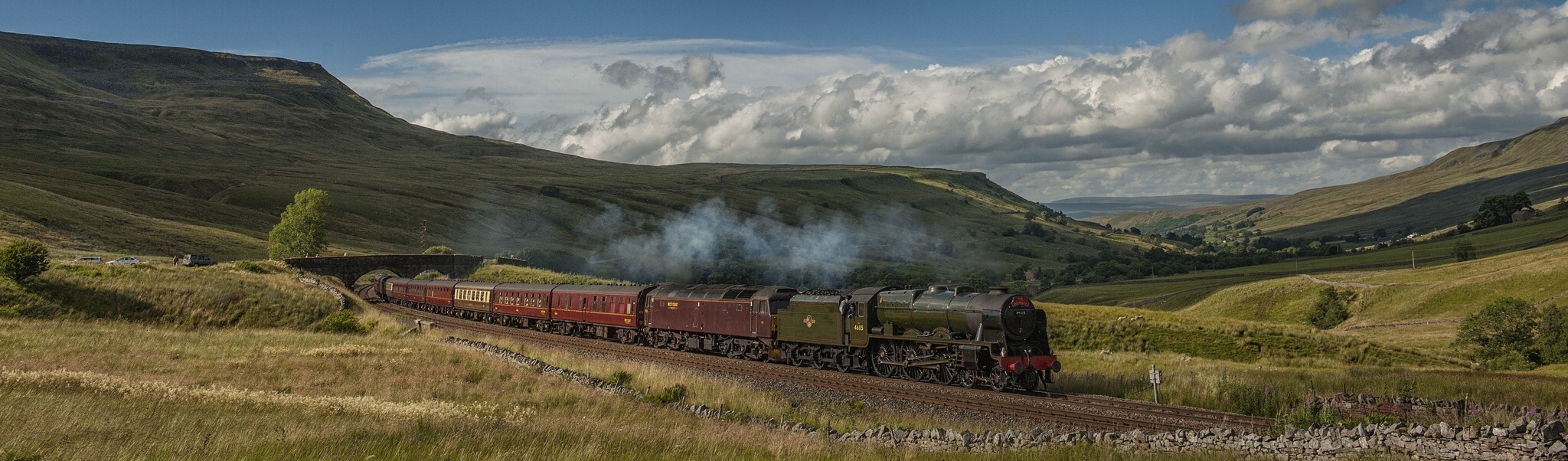
The “Black Five” was Stanier's most famous design and also one of the most famous British steam locomotives ever. It was created because Stanier was of the opinion that the 2-6-0 Moguls used in power class 5 in mixed service would soon no longer be sufficient. From his time at the GWR he was familiar with the class 4900 “Hall”, which, with a 4-6-0 wheel arrangement and a driver diameter of six feet, was suitable for all trains from freight to express. Since the Hall had been developed for the re-gauged, formerly broad-gauge lines of the GWR and therefore did not fit into the loading gauge of the lines in the north, Stanier designed a slightly narrower and lighter locomotive. Since these were painted black, in contrast to the crimson the LMS had previously used, and belonged to power class 5, they were soon known as the “Black Five”. They quickly gained the image of locomotives that could be used almost anywhere and take on almost any task. They were found with freight trains as well as with heavy express trains that could travel at speeds of up to 80 mph.
From the Moguls, Stanier adopted the tapered Belpaire firebox and from the Halls he adopted the six foot wheel diameter. The first 70 locomotives came partly from the LMS workshops in Crewe and partly from the Vulcan Foundry. After 57 examples were built, a new boiler was used, which, unlike the original, had a steam dome and a higher degree of superheating. The upper edge of the firebox was soon designed to slope backwards in order to lengthen the flame paths in the boiler.
In 1936 Armstrong Whitworth received an order for 227 Black Fives, which at the time was the largest order that a British railway company had ever placed with a commercial factory. In the same period, 20 more were built at Crewe with an even higher degree of superheating. New batches were again commissioned during the Second World War, beginning in 1943 at the Derby works. From 1947 roller bearings were used for the axles, at the same time the wheelbase was slightly extended and some details on the boiler were improved. George Ivatt, as the new chief engineer, further improved the locomotives in 1948 with better bearings and a different valve design. Some locomotives received a steel instead of copper firebox and double chimneys and blastpipes.
British Railways continued production until 1951, so that a total of 842 were built. Even the Standard Class 5 was developed from these. The Black Five also remained in service in large numbers well into the last days of steam traction in Britain. After only one had been withdrawn in 1961, the number of withdrawals rose only slowly at first. They peaked in 1967 with 305 and in 1968 the last 151 disappeared. Today 18 have survived, 12 of which were purchased directly from British Railways and six were rescued from the scrapyard. As of 2024, seven were still in operational condition, six of which had unrestricted certification for the British main lines and were not restricted to individual preserved railways.