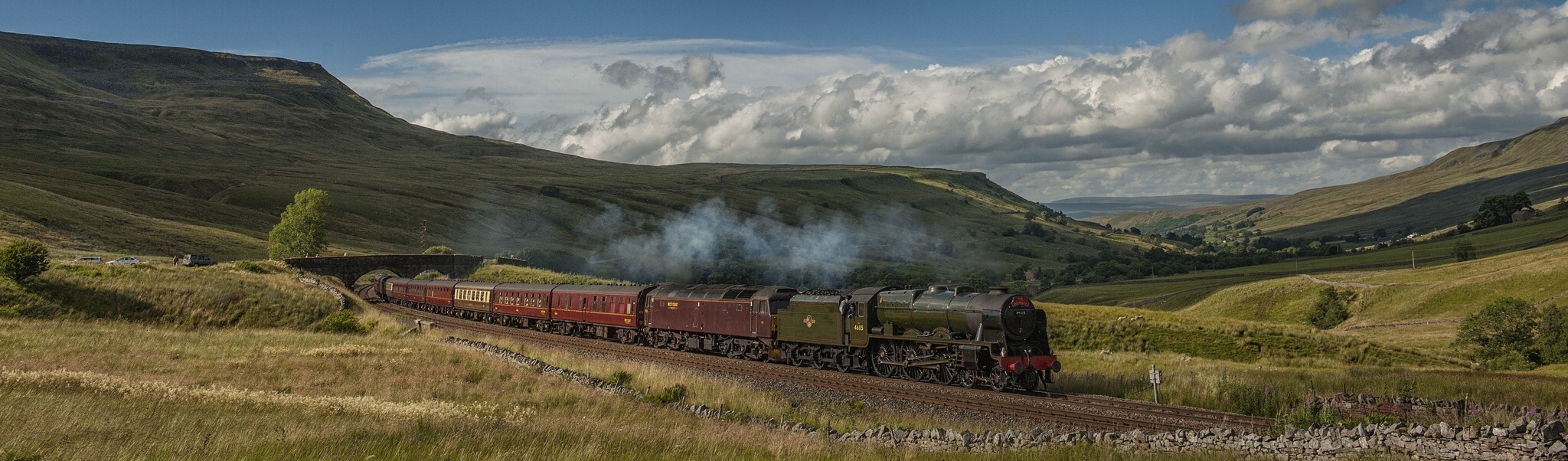



Southern Railway (UK) West Country and Battle of Britain classes
Bulleid Light Pacific

After Bulleid had introduced his innovative Pacific of the Merchant Navy class, the Southern Railway identified the need for a lighter locomotive that was also suited for express and fast freight trains. On the one hand these were needed for the lighter rails in the West Country, but also for many lines which were not maintained well during the war and for which the Merchant Navy was too heavy. This included the haulage of express freights on the electrified suburban lines without slowing down the electric multiple units which operated on the same tracks.
After evaluating different wheel arrangements, Bulleid decided to build a Pacific that was a scaled-down version of the Merchant Navy, along with all its innovations. This was accomplished by the mounting of a smaller boiler, decreasing the overall length and reducing the cylinder dimensions. In the result, they were five tonnes lighter, but had the same features like the Bulleid chain-driven valve gear and the air-smoothed casing that was primarily intended to facilitate cleaning of the locomotives and also brought them the nickname “Spam Cans”. The cab was also reduced in size to fit the loading gauge of some lines and some got a smaller tender for use in the West Country.
Between 1945 and 1951, 110 locomotives were built at the SR's Brighton and Eastleigh works. The first 48 locomotives were named after places in the West Country, leading to the name “West Country class”. Since they were also intended to be used in other regions, all which followed were named after subjects or persons associated with the Battle of Britain and the RAF, hence the second name “Battle of Britain class”. They were also known by their common name “Bulleid Light Pacifics”, while their heavier sisters were called “Bulleid Heavy Pacifics”.
As with their sisters, it became evident that they were expensive to maintain, mostly due to their chain-driven valve gear. So they were rebuilt in the same way, what included the removal of the casing and the fitting of a more conventional Walschaerts valve gear. Additionally, the boiler pressure was reduced from 280 to 250 psi. Although these changes reduced their power, they reduced the maintenance costs by 60 percent and also reduced the coal consumption a bit.
The rebuilding process was halted in 1961 after 60 locomotives had been rebuilt. This was due to the fact that more and more lines in the Southern Region had been electrified, alongside the introduction of diesel locomotives on other lines. The withdrawals started in 1963 and were completed in July 1967 when all steam service ended in the Southern Region. 20 locomotives were preserved, what includes a mix of rebuilt and unrebuilt ones. Eight of them are currently operational, with more either under overhaul or awaiting the start of their overhaul.
Technical data
General
| Property | as built | rebult |
|---|---|---|
| Built | 1945-1951 | 1955-1961 |
| Manufacturers | Brighton, Eastleigh | |
| Wheel arrangement | 4-6-2 (Pacific) | |
| Gauge | 1,435 mm (Standard gauge) | |
Dimensions and weights
| Property | as built | rebult |
|---|---|---|
| Length | 20.54 m | |
| Wheelbase | 10.85 m | |
| Total wheelbase | 17.53 m | |
| Empty mass | 78 t | |
| Service mass | 87.4 t | 92.6 t |
| Adhesion mass | 51 t | |
| Total mass | 121.3 t | |
| Rigid wheelbase | 4.50 m | |
| Axle load | 19.1 t | |
| Water capacity | 20,456 l | |
| Fuel capacity | 5.1 t (coal) | |
Boiler
| Property | as built | rebult |
|---|---|---|
| Grate area | 3.554 m² | |
| Firebox surface | 23.504 m² | |
| Tube heating surface | 173.636 m² | |
| Evaporative heating surface | 197.14 m² | |
| Superheater surface | 50.632 m² | |
| Total heating surface | 247.8 m² | |
Power plant
| Property | as built | rebult |
|---|---|---|
| Driver diameter | 1,880 mm | |
| Boiler pressure | 19.3 bar | 17.2 bar |
| Expansion type | simple expansion | |
| Cylinders | three, 416 x 610 mm | |
Power
| Property | as built | rebult |
|---|---|---|
| Power source | steam | |
| Estimated power | 1,939 kW (2,636 PS) | 1,864 kW (2,534 PS) |
| Starting effort | 138.1 kN | 123.3 kN |
Calculated values
| Property | as built | rebult |
|---|---|---|
| Factor of adhesion | 1 : 3.62 | |
| Optimal speed | 85 km/h | 92 km/h |
| Power-to-weight ratio | 22.2 kW/t | 20.1 kW/t |
| Heating Surface Equivalent | 415.9 m² | |
| Cylinder volume/HSE | 1 : 597.41 | |
| Adhesive weight/Total | 1 : 1.71 | |
| Tractive force/Heating surface | 1 : 11.64 | 1 : 10.39 |
| Grate area/Heating surface | 1 : 69.72 | |
| Firebox/Tube surface | 1 : 7.39 | |
| Total/Superheater | 1 : 3.89 | |