


London & North Western Claughton class
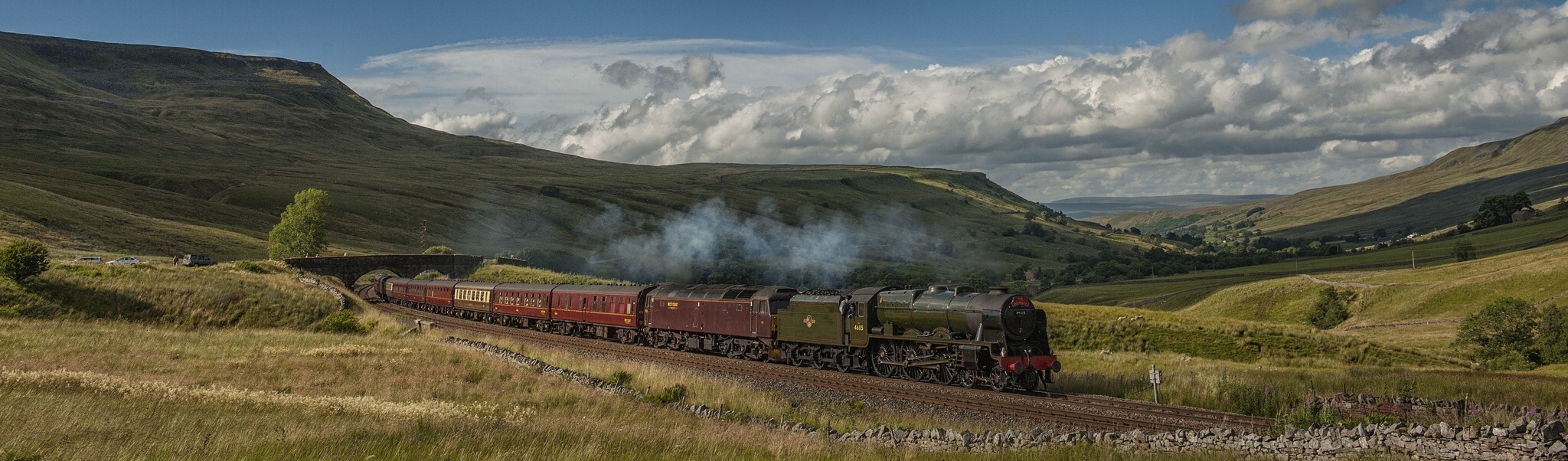
The Claughton class consisted of a total of 130 4-6-0 express locomotives which were designed by Bowen Cooke and built at Crewe between 1913 and 1921. They had four cylinders mounted in one line, all powering the first driving axle with simple expansion. Depending on the production batch, the diameter of the cylinders measured either 15, 15 3/4 or 16 inches, at a stroke of 26 inches. The Walschaerts valve gear mounted outside also drove the inside cylinders via rocking levers. They had a Belpaire firebox and used the Schmidt superheater that had already become standard at the LNWR at this time.
Apparently, a limiting factor in the design were the facilities at Crewe, which limited boiler size and total weight. Nevertheless, they were reported to deliver impressive performances in right hands. In test runs in 1913, an average power of 1,350 to 1,400 hp was indicated. Between London and Crewe and between Crewe and Carlisle, an average speed of 60 mph or 97 km/h could be attained with train loads of 437 and 360 tons, both excluding the weight of locomotive and tender. On the other hand, they were known for a high coal consumption and costly maintenance due to their four-cylinder engine.
The first locomotive of the class was named after Sir Gilbert Claughton, chairman of the LNWR, what led to the class name. They hauled the top express trains between London-Euston and Carlisle until the introduction of the Royal Scot in 1927. Starting in 1928, 20 of them got a larger boiler and half of these additionally got Caprotti valve gear. Twelve others were rebuilt to the Patriot class in 1930, but only a small number of parts and the number and name plates had been re-used. Most locomotives of the Claughton class were withdrawn between 1932 and 1937. Three followed in 1940 and 1941 and only the last one had been assigned its BR number 46004 in 1948, but was also quickly withdrawn. With the exception of the rebuilt Patriot class locomotives, all were scrapped.
Technical data
General
- Built
- 1913-1921
- Manufacturers
- Crewe
- Wheel arrangement
- 4-6-0 (Ten-wheeler)
- Gauge
- 1,435 mm (Standard gauge)
Dimensions and weights
- Length
- 19.33 m
- Length loco
- 12.21 m
- Wheelbase
- 8.84 m
- Total wheelbase
- 16.46 m
- Service mass
- 79 t
- Adhesion mass
- 59.9 t
- Total mass
- 118.9 t
- Rigid wheelbase
- 4.65 m
- Axle load
- 20.1 t
- Water capacity
- 13,639 l
- Fuel capacity
- 6.1 t (coal)
Boiler
- Grate area
- 2.834 m²
- Firebox surface
- 15.905 m²
- Tube heating surface
- 152.946 m²
- Evaporative heating surface
- 168.851 m²
- Superheater surface
- 38.425 m²
- Total heating surface
- 207.3 m²
Power plant
- Driver diameter
- 2,057 mm
- Boiler pressure
- 12.1 bar
- Expansion type
- simple expansion
- Cylinders
- four, 406 x 660 mm
Power
- Power source
- steam
- Estimated power
- 1,044 kW (1,419 PS)
- Starting effort
- 108.7 kN
Calculated values
- Factor of adhesion
- 1 : 5.41
- Optimal speed
- 60 km/h
- Power-to-weight ratio
- 13.2 kW/t
- Heating Surface Equivalent
- 325.2 m²
- Cylinder volume/HSE
- 1 : 1,053.61
- Adhesive weight/Total
- 1 : 1.32
- Tractive force/Heating surface
- 1 : 10.96
- Grate area/Heating surface
- 1 : 73.14
- Firebox/Tube surface
- 1 : 9.62
- Total/Superheater
- 1 : 4.39