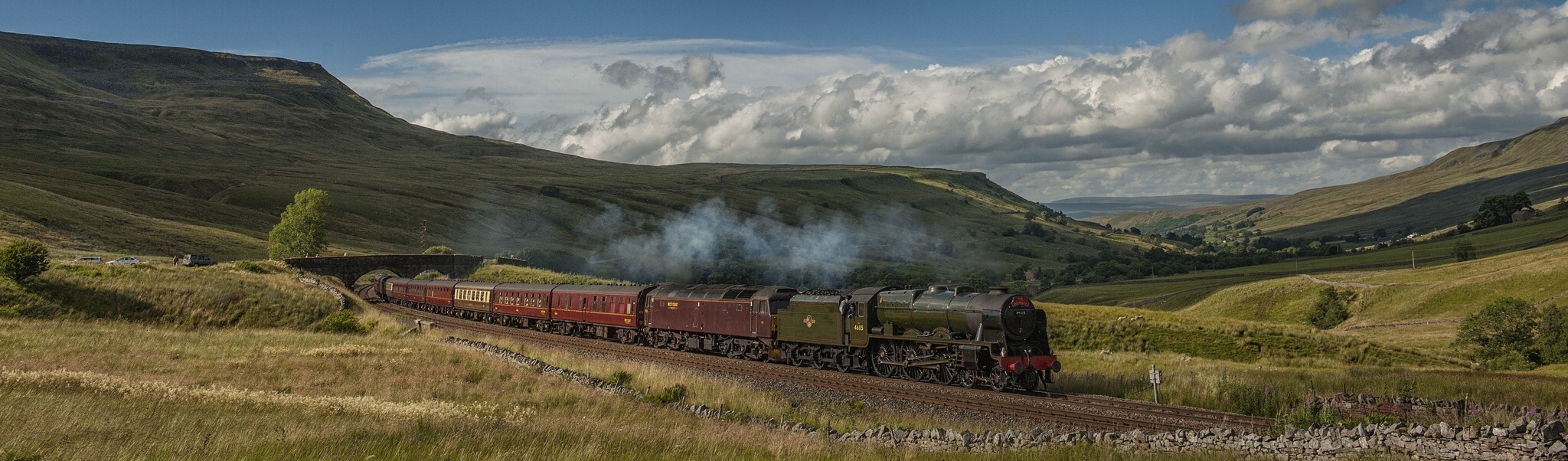



Highland Railway class L “Skye Bogies”
London, Midland & Scottish class 1P
The Highland Railway had taken over the Dingwall and Skye Railway in 1880, which traversed the northern part of the Scottish Highlands from east to west. Although it was not until 1897 that the last ten miles were extended to Kyle of Lochalsh, ending opposite the Isle of Skye, the line was not easy to negotiate. There were many inclines up to 1 in 50 and curves with a radius of 1.300 feet or less.
David Jones' Duke class, later known as the class F, did reasonably well on the track. However, since the 75.5-inch driving wheels were too large and the speed dropped too sharply on the inclines, locomotive number 70 was built in 1882 with 63-inch wheels. Like the class F, it had an outside frame, slightly sloping cylinders with the same dimensions and also the same valve gear. In addition to the downsized wheels, boiler pressure has been increased by ten psi to further increase pulling power. Now the number 70 could be used in front of both passenger and freight trains.
It was not until 1892 that Jones had four more built and his successor Peter Drummond procured four more until 1901. They were called “Skye Bogies” since their domain was the line to Skye and they had a leading bogie in contrast to the usual 2-4-0 express locomotives used in the UK at this time. The nine examples formed the only class on the Highland Railway to be built entirely in their own workshops at Lochgorm, Inverness. They were classified by the LMS in power class 1P, but were completely withdrawn and scrapped between 1922 and 1930.
Technical data
General
- Built
- 1882-1901
- Manufacturers
- Lochgorm
- Wheel arrangement
- 4-4-0 (American)
- Gauge
- 1,435 mm (Standard gauge)
Dimensions and weights
- Length
- 17.86 m
- Wheelbase
- 6.55 m
- Service mass
- 43.7 t
- Adhesion mass
- 28.4 t
- Total mass
- 74.2 t
- Rigid wheelbase
- 2.67 m
- Axle load
- 14.2 t
- Water capacity
- 11,455 l
Boiler
- Grate area
- 1.505 m²
- Firebox surface
- 8.64 m²
- Tube heating surface
- 104.33 m²
- Evaporative heating surface
- 112.97 m²
- Total heating surface
- 113.0 m²
Power plant
- Driver diameter
- 1,600 mm
- Boiler pressure
- 10.3 bar
- Expansion type
- simple expansion
- Cylinders
- two, 457 x 610 mm
Power
- Power source
- steam
- Estimated power
- 410 kW (557 PS)
- Starting effort
- 70.0 kN
Calculated values
- Factor of adhesion
- 1 : 3.99
- Optimal speed
- 35 km/h
- Power-to-weight ratio
- 9.4 kW/t
- Heating Surface Equivalent
- 156.2 m²
- Cylinder volume/HSE
- 1 : 1,281.68
- Adhesive weight/Total
- 1 : 1.54
- Tractive force/Heating surface
- 1 : 12.94
- Grate area/Heating surface
- 1 : 75.06
- Firebox/Tube surface
- 1 : 12.08