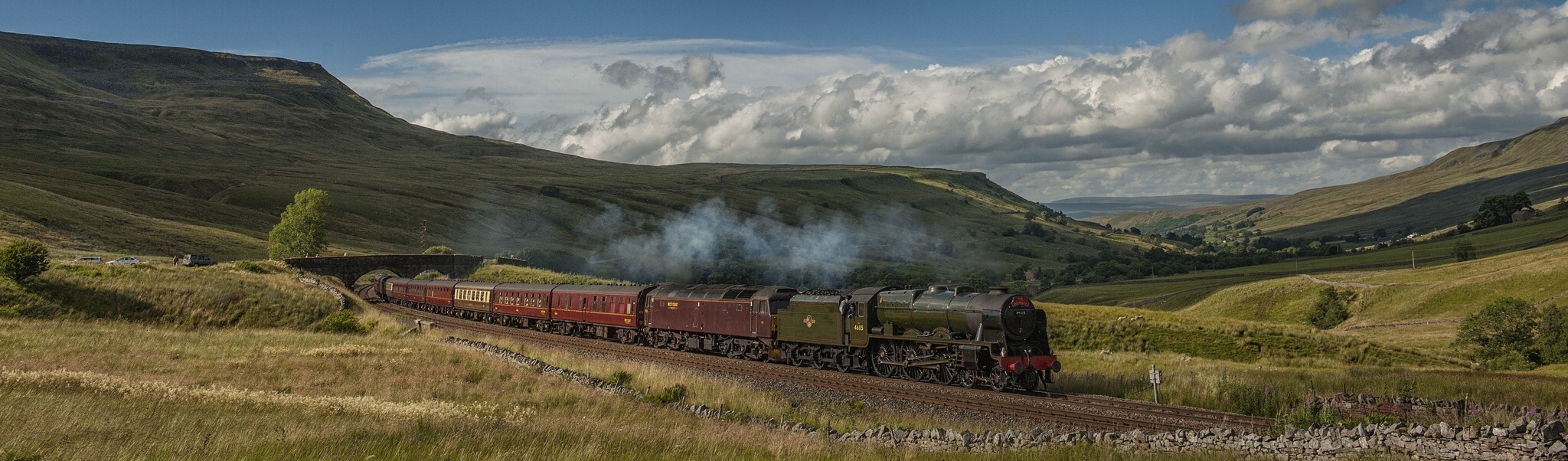
On the Raton Pass between Colorado and New Mexico, the ATSF used pusher locomotives with a 2-10-0 wheel arrangement. Since there was no way to turn the locomotives on the summit, they had to run backwards down the mountain. In order to improve reverse running characteristics, some 2-10-0 locomotives with an additional trailing axle were ordered from Baldwin. This led to the class 900 with the new 2-10-2 wheel arrangement, now known as the “Santa Fé”.
Propulsion was by four compound-acting cylinders arranged in tandem. The high-pressure cylinders were each directly in front of the low-pressure cylinders and worked together with them on the third driving axle. To service the low-pressure cylinders, the high-pressure cylinders could be removed with an onboard crane. The third coupled axle was also the only one that didn't have wheel flanges.
The axle load of the first two driving axles and the leading axle was balanced with each other by means of a equalizing beam, as was the axle load of the rear three driving axles and the trailing axle. Some locomotives received a special form of firebox developed by Henry W. Jacobs and Frank W. Shupert of Frisco Lines. This used perforated plates instead of staybolts and had advantages in terms of maintenance, but was not able to establish itself.
A total of 85 of the class 900 were built. The first 40 of these were destined for Raton Pass and were coal fired. The rest were used on the line between Albuquerque and Arizona and were oil-fired. From 1905, 76 class 1600 locomotives were built, which were essentially identical to the class 900. However, since the frame had often broken on the previous one, the frame was reinforced here, which increased the adhesive weight. However, different specs for both classes could not be found.
From 1916 the locomotives of both classes were rebuilt, after which they were identical again. The boilers were equipped with a superheater and arch tubes in the firebox. Since the tandem engine required too much maintenance, it was replaced by a two-cylinder engine with simple expansion. Only the high-pressure cylinders were removed and the low-pressure cylinders enlarged.