


Imperial-Royal State Railways class 329
Hungarian State Railways series IIIt No. 3751 to 3815 and class 323, Polish State Railways Ol11, Czechoslovak State Railways class 354.6, Italian State Railway class 687, and Yugoslav Railway classes 107 and 108
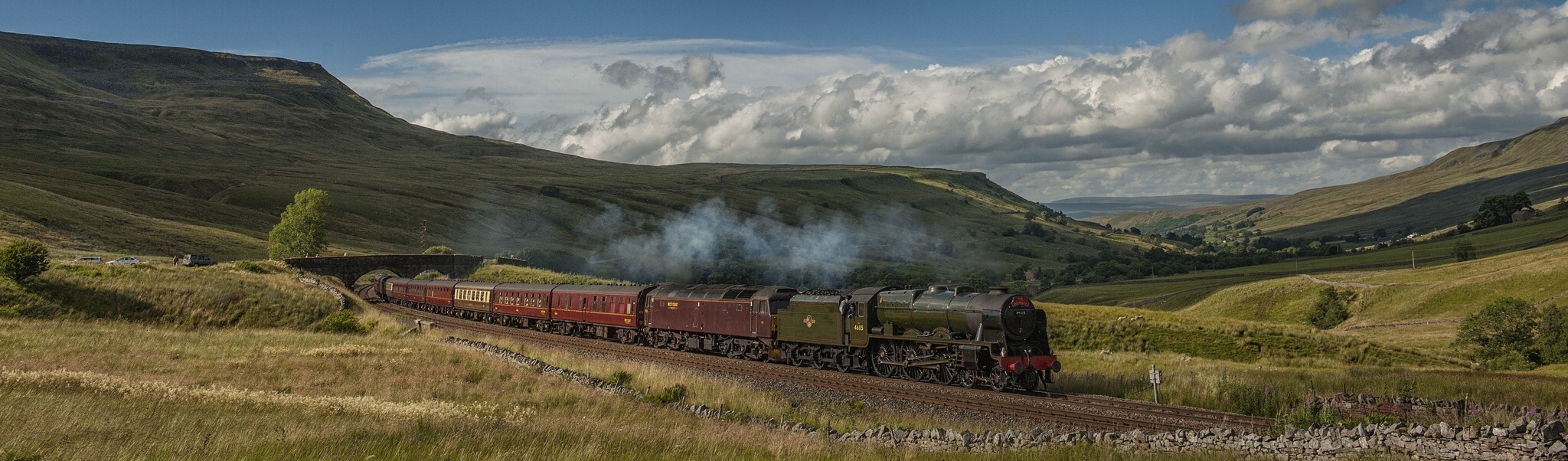
The kkStB network included many lines on which both passenger and express trains could not travel faster than 70 or 75 km/h due to the topographical conditions. When the four-coupled locomotives were no longer sufficient for these services, it was necessary to switch to a six-coupled one. At that time, the 4-6-0 wheel arrangement was popular in other countries, but it didn't offer much space for a large firebox between the coupled wheels. Since a trailing axle was needed due to the low-energy coal in Austria, the class 110 for faster trains had been introduced as early as 1905 with a 2-6-2 wheel arrangement. So Gölsdorf also developed the class 329 with this wheel arrangement, but a driver diameter of only 1,614 mm.
The running gear was taken over almost unchanged from the tank locomotive of the class 229. This had a two-cylinder compound engine and had already been introduced in 1904 for passenger trains. Since the water and coal reserves on the locomotive were no longer available, a significantly larger boiler could be used. This was placed high in order to be able to arrange an even larger firebox above the last coupled axle and the trailing axle. Instead of a Schmidt superheater, a Clench-Gölsdorf type steam dryer was used.
The kkStB had 93 built, which came from all the important factories in Austria. Although they reached up to 110 km/h in test runs, they were approved for 80 km/h. A speed of between 42 and 45 km/h was reached with a train load of 313 tonnes on a one percent winding incline, which corresponds to an output of 950 to 1,000 hp. Alternatively, express freight trains of up to 750 tonnes and conventional freight trains of up to 1,150 tonnes could be transported on gentle gradients.
In addition to the kkStB, the k.u.k. Military railway Banjaluka-Dobrlin bought two and the MÁV a total of 65. Although MÁV had its own factory, all were built in the same factories that kkStB locomotives came from. The Hungarian locomotives had the Westinghouse air brake, while the Austrian had a vacuum brake.
After the First World War only 20 locomotives ended up with the BBÖ. The PKP had received 21 and called them Ol11. After the Second World War, the PKP received another 14 of the BBÖ locomotives, which the Reichsbahn had relocated to Kraków as class 351 and were therefore in Poland after the end of the war. A total of 38 came to Czechoslovakia to the ČSD, which classified them as class 354.1. They were gradually all converted into superheated steam simples and were also given electric lighting and air brakes. The last of them were in service until 1968.
Technical data
General
- Built
- 1907-1909
- Manufacturers
- Floridsdorf, Wiener Neustadt, StEG, BMMF
- Wheel arrangement
- 2-6-2 (Prairie)
- Gauge
- 1,435 mm (Standard gauge)
Dimensions and weights
- Length
- 15.94 m
- Wheelbase
- 8.03 m
- Empty mass
- 54.2 t
- Service mass
- 59.7 t
- Adhesion mass
- 43 t
- Total mass
- 96.2 t
- Rigid wheelbase
- 4.00 m
- Axle load
- 14.4 t
- Water capacity
- 14,200 l
- Fuel capacity
- 7 t (coal)
Boiler
- Grate area
- 3 m²
- Firebox surface
- 14.2 m²
- Tube heating surface
- 107.6 m²
- Evaporative heating surface
- 121.8 m²
- Superheater surface
- 45.4 m²
- Total heating surface
- 167.2 m²
Power plant
- Driver diameter
- 1,614 mm
- Boiler pressure
- 15 bar
- Expansion type
- compound
- Cylinders
- two, HP: 450 x 720 mm and LP: 690 x 720 mm
Power
- Power source
- steam
- Estimated power
- 1,000 kW (1,360 PS)
- Top speed
- 80 km/h
- Starting effort
- 80.8 kN
- Starting effort simple
- 97.0 kN
Calculated values
- Factor of adhesion
- 1 : 5.22
- Optimal speed
- 76 km/h
- Power-to-weight ratio
- 16.8 kW/t
- Heating Surface Equivalent
- 283.6 m²
- Cylinder volume/HSE
- 1 : 878.44
- Adhesive weight/Total
- 1 : 1.39
- Tractive force/Heating surface
- 1 : 10.09
- Grate area/Heating surface
- 1 : 55.73
- Firebox/Tube surface
- 1 : 7.58
- Total/Superheater
- 1 : 2.68