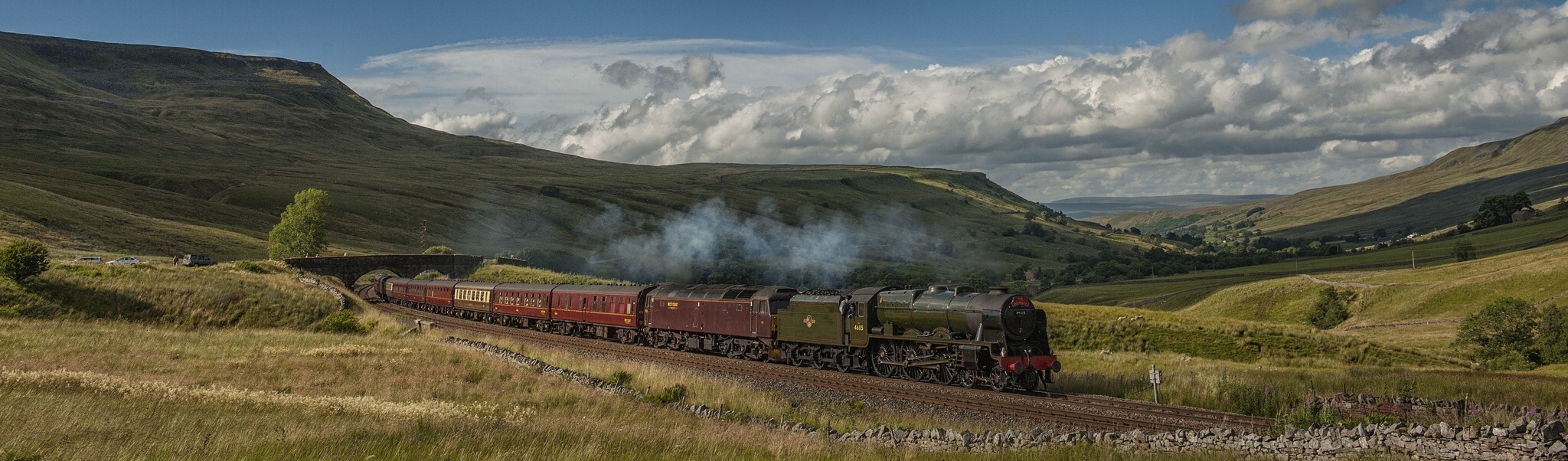



Lancashire & Yorkshire class 30 (Aspinall)
Great Britain 1900 110 produced
In 1900, John Aspinall introduced a new class of 0-8-0 locomotives for heavy mineral traffic. Their drivers measured 4 feet and 5 7/8 inches and their cylinders measured 20 by 26 inches. They could haul trains of up to 60 coal wagons, but usually the number was only 27. By 1908, a total of 110 had been built at Horwich.
20 of these locomotives had been built with Henry Hoy's corrugated steel inner furnace. Since this was no success, these received standard fireboxes between 1911 and 1914. Later this class was rebuilt with new superheated boilers and modern side-window cabs. The LMS put them in power class 5F and the first ones were withdrawn in 1926. British Railways only received two which had already gone in 1950.
Technical data
General
- Built
- 1900-1908
- Manufacturers
- Horwich
- Wheel arrangement
- 0-8-0 (Eight-coupled)
- Gauge
- 1,435 mm (Standard gauge)
Dimensions and weights
- Wheelbase
- 4.98 m
- Service mass
- 58.8 t
- Adhesion mass
- 58.8 t
- Total mass
- 90 t
- Rigid wheelbase
- 4.98 m
- Axle load
- 15.6 t
- Water capacity
- 15,910 l
- Fuel capacity
- 6.1 t (coal)
Boiler
- Grate area
- 2.141 m²
- Firebox surface
- 13.657 m²
- Tube heating surface
- 164.16 m²
- Evaporative heating surface
- 177.817 m²
- Total heating surface
- 177.8 m²
Power plant
- Driver diameter
- 1,368 mm
- Boiler pressure
- 12.4 bar
- Expansion type
- simple expansion
- Cylinders
- two, 508 x 660 mm
Power
- Power source
- steam
- Estimated power
- 652 kW (886 PS)
- Starting effort
- 131.4 kN
Calculated values
- Factor of adhesion
- 1 : 4.39
- Optimal speed
- 31 km/h
- Power-to-weight ratio
- 11.1 kW/t
- Heating Surface Equivalent
- 246.1 m²
- Cylinder volume/HSE
- 1 : 1,087.78
- Adhesive weight/Total
- 1 : 1.00
- Tractive force/Heating surface
- 1 : 15.43
- Grate area/Heating surface
- 1 : 83.05
- Firebox/Tube surface
- 1 : 12.02