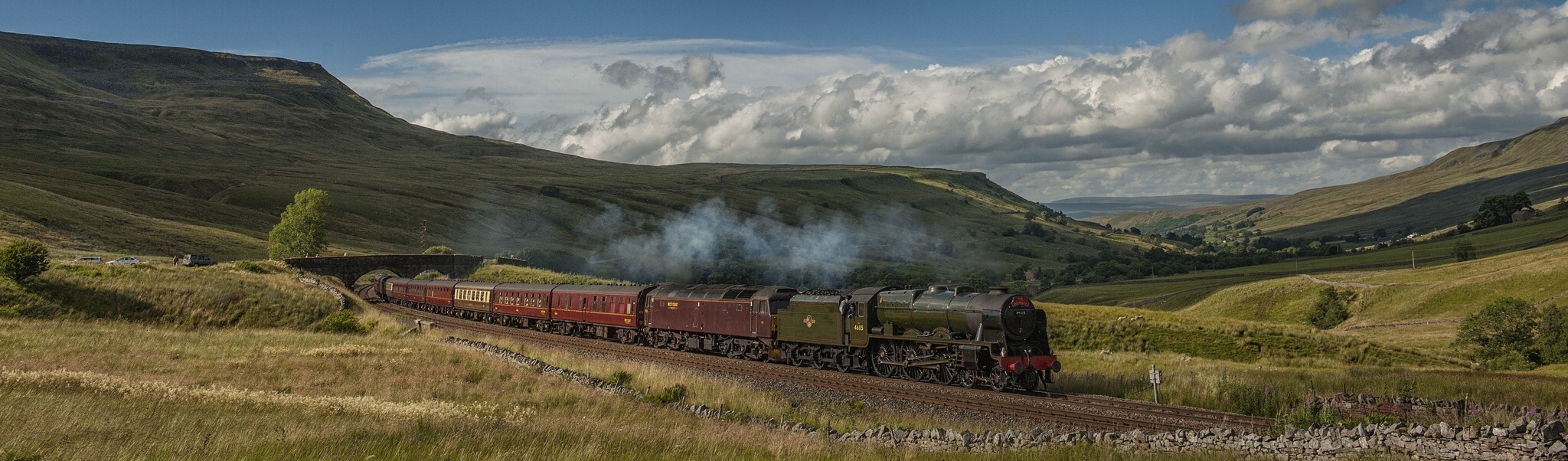
The NSB had the largest and most powerful steam locomotives ever used in Norway built to operate the increasingly heavier express trains on the steeply graded Dovre Railway. They became known by the nickname “Dovregubben”. They were built in the 2-8-4 design in order to achieve a high tractive force in addition to be able to accommodate a large firebox, with which a large steam production could be maintained on long inclines. Since high speeds could not be run on the route and traction was more important, the driving wheels were designed with a diameter of just 1,530 mm and a top speed of 90 km/h was enough. Since the total length was also limited due to the existing turntables, the smaller driving wheels also made it possible to accommodate the four driving axles. These were necessary in order to be able to maintain the maximum axle load of 15.5 tonnes on the mountain routes. The engine was designed with four cylinders and compound action.
The first two machines, later designated type 49a, were delivered by Hamar and Thune in June and September 1935. Despite the small wheels, one reached 115 km/h at a press tour. The pronounced lightweight construction of the entire locomotive led to problems in some places, which was improved by adapting some parts. The one-off type 49b, which was also built in Norway, followed the next year. The bogie had an engageable booster with drive on both axles in order to provide additional tractive power for starting and on steep inclines.
Two of the Type 49c were delivered by Krupp in 1940 and two by Thunes in 1941. These had no booster and were similar to the 49a, but with some detail improvements. This included making the cylinders smaller in order to save weight and to strengthen the axles at the same time. Seven more were destroyed in a bombing raid on the Krupp factory in World War II, four others were never completed in Norway and were used as spare parts donors.
Due to the four cylinders, the locomotives were very demanding in terms of maintenance, but were able to fully convince in terms of their performance and economy. The economy was even certified in Germany by the Grunewald Locomotive Testing facility during tests with one of the locomotives built by Krupp. When the NSB introduced the Di 3 diesel locomotives, they were initially used together with the type 49. It quickly became apparent that the steam locomotives could maintain their speed much better on long inclines than the diesel locomotives with 1,900 hp. However, since the latter were much easier to maintain, all type 49 were retired by 1958.