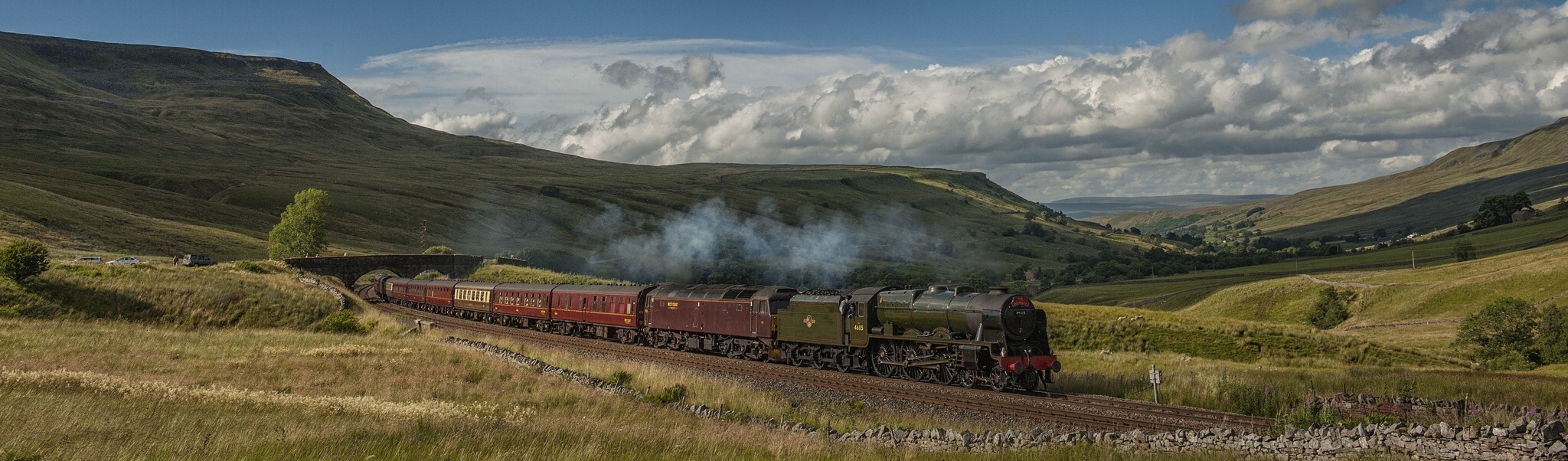



Imperial-Royal State Railways class 100

When the class 380 with a 2-10-0 wheel arrangement could no longer cope with the increased weight of the express trains on the Tauern Railway, Gölsdorf had to develop an even more powerful mountain express locomotive. Since the maximum axle load was still limited to 13.8 tonnes, a total of six axles was no longer sufficient. Based on his previous experience with laterally adjustable coupled axles, he dared to develop a twelve-coupled locomotive for the winding mountain line for the first time.
In order to be able to negotiate curves with a radius of 150 meters, the leading axle could be radially adjusted by 50 mm and three of the driving axles could be shifted laterally. The freedom of movement of the second and fifth driving axle was 26 mm and that of the sixth 40 mm. The third, which was the driven axle, had no wheel flanges. To prevent the coupling rods from jamming in curves, these were connected to the crank pins on the last two axles with cardan joints.
The boiler tapers towards the front and was the largest that had been installed on an Austrian locomotive to date. With the oil firing, this generated an output of 2,020 hp. Express trains weighing 360 tonnes could be pulled at 40 km/h on the Tauern Railway's incline of 2.8 percent. In order to comply with the axle loads, the lightweight construction of the locomotive was taken to the extreme in many places, which later led to problems with durability.
Although the chassis showed good running characteristics on test runs at up to 92 km/h, it was only approved for 60 km/h. However, it remained with a single locomotive, which was taken over by the BBÖ after the First World War and was not built again due to the plans for electrification. It was retired in 1928 after a crack in one of the inner cylinders. In Württemberg, the otherwise good experience with the locomotive was used as an opportunity to develop the K with the same wheel arrangement.
Technical data
General
- Built
- 1911
- Manufacturers
- Floridsdorf
- Wheel arrangement
- 2-12-0 (Centipede)
- Gauge
- 1,435 mm (Standard gauge)
Dimensions and weights
- Length
- 19.32 m
- Length loco
- 13.19 m
- Wheelbase
- 10.10 m
- Total wheelbase
- 15.93 m
- Empty mass
- 88.3 t
- Service mass
- 95.8 t
- Adhesion mass
- 82.2 t
- Rigid wheelbase
- 4.59 m
- Axle load
- 13.9 t
- Water capacity
- 18,500 l
- Fuel capacity
- 4,500 l (oil)
Boiler
- Grate area
- 5 m²
- Firebox surface
- 17.4 m²
- Tube heating surface
- 231.6 m²
- Evaporative heating surface
- 249 m²
- Superheater surface
- 47 m²
- Total heating surface
- 296.0 m²
Power plant
- Driver diameter
- 1,410 mm
- Boiler pressure
- 16 bar
- Expansion type
- compound
- Cylinders
- four, HP: 450 x 680 mm and LP: 760 x 680 mm
Power
- Power source
- steam
- Indicated power
- 1,485 kW (2,019 PS)
- Top speed
- 60 km/h
- Starting effort
- 196.7 kN
- Starting effort simple
- 236.0 kN
Calculated values
- Factor of adhesion
- 1 : 4.10
- Optimal speed
- 47 km/h
- Power-to-weight ratio
- 15.5 kW/t
- Heating Surface Equivalent
- 430.0 m²
- Cylinder volume/HSE
- 1 : 1,220.41
- Adhesive weight/Total
- 1 : 1.17
- Tractive force/Heating surface
- 1 : 13.88
- Grate area/Heating surface
- 1 : 59.20
- Firebox/Tube surface
- 1 : 13.31
- Total/Superheater
- 1 : 5.30