


Austrian Federal Railways (BBÖ) class 214
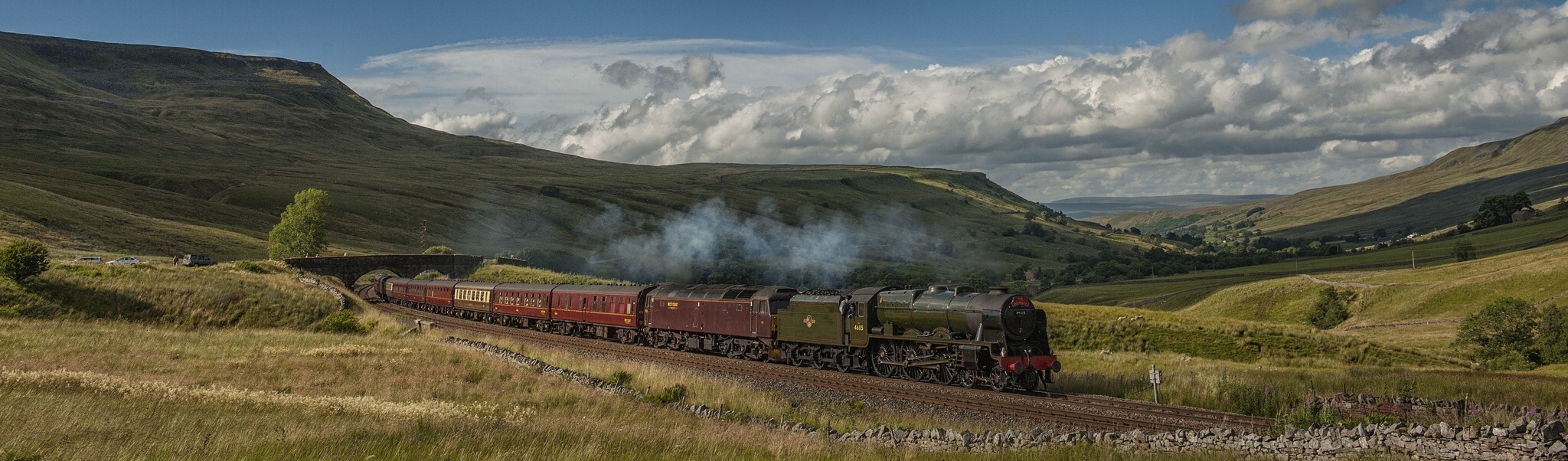
Austrian Federal Railways class 12 and Romanian Railway series 142

At the end of the 1920s, the BBÖ tried to increase the average speeds of the ever-increasing train weights of 550 to 600 tonnes. Instead of further increasing the maximum speed in the lowlands, the aim was to significantly increase the speeds in the mountains. However, since the electrification of the Austrian routes did not progress as quickly as hoped, there was a need for powerful express steam locomotives. In order to be able to achieve a power similar to that of the electric locomotives of the time, exceptionally large locomotives were required.
Since Austria already had good experience with express locomotives with trailing bogies and a 2-6-4 wheel arrangement, locomotives with a 2-8-4 wheel arrangement were designed. Thanks to four driven axles, this allowed a high adhesive weight, but at the same time, thanks to the bogie, a long and wide firebox. Due to the 1,940 mm wheels and the drive on the third coupled axle, the longest connecting rods ever installed on a steam locomotive were required. This record was not surpassed by any other locomotive later. The 114.01 with three cylinders and the 214.01 with two cylinders were built as prototypes.
Since the smooth running of the three-cylinder locomotive was offset by noticeably higher consumption, the 214 was selected as the series model. In 1931 and 1936 six were built at the Lokomotivfabrik Floridsdorf. They were the most powerful express locomotives in Europe and were used on the Westbahn as far as Passau. In trial runs, speeds of up to 155 km/h were reached. From 1938 they became the class 12 on the Deutsche Reichsbahn and kept this number later on at the ÖBB. After the western railway was electrified, they were used in the south of Austria, where there was greater wear and tear due to the tighter curve radii. As a result, the locomotives were no longer used for express trains after 1956 and were retired by 1962.
The Romanian State Railways CFR acquired the license to build these machines and produced 79, which were designated as series 142 there. In Austria, 12.10 and 12.14 are still existing. The latter was actually CFR 142.063 that was bought by the Austrian Society for Railway History (ÖGEG) in the 1980s and given an originally unassigned Austrian number. At least three are remaining in Romania. These are 142.008, 142.044 and 142.072.
Technical data
General
- Built
- 1928-1939
- Manufacturers
- Floridsdorf, Reș, iț, a
- Wheel arrangement
- 2-8-4 (Berkshire)
- Gauge
- 1,435 mm (Standard gauge)
Dimensions and weights
- Length
- 22.58 m
- Length loco
- 15.04 m
- Empty mass
- 107 t
- Service mass
- 118 t
- Adhesion mass
- 72 t
- Total mass
- 178 t
- Axle load
- 18 t
- Water capacity
- 29,500 l
- Fuel capacity
- 8 t (coal)
Boiler
- Grate area
- 4.72 m²
- Firebox surface
- 18.8 m²
- Tube heating surface
- 264.7 m²
- Evaporative heating surface
- 283.5 m²
- Superheater surface
- 91 m²
- Total heating surface
- 374.5 m²
Power plant
- Driver diameter
- 1,940 mm
- Boiler pressure
- 15 bar
- Expansion type
- simple expansion
- Cylinders
- two, 650 x 720 mm
Power
- Power source
- steam
- Indicated power
- 2,162 kW (2,940 PS)
- Top speed
- 110 km/h
- Starting effort
- 199.9 kN
Calculated values
- Factor of adhesion
- 1 : 3.53
- Optimal speed
- 66 km/h
- Power-to-weight ratio
- 18.3 kW/t
- Heating Surface Equivalent
- 559.5 m²
- Cylinder volume/HSE
- 1 : 854.04
- Adhesive weight/Total
- 1 : 1.64
- Tractive force/Heating surface
- 1 : 11.15
- Grate area/Heating surface
- 1 : 79.34
- Firebox/Tube surface
- 1 : 14.08
- Total/Superheater
- 1 : 3.12