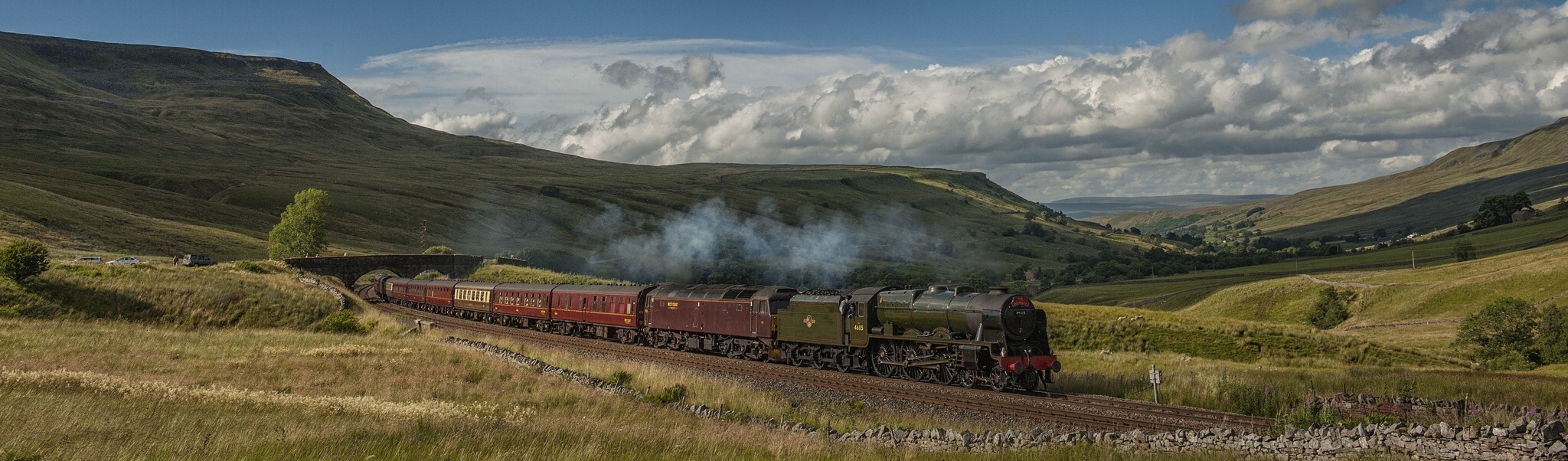




Natal Government Railways class F
South African class E

The ten locomotives of the NGR class F were built for the Natal South Coast where frequent reverse running required a tank locomotive with a symmetric wheel arrangement. G.W. Reid had already rebuilt a single class G 4-6-0T locomotive into the 4-6-4T class H. Since this was a success, Reid designed the class F that was most likely the first class of locomotives ever that was built as 4-6-4 from the start. With the founding of the SAR, they became class E and were mostly used for shunting service. In World War I, two came to German South West Africa that recently had been occupied by South Africa. In 1926, the boiler pressure of the locomotives was reduced from 175 to 160 psi. They spent their last years on the Cape Midland System and were withdrawn in 1937.
Technical data
General
- Built
- 1902
- Manufacturers
- Neilson & Co., Reid & Co.
- Wheel arrangement
- 4-6-4T (Hudson)
- Gauge
- 1,067 mm (Cape gauge)
Dimensions and weights
- Length
- 9.84 m
- Wheelbase
- 7.80 m
- Service mass
- 39.8 t
- Adhesion mass
- 26 t
- Rigid wheelbase
- 2.36 m
- Axle load
- 9.1 t
- Water capacity
- 4,910 l
- Fuel capacity
- 2.3 t (coal)
Boiler
- Grate area
- 1.18 m²
- Firebox surface
- 6.503 m²
- Tube heating surface
- 74.601 m²
- Evaporative heating surface
- 81.104 m²
- Total heating surface
- 81.1 m²
Power plant
- Driver diameter
- 991 mm
- Boiler pressure
- 12.1 bar
- Expansion type
- simple expansion
- Cylinders
- two, 381 x 559 mm
Power
- Power source
- steam
- Estimated power
- 261 kW (355 PS)
- Starting effort
- 84.0 kN
Calculated values
- Factor of adhesion
- 1 : 3.04
- Optimal speed
- 19 km/h
- Power-to-weight ratio
- 6.6 kW/t
- Heating Surface Equivalent
- 113.6 m²
- Cylinder volume/HSE
- 1 : 1,121.44
- Adhesive weight/Total
- 1 : 1.53
- Tractive force/Heating surface
- 1 : 21.63
- Grate area/Heating surface
- 1 : 68.73
- Firebox/Tube surface
- 1 : 11.47