


London, Midland & Scottish Ivatt class 2 2-6-0

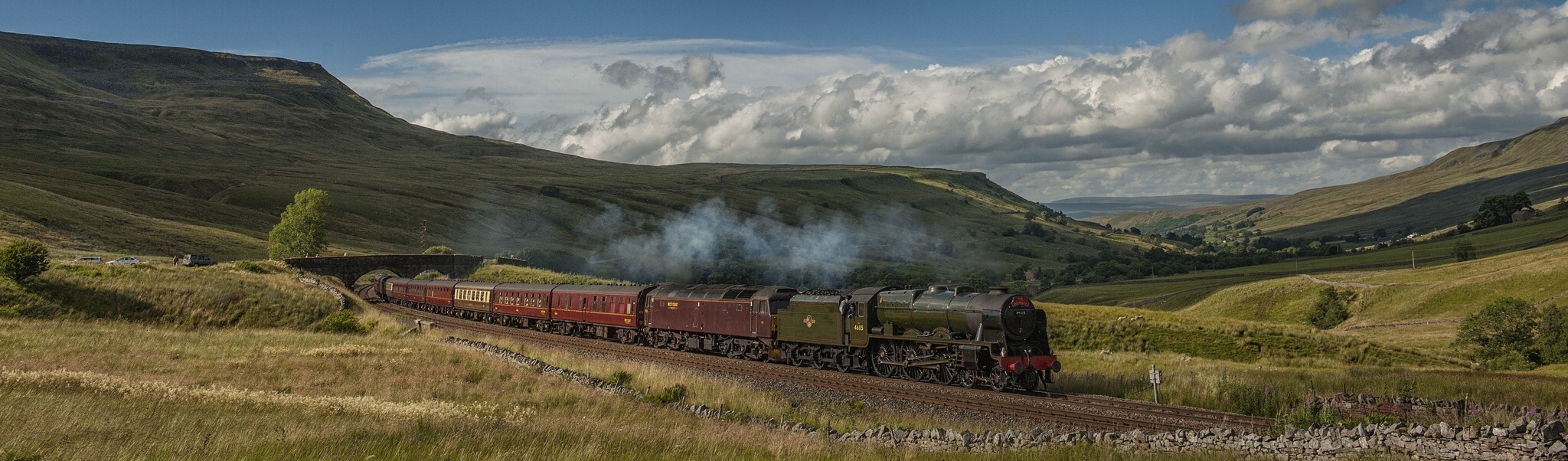
The steam locomotives built by the LMS after the Second World War also included Class 2 tender locomotives for mixed service, which were intended to replace older 0-6-0 locomotives. The choice fell on the 2-6-0 wheel arrangement in order to be able to easily increase power and speed. George Ivatt, who had recently been appointed chief engineer of the LMS at the time, used his newly designed tank locomotive with a 2-6-2T wheel arrangement as the basis. Compared to the tank locomotive, the water supply of the tender locomotive was increased from 1,350 to 3,000 gallons and the coal supply from 3 to 4 long tons. Thus, these locomotives could cover large distances, but with a weight of less than 50 long tons, they could be used universally.
Only 20 examples were built by the LMS in 1947 and 1948 and were numbered 6400 to 6419. British Railways added 40,000 to the running numbers and continued production. A total of 128 were made by 1953, which now bore the numbers 46400 to 46527. Beginning with 46465, the diameter of the cylinders was increased by one inch, increasing the locomotive's weight and pulling power. They formed the basis for the BR standard class 2 2-6-0, which was built until 1956. Both the Ivatt locos and the standard class were nicknamed “Mickey Mouse”. The end of service of the 128 locomotives of the original class was between 1961 and 1967 and today seven units are still preserved, six of which are or were operational and some were also used intensively on main routes.
Technical data
General
| Property | 1946 variant | 1951 variant |
|---|---|---|
| Built | 1946-1953 | |
| Manufacturers | Crewe | Darlington, Swindon |
| Wheel arrangement | 2-6-0 (Mogul) | |
| Gauge | 1,435 mm (Standard gauge) | |
Dimensions and weights
| Property | 1946 variant | 1951 variant |
|---|---|---|
| Length | 16.20 m | |
| Wheelbase | 6.78 m | |
| Total wheelbase | 13.49 m | |
| Service mass | 47.9 t | 49.2 t |
| Adhesion mass | 40 t | 41 t |
| Total mass | 82.6 t | 83.9 t |
| Rigid wheelbase | 4.19 m | |
| Axle load | 13.5 t | 13.8 t |
| Water capacity | 13,639 l | |
| Fuel capacity | 4.1 t (coal) | |
Boiler
| Property | 1946 variant | 1951 variant |
|---|---|---|
| Grate area | 1.626 m² | |
| Firebox surface | 9.383 m² | |
| Tube heating surface | 85.842 m² | |
| Evaporative heating surface | 95.226 m² | |
| Superheater surface | 12.449 m² | 11.52 m² |
| Total heating surface | 107.7 m² | 106.7 m² |
Power plant
| Property | 1946 variant | 1951 variant |
|---|---|---|
| Driver diameter | 1,524 mm | |
| Boiler pressure | 13.8 bar | |
| Expansion type | simple expansion | |
| Cylinders | two, 406 x 610 mm | |
Power
| Property | 1946 variant | 1951 variant |
|---|---|---|
| Power source | steam | |
| Estimated power | 634 kW (862 PS) | |
| Starting effort | 77.4 kN | |
Calculated values
| Property | 1946 variant | 1951 variant |
|---|---|---|
| Factor of adhesion | 1 : 5.07 | 1 : 5.19 |
| Optimal speed | 50 km/h | |
| Power-to-weight ratio | 13.2 kW/t | 12.9 kW/t |
| Heating Surface Equivalent | 167.0 m² | 165.2 m² |
| Cylinder volume/HSE | 1 : 946.80 | 1 : 957.45 |
| Adhesive weight/Total | 1 : 1.20 | |
| Tractive force/Heating surface | 1 : 15.02 | 1 : 15.15 |
| Grate area/Heating surface | 1 : 66.22 | 1 : 65.65 |
| Firebox/Tube surface | 1 : 9.15 | |
| Total/Superheater | 1 : 7.65 | 1 : 8.27 |