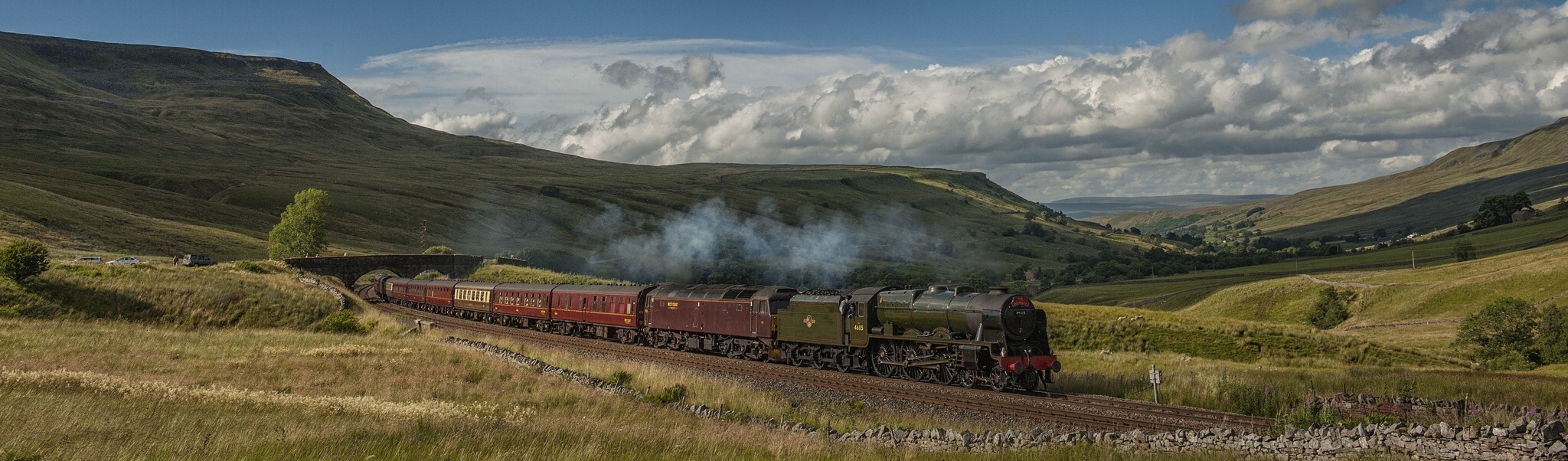



Imperial Russian Railways series Щ (Shcha)
Polish State Railways Tr103 and German Reichsbahn class 56415

At the beginning of the 20th century, the railways in the Russian Empire needed more powerful freight locomotives. Recent track updates in many parts of the country now allowed heavier locomotives with an axle load of 16 tonnes. To increase the top speed, the new locomotive was designed as an eight-coupled with a leading axle. The class was called Щ (Shcha) after engineer and later minister of transport Shchukin.
While the prototypes still had an axle load that was too high, some measures had to be taken to decrease the weight. Production ran from 1906 to 1918 and some more were built between 1921 and 1924. In total, 1,910 were built. The main variant was the two-cylinder compound Щ, while the superheated compound variant was the ЩЩ. A saturated simple variant was the Щp, while a single one that was superheated in 1945 was called Щr.
Essentially built after 19th century design principles, it soon became clear that this eight-coupled locomotive wasn't powerful enough for the increasing weights of freight trains. Also the top speed of 75 km/h wasn't necessary for freight trains, since they didn't have continuous brakes and where thus limited to lower speeds. Additionally, some design features complicated daily service. So for example, lubrication of the leading truck was only possible in a horizontal position below the locomotive, while some of the oil dripped back onto the person.
Soon they were replaced by ten-coupled locomotives and used for lighter trains. After World War I, 28 came to Poland and were converted to standard gauge. PKP designated them Tr103 and in World War II, eight were taken over by the Reichsbahn and became class 56415, but were soon retired. In the Soviet Union, they were used until the late fifties.
Technical data
General
| Property | Щ | ЩЩ | Щp |
|---|---|---|---|
| Built | 1906-1918;1921-1924 | ||
| Manufacturers | Kharkiv, Bryansk, Luhansk, Nevski, Putilov, Sormovo, Kolomna | ||
| Wheel arrangement | 2-8-0 (Consolidation) | ||
| Gauge | 1,520 mm (Russian broad gauge) | ||
Dimensions and weights
| Property | Щ | ЩЩ | Щp |
|---|---|---|---|
| Length | 20.69 m | ||
| Length loco | 11.70 m | ||
| Wheelbase | 7.80 m | ||
| Total wheelbase | 17.73 m | ||
| Empty weight | 69 t | 71.2 t | |
| Service weight | 77.3 t | 78.3 t | |
| Adhesive weight | 64.2 t | 64.7 t | |
| Axle load | 16 t | 16.2 t | |
| Water capacity | 13,930 l | 19,300 l | |
Boiler
| Property | Щ | ЩЩ | Щp |
|---|---|---|---|
| Grate area | 2.8 m² | ||
| Firebox surface | 15.2 m² | 15.1 m² | |
| Tube heating surface | 190.9 m² | 161.6 m² | 153.8 m² |
| Evaporative heating surface | 206.1 m² | 176.7 m² | 168.9 m² |
| Total heating surface | 206.1 m² | 235.7 m² | 204.0 m² |
| Superheater surface | 59 m² | 35.1 m² | |
Power plant
| Property | Щ | ЩЩ | Щp |
|---|---|---|---|
| Driver diameter | 1,300 mm | ||
| Boiler pressure | 14 bar | 12 bar | |
| Expansion type | compound | simple expansion | |
| Cylinders | two, HP: 510 x 700 mm and LP: 765 x 700 mm | two, 590 x 700 mm | |
Power
| Property | Щ | ЩЩ | Щp |
|---|---|---|---|
| Power source | steam | ||
| Estimated power | 700 kW (952 PS) | 850 kW (1,156 PS) | 820 kW (1,115 PS) |
| Top speed | 75 km/h | ||
| Starting effort | 115.4 kN | 191.2 kN | |
| Starting effort simple | 138.5 kN | ||
Calculated values
| Property | Щ | ЩЩ | Щp |
|---|---|---|---|
| Factor of adhesion | 1 : 5.46 | 1 : 5.50 | 1 : 3.32 |
| Optimal speed | 37 km/h | 45 km/h | 26 km/h |
| Power-to-weight ratio | 9.1 kW/t | 10.9 kW/t | 10.5 kW/t |
| Heating Surface Equivalent | 282.1 m² | 370.2 m² | 314.6 m² |
| Cylinder volume/HSE | 1 : 1,077.17 | 1 : 820.83 | 1 : 1,216.64 |
| Adhesive weight/Total | 1 : 1.20 | 1 : 1.21 | |
| Tractive force/Heating surface | 1 : 11.69 | 1 : 10.22 | 1 : 19.57 |
| Grate area/Heating surface | 1 : 73.61 | 1 : 84.18 | 1 : 72.86 |
| Firebox/Tube surface | 1 : 12.56 | 1 : 10.70 | 1 : 10.19 |
| Total/Superheater | 1 : 2.99 | 1 : 4.81 | |