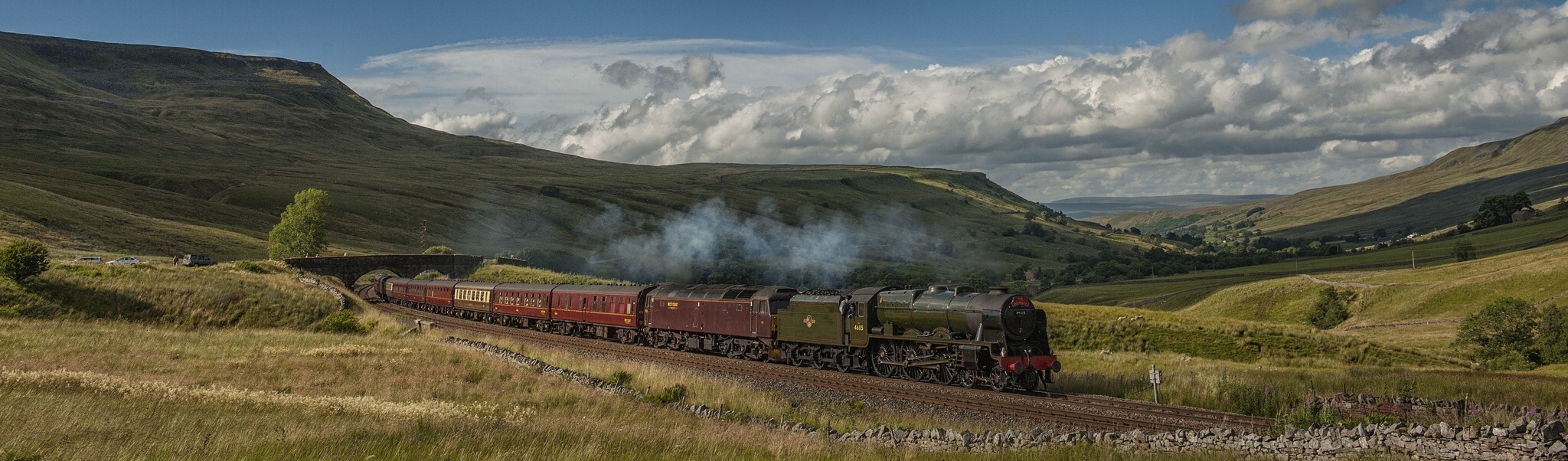



South Eastern & Chatham class N
Shortly before the First World War, the SECR had the problem that the significantly increased traffic volumes were encountered with weak, outdated locomotives and the light rails and bridges. On the one hand passenger trains had to be hauled between London and the port of Dover and on the other hand goods trains became heavier and heavier. For cost and time reasons, a locomotive had to be developed for both tasks.
Maunsell found the help of Harold Holcroft, a former GWR employee. Since the wheel arrangement 2-6-0 was selected for the task, the GWR class 4300, on which Holcroft had worked, was used as the basis. Thus, the locomotive also contained principles that Churchward had worked out. Visual influences, on the other hand, came from the Midland Railway, which had been brought in by the chief draftsman James Clayton.
Some parts were developed in such a way that they could also be used on other locomotives. There were more similarities with the class K tank locomotive, which had the wheel arrangement 2-6-4T. Since the same boiler was to be used on both locomotives and the supplies had to be carried on the tender locomotive, the boiler could not be too heavy to maintain the axle load. The frame also had to be built relatively lightly.
As a result, the potential of the tender locomotive was not fully exploited. This boiler had a Belpaire firebox that narrowed towards the bottom and a boiler barrel that tapered towards the front. The valves were designed with a long travel to allow speeds of up to 70 mph (113 km/h).
As production was delayed due to the First World War, the first locomotive was only completed in 1917. The first series of 15 locomotives was only delivered between 1920 and 1923. One of these was rebuilt with three smaller cylinders, serving as a prototype for the N1 class.
When the railway companies were grouped, Maunsell had the task of selecting a locomotive from the predecessor companies for mixed service. As the Class N was a good all-rounder it was chosen and 100 kits were made at the Royal Arsenal in Woolwich. 50 of these were assembled for the SECR at Ashford and the remainder were sold to other railway companies. Hence the nickname “Woolworths”.
In the years that followed, some locomotives were used to test different upgrades, but these were not adopted in the entire class. The last 15 locomotives were built directly by the Southern Railway at Ashford. The last eight of them had the driver's position on the left and smoke deflectors. The previous locomotives could not be used on all lines of the Southern because the cylinders, the chimney and the cab exceeded the loading gauge in some places. While the outer dimensions of the cylinders could not be reduced, these last locomotives were given a lower chimney.
Some of the older locomotives were subsequently adapted to the last ones built. All 80 went to British Railways in 1948 and not one was retired before 1962. Some had received new cylinders or frames during this time. New chimneys were also installed for better draft. It was not until 1966 that the last six members of the class N disappeared from service. Number 31874 was rescued from a junkyard in 1974. Since 2014, its overhaul has been taking place.
Technical data
General
- Built
- 1917-1934
- Manufacturers
- Ashford
- Wheel arrangement
- 2-6-0 (Mogul)
- Gauge
- 1,435 mm (Standard gauge)
Dimensions and weights
- Length
- 17.63 m
- Wheelbase
- 7.42 m
- Total wheelbase
- 14.57 m
- Service mass
- 60.4 t
- Adhesion mass
- 51.7 t
- Total mass
- 95.2 t
- Rigid wheelbase
- 4.72 m
- Axle load
- 17.8 t
- Water capacity
- 15,910 l
- Fuel capacity
- 5.1 t (coal)
Boiler
- Grate area
- 2.323 m²
- Firebox surface
- 12.542 m²
- Tube heating surface
- 141.77 m²
- Evaporative heating surface
- 154.312 m²
- Superheater surface
- 18.859 m²
- Total heating surface
- 173.2 m²
Power plant
- Driver diameter
- 1,676 mm
- Boiler pressure
- 13.8 bar
- Expansion type
- simple expansion
- Cylinders
- two, 483 x 711 mm
Power
- Power source
- steam
- Estimated power
- 820 kW (1,115 PS)
- Starting effort
- 115.8 kN
Calculated values
- Factor of adhesion
- 1 : 4.38
- Optimal speed
- 43 km/h
- Power-to-weight ratio
- 13.6 kW/t
- Heating Surface Equivalent
- 254.7 m²
- Cylinder volume/HSE
- 1 : 1,021.38
- Adhesive weight/Total
- 1 : 1.17
- Tractive force/Heating surface
- 1 : 13.97
- Grate area/Heating surface
- 1 : 74.55
- Firebox/Tube surface
- 1 : 11.30
- Total/Superheater
- 1 : 8.18