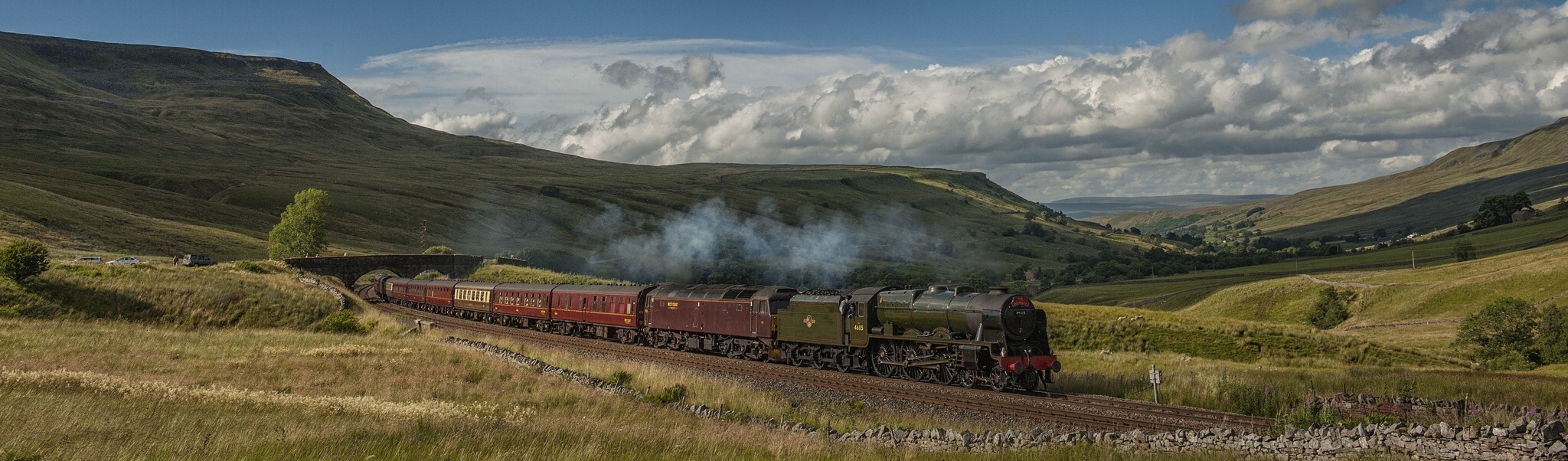



US Railroad Administration Heavy Pacific
United States 1918 20 produced
The Heavy Pacific was intended as the standard heavy express locomotive in the USRA program. It shared the cross-section of the boiler barrel with the Light Mikado and Light Mountain. It had a driver diameter of 79 inches (2,007 mm) and cylinders with a 27 inch diameter and 28 inch stroke.
Only 20 of the original USRA design were delivered to the Erie Railroad and designated class K-5. 20 P-7 from the Baltimore & Ohio, 64 Ps-4 from the Southern and two P-74 from the West Point Route were built as copies, some of which had a different driver diameter. Today, one locomotive still exists of each of the three classes of copies.
Technical data
General
- Built
- 1918
- Manufacturers
- ALCO, Baldwin
- Wheel arrangement
- 4-6-2 (Pacific)
- Gauge
- 1,435 mm (Standard gauge)
Dimensions and weights
- Wheelbase
- 11.02 m
- Service mass
- 138.8 t
- Adhesion mass
- 89.4 t
- Total mass
- 226.9 t
- Rigid wheelbase
- 4.27 m
- Axle load
- 27.2 t
- Water capacity
- 30,283 l
- Fuel capacity
- 14.5 t (coal)
Boiler
- Grate area
- 6.578 m²
- Firebox surface
- 30.379 m²
- Tube heating surface
- 324.882 m²
- Evaporative heating surface
- 355.262 m²
- Superheater surface
- 82.405 m²
- Total heating surface
- 437.7 m²
Power plant
- Driver diameter
- 2,007 mm
- Boiler pressure
- 13.8 bar
- Expansion type
- simple expansion
- Cylinders
- two, 686 x 711 mm
Power
- Power source
- steam
- Estimated power
- 2,312 kW (3,143 PS)
- Starting effort
- 195.4 kN
Calculated values
- Factor of adhesion
- 1 : 4.49
- Optimal speed
- 72 km/h
- Power-to-weight ratio
- 16.7 kW/t
- Heating Surface Equivalent
- 672.0 m²
- Cylinder volume/HSE
- 1 : 781.91
- Adhesive weight/Total
- 1 : 1.55
- Tractive force/Heating surface
- 1 : 9.32
- Grate area/Heating surface
- 1 : 66.53
- Firebox/Tube surface
- 1 : 10.69
- Total/Superheater
- 1 : 4.31