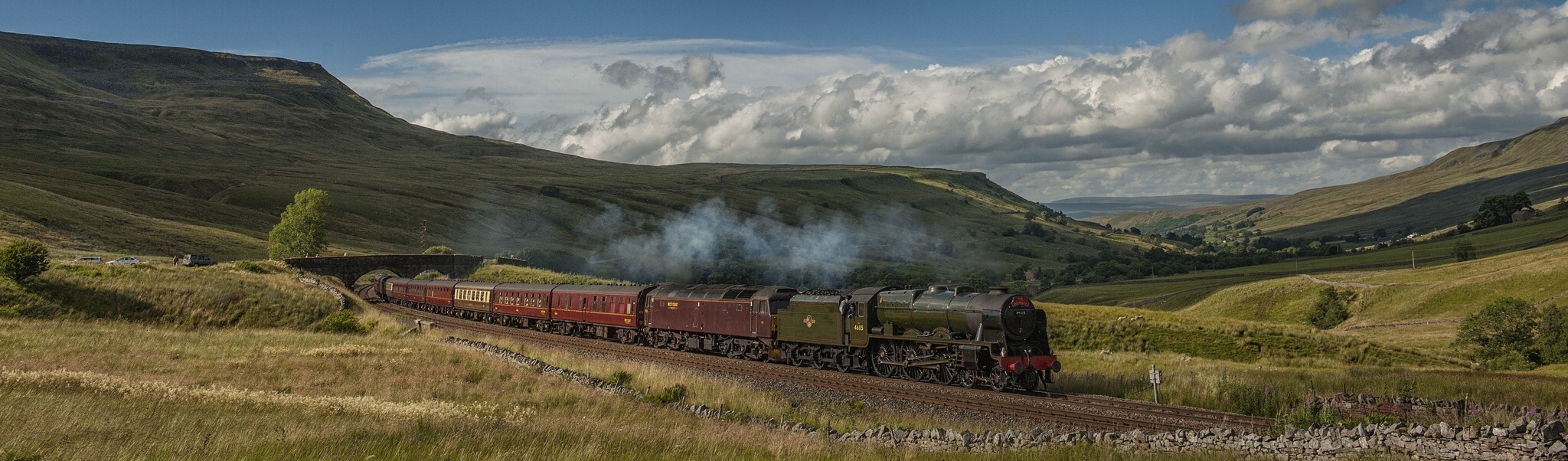
The G 121 was created as a freight locomotive due to the fact that the weight of the trains had increased significantly in the years before the First World War and increased even more after the outbreak of the war. Contrary to what its name suggests, it formed the basis for the somewhat lighter G 12, which was subsequently built more than 1,000 times for many different railway administrations in Germany. After the G 11 built in Alsace-Lorraine, they were the second class in Germany with the wheel arrangement 2-10-0.
To increase power, they received an engine with three cylinders, which also had a beneficial effect on running characteristics. Due to the five coupled axles, a narrow firebox had to be used, which could be installed between the frames in order to be able to arrange the boiler in the usual low position. As a result, the grate was more than three meters long, which made feeding the coal evenly a big challenge for the fireman.
In addition to the 21 units for Prussia and 12 units for Alsace-Lorraine, Hartmann in Chemnitz also manufactured the XIII H for the Saxon State Railways, which were almost identical to the G 121. The difference was the greater weight, which at 101.1 tonnes exceeded the 100-tonne mark for the first time in a freight locomotive in Germany.
Despite its high power, production was discontinued in 1917 in favor of the G 12, which, with a slightly lower weight, was better suited for branch lines. Due to the delivery of some G 121 as reparations, the Reichsbahn only took over 15 units and gave them the numbers 58 001 to 58 015. 14 of the Saxon units could be taken over and were given the numbers 58 101 to 58 114. All the locomotives taken over were replaced by standard locomotives by the mid-1930s, but others came back from France during the Second World War. After the end of the war, these all ended up in the GDR and were decommissioned there by 1957 at the latest.