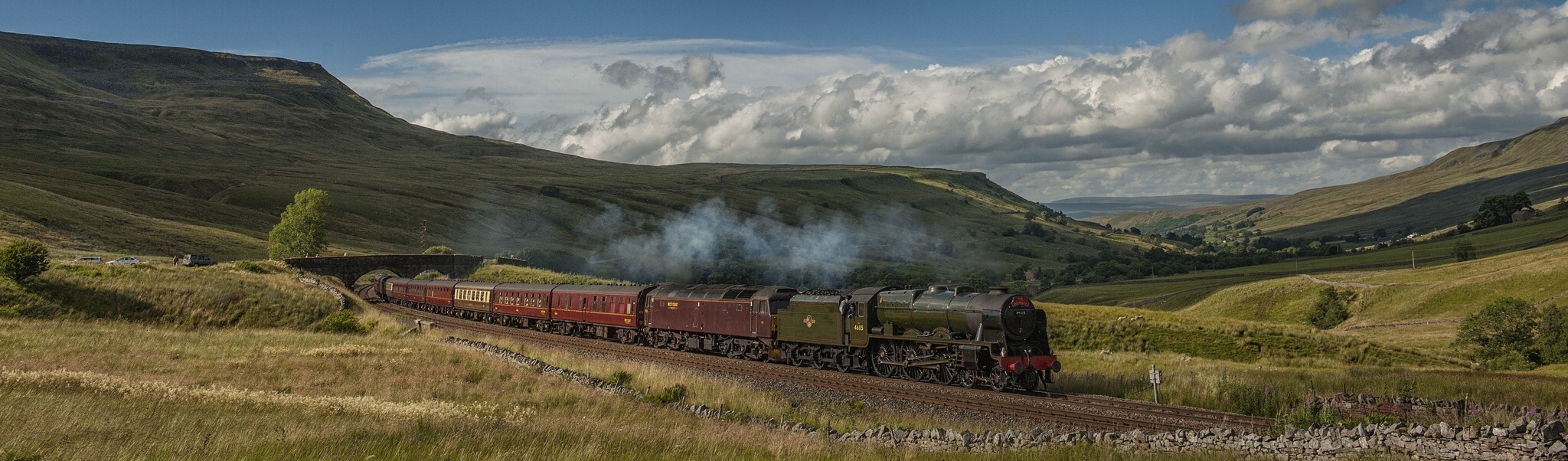
The IV f was an express locomotive with which the Munich company Maffei had won a competition held by the Grand Duchy of Baden State Railways in 1905. After three pre-production models built by Maffei, 32 more followed from the Karlsruhe mechanical engineering company. It was the first locomotive in Germany with the 4-6-2 wheel arrangement, which is also known internationally under the American designation “Pacific”. The well-known Bavarian S 3/6 was later to become a development of the IV f.
The Pacific design and the bar frame instead of a plate frame were approaches that had been taken over from American locomotive construction. Nevertheless, the entire locomotive received a filigree and streamlined appearance, which was in contrast to the bulky American locomotives. In addition, the four-cylinder compound engine based on the Von Borries design was a typical feature of southern German express train locomotives.
Since the IV f was also to be used in mountainous areas away from the main Rhenish route, its 1,800 mm diameter driving wheels were relatively small. As a result, a higher tractive force could be achieved on inclines than with larger wheels, but the entire running gear reached high rotational speeds on flat land at high speeds, which also led to increased wear and consumption. To enlarge the grate area, the firebox was pulled behind the driving wheels and widened so that it is clearly visible from the outside. It was only because of this change and the resulting increased overhang that the 4-6-0 wheel arrangement had to be abandoned and the trailing axle added. By balancing the load between the two rear axles, it was possible to increase the adhesive weight by around three tonnes on well-developed lines.
When they were taken over by the Reichsbahn in 1925, 22 of the 35 locomotives were still in use, which became the class 182. While the more numerous former S 3/6 remained in service for a long time despite the high-maintenance power plant, all members of the former IV f were retired by 1930.