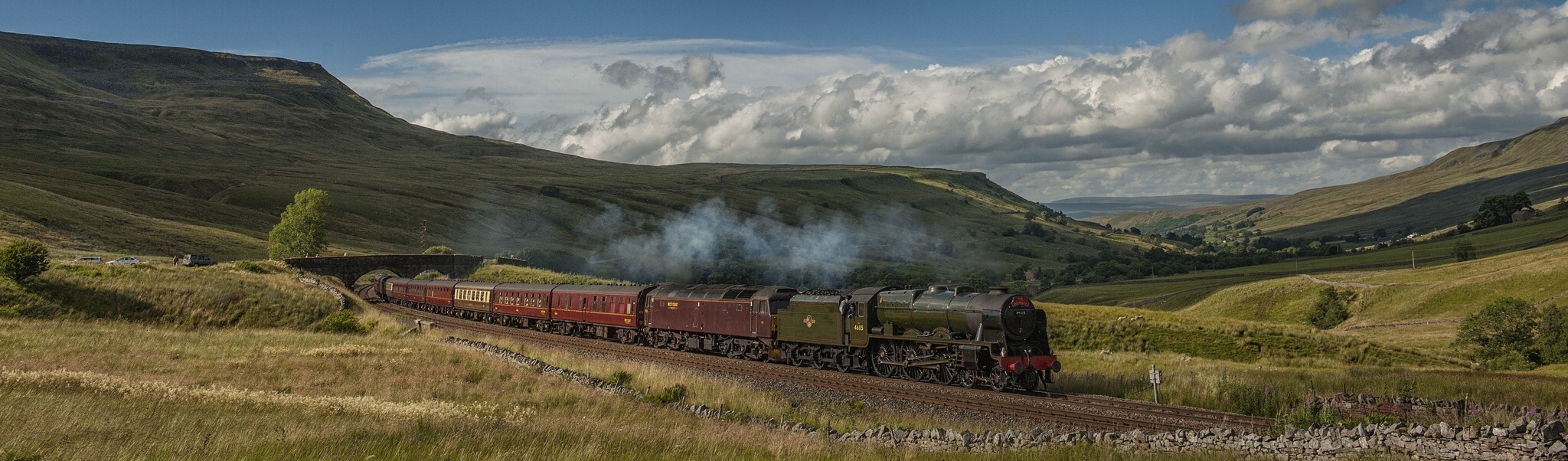
In 1904, the Locomotive Committee of the Prussian State Railways determined that, in addition to the S 4 and S 5 that had been procured at the time, there was still a need for faster and more powerful express locomotives. Linke-Hoffmann in Breslau presented a design with a 4-4-0 wheel arrangement and a two-cylinder superheated steam engine. By then, many locomotives with saturated compound engines had been built in Prussia. However, Robert Garbe, Head of Development and Procurement, wanted to prove the superiority of superheated steam technology with this design.
As with its predecessors, it still had a total of four axles, so the required power caused problems with the axle load, which was limited to 16 tonnes at the time. The solution was to move the boiler far forward to allow the two leading axles to carry a larger proportion of the overall weight. In addition, lightweight construction was practiced in order to be able to accommodate the largest possible boiler while complying with the required total weight. The diameter of the coupled wheels was initially planned at 2,200 mm in order to be able to keep the speeds low and also to improve running smoothness. With an overall wheelbase that was as long as possible, the overhangs at the front and rear could be almost completely eliminated, which should also improve smooth running at high speeds. A particularly strong coupling between the locomotive and the tender reduced the snaking movements.
Although the coupled wheels finally only got a diameter of 2,100 mm, the locomotive was able to reach speeds of up to 140 km/h or 87 mph during test runs and still ran very smoothly. The maximum operating speed was set at 110 km/h or 68 mph, which was slightly lower than the express locomotives of other railways. Despite the comparatively small mass, the S 6 was also able to pull heavier express trains on flat land at a high average speed. The Berlin-Halle route was given as an example with an average speed of 88 km/h or 55 mph. When the axle load limit fell in 1910, the locomotive was strengthened. With an axle load of over 17 tonnes, the indicated power could be increased from 911 to 1,167 hp.
Just two years later, the S10 pushed them out of fast express service, although production of the S 6 was still going on at the time. A total of 584 pieces were made by three manufacturers, of which 126 had to be handed over to various countries as reparations after the First World War. The Reichsbahn took over 286 units, which were given the numbers 13 1001 to 13 1286 and were retired by 1931.