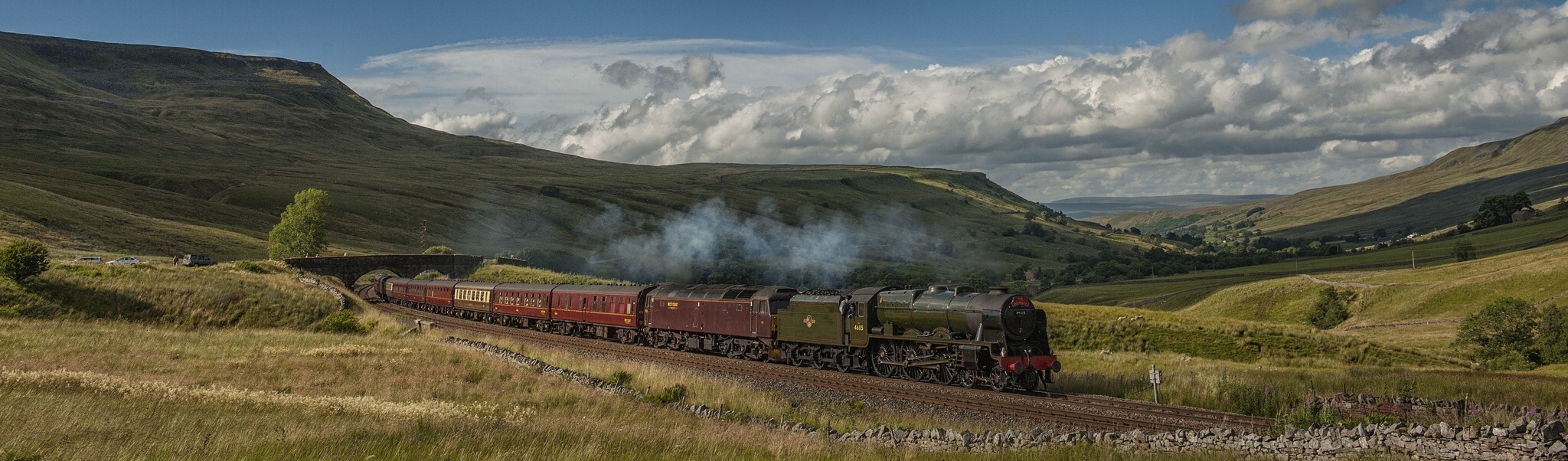



London, Midland & Scottish Royal Scot class
London, Midland & Scottish class 7P

The LMS inherited the many light locomotives from the Midland Railway, which were very often used double-headed. For example, heavy express trains on the West Coast Main Line were mostly seen behind either a pair of the 4-4-0 compounds or behind a 4-6-0 supported by a 4-4-0 for much of the route. After a GWR Castle class member had been tested with great success on the London to Carlisle section of the Royal Scot, the LMS wanted to procure a similar locomotive.
Sir Henry Fowler, formerly Chief Engineer at the Midland and now at the LMS, had already prepared designs for a compound Pacific. However, experience with the Castle class led to the selection of a non-compound 4-6-0. In the actual development, instead of Fowler, the North British Locomotive Company was in charge, where the first 50 examples were manufactured.
Instead of a simple four-cylinder engine, only three cylinders were installed and a high pressure of 250 psi was used. Since the trailing axle of the Pacific was left out, the boiler had to be positioned relatively high and, with a relatively short length, had a large diameter. The Belpaire firebox had to be over three meters long in order to be able to use a sufficiently large grate area when installing it between the driving wheels. Since the loading gauge was fully utilized, a very flat steam dome had to be designed and special safety valves with a low installation height had to be developed.
After the first batch from 1927, a further batch of 20 examples was launched in 1930, which were built in the company's own workshops at Derby. Most examples were named after British Army regiments and some after historic LNWR locomotives. The latter were later also named after regiments. The locomotives mainly hauled the “Royal Scot” from London to Glasgow and Edinburgh, after which the class was named. They were able to pull the 15 coaches without assistance at an average speed of around 53 mph (85 km/h) and thus achieved very acceptable fuel consumption. Downhill speeds of almost 80 mph (129 km/h) were also possible. One example toured the United States in 1933, including being exhibited at the Century of Progress World's Fair in Chicago.
Initially, the piston valves caused problems, which led to a significantly increased steam consumption with increasing wear. It also took several attempts to find the optimum shape for the smoke deflectors, so as to restrict the crew's view as little as possible. In 1935, number 6399 “Fury” was built as an experimental locomotive with a high-pressure boiler based on the Royal Scot. It was a three-cylinder compound, but was later rebuilt to a similar level as the Royal Scot, only with a more modern boiler that tapered towards the front.
Between 1943 and 1955 all 70 examples of the Royal Scot were rebuilt to a state similar to the stripped down “Fury”. Except for the wheels, cabs, parts of the frame and some boiler fittings, no parts were reused, so in reality it was more of a new build. The nameplates were retained, but usually they were not attached to the same locomotive from which the parts taken over. Thus, the rebuilt locomotives were treated as a separate class called “Rebuilt Scot”. When it came to maximum output, they could certainly keep up with the Pacifics of the Coronation Class. They were retired between 1962 and 1966.
Technical data
General
| Property | as built | Rebuilt Scot |
|---|---|---|
| Built | 1927, 1930 | 1943-1955 |
| Manufacturers | North British, Derby | |
| Wheel arrangement | 4-6-0 (Ten-wheeler) | |
| Gauge | 1,435 mm (Standard gauge) | |
Dimensions and weights
| Property | as built | Rebuilt Scot |
|---|---|---|
| Length | 19.22 m | |
| Length loco | 12.52 m | |
| Wheelbase | 8.38 m | |
| Empty mass | 78 t | |
| Service mass | 86.3 t | 84.3 t |
| Adhesion mass | 63.5 t | 62 t |
| Total mass | 131.4 t | 139.9 t |
| Rigid wheelbase | 4.67 m | |
| Axle load | 21.2 t | 20.7 t |
| Water capacity | 15,910 l | 18,185 l |
| Fuel capacity | 5.6 t (coal) | 9.1 t (coal) |
Boiler
| Property | as built | Rebuilt Scot |
|---|---|---|
| Grate area | 2.899 m² | |
| Firebox surface | 17.559 m² | 18.116 m² |
| Tube heating surface | 175.68 m² | 154.87 m² |
| Evaporative heating surface | 193.239 m² | 172.986 m² |
| Superheater surface | 37.068 m² | 32.33 m² |
| Total heating surface | 230.3 m² | 205.3 m² |
Power plant
| Property | as built | Rebuilt Scot |
|---|---|---|
| Driver diameter | 2,057 mm | |
| Boiler pressure | 17.2 bar | |
| Expansion type | simple expansion | |
| Cylinders | three, 457 x 660 mm | |
Power
| Property | as built | Rebuilt Scot |
|---|---|---|
| Power source | steam | |
| Estimated power | 1,715 kW (2,332 PS) | |
| Starting effort | 147.5 kN | |
Calculated values
| Property | as built | Rebuilt Scot |
|---|---|---|
| Factor of adhesion | 1 : 4.23 | 1 : 4.12 |
| Optimal speed | 71 km/h | |
| Power-to-weight ratio | 19.9 kW/t | 20.3 kW/t |
| Heating Surface Equivalent | 355.2 m² | 328.2 m² |
| Cylinder volume/HSE | 1 : 915.79 | 1 : 990.96 |
| Adhesive weight/Total | 1 : 1.36 | |
| Tractive force/Heating surface | 1 : 13.37 | 1 : 15.00 |
| Grate area/Heating surface | 1 : 79.44 | 1 : 70.82 |
| Firebox/Tube surface | 1 : 10.01 | 1 : 8.55 |
| Total/Superheater | 1 : 5.21 | 1 : 5.35 |