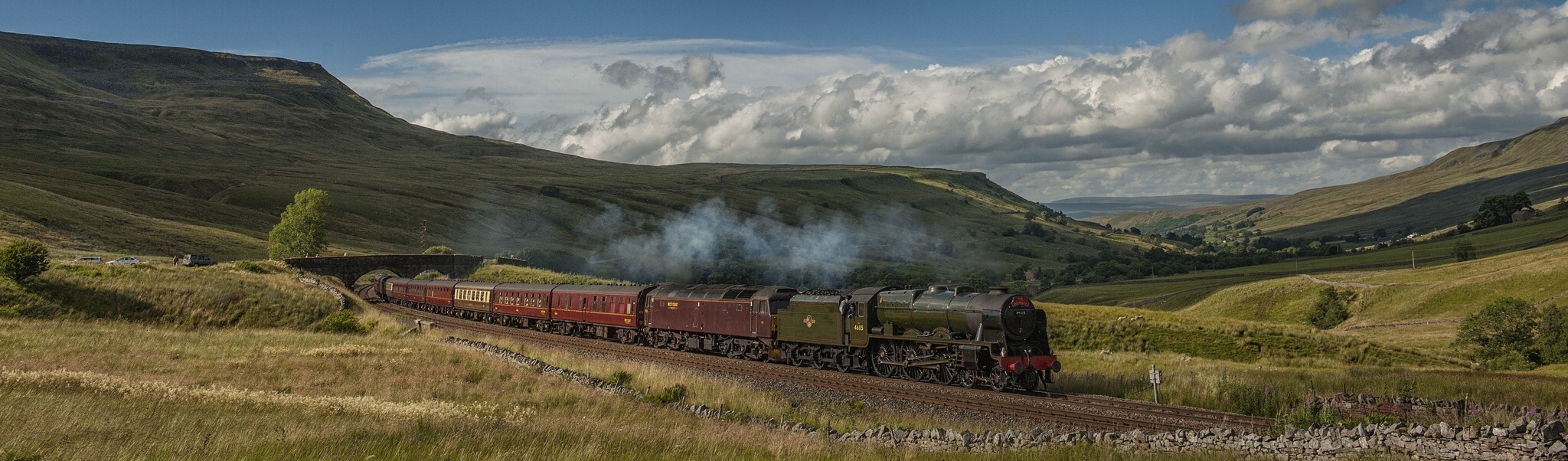



London, Brighton & South Coast class E3
The 0-6-2T class E3 was designed by Stroudley to replace the 0-6-0T E1 in short-distance goods and shunting duties. He only ordered the production of one prototype in 1891, but did not survive its completion. His successor Billinton took some time to fix the teething problems and had Brighton produce 16 more in 1894 and 1895. They were also called “Small Radials”, while the E4 was called “Large Radials”.
From 1918, they were rebuilt with a new boiler that had an extended smokebox and was operated at a higher pressure of 170 psi. The Southern Railway later decreased the cylinder diameter from 18 to 17.5 inches. Only the prototype was withdrawn in 1934. The other 16 were all taken over by British Railways and the last one was gone by 1959.
Technical data
General
- Built
- 1891, 1894-1895
- Manufacturers
- Brighton
- Wheel arrangement
- 0-6-2T (Webb)
- Gauge
- 1,435 mm (Standard gauge)
Dimensions and weights
- Length
- 9.83 m
- Wheelbase
- 6.55 m
- Service mass
- 51.8 t
- Adhesion mass
- 38.6 t
- Rigid wheelbase
- 4.65 m
- Axle load
- 14.2 t
- Water capacity
- 6,261 l
- Fuel capacity
- 2.5 t (coal)
Boiler
- Grate area
- 1.619 m²
- Firebox surface
- 8.64 m²
- Tube heating surface
- 102.792 m²
- Evaporative heating surface
- 111.432 m²
- Total heating surface
- 111.4 m²
Power plant
- Driver diameter
- 1,372 mm
- Boiler pressure
- 11 bar
- Expansion type
- simple expansion
- Cylinders
- two, 457 x 660 mm
Power
- Power source
- steam
- Estimated power
- 410 kW (557 PS)
- Starting effort
- 94.4 kN
Calculated values
- Factor of adhesion
- 1 : 4.01
- Optimal speed
- 27 km/h
- Power-to-weight ratio
- 7.9 kW/t
- Heating Surface Equivalent
- 154.6 m²
- Cylinder volume/HSE
- 1 : 1,402.30
- Adhesive weight/Total
- 1 : 1.34
- Tractive force/Heating surface
- 1 : 17.69
- Grate area/Heating surface
- 1 : 68.83
- Firebox/Tube surface
- 1 : 11.90