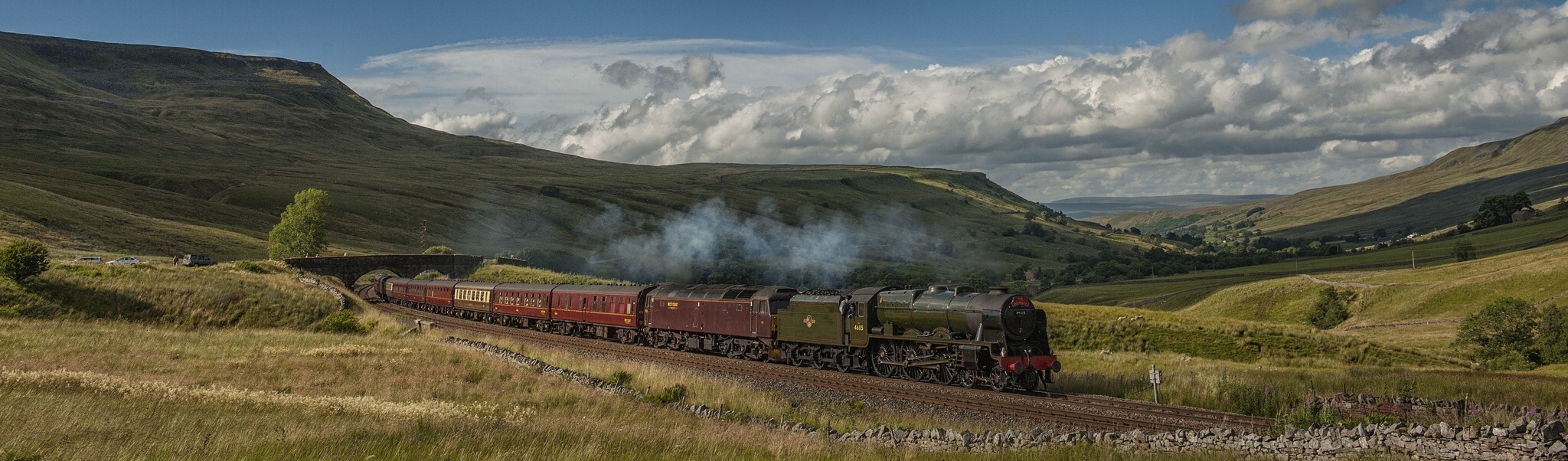



Imperial-Royal State Railways class 310
Czechoslovak State Railways class 375.0 and Polish State Railways Pn12

With the class 210 express locomotives completed in 1908, Karl Gölsdorf had already shown that the lower coal quality in Austria could be successfully exploited by reversing the 4-6-2 wheel arrangement known as the Pacific and thus achieving a larger grate area. While the class 210 only had a steam dryer, the class 310 was developed with a superheated boiler and an otherwise almost identical design.
The cylinders had the same dimensions as the 210 and still acted on the second driving axle. However, the valve bodies were no longer cast in one piece so that the entire part no longer had to be replaced in the event of defects. Although the boiler dimensions of the 210 and 310 were roughly the same and the steam dryer of the 210 was larger at 69.9 square meters than the Schmidt superheater of the 310, the latter was significantly more efficient.
Between 1911 and 1916 a total of 90 examples were made by various manufacturers. Depending on the series, the boiler pressure was 15 or 16 bars. The permitted maximum speed remained at 100 km/h, but could be exceeded without hesitation in order to make up for delays. After the First World War, a total of 35 came to the CSD as class 375.0 and twelve as Pn12 to the PKP. During the Second World War, the Reichsbahn included the 310 in the class 16 and later the ÖBB took over this number. They were only used until 1950 by CSD and until 1957 by ÖBB.
During the First World War, more locomotives were to be purchased, but the large firebox could no longer be manufactured due to a lack of copper. The solution was a brotan boiler with a smaller steel firebox. The result were the ten locomotives of the class 310.3, which with an axle load of 15.4 tonnes were no longer allowed to run anywhere in Austria. Seven locomotives that hadn't yet been delivered to the kkStB at the end of the war had to be sold to the Prussian State Railways due to the dissolution of the kkStB, which used them as the S 11 between Berlin and Katowice. The other three locomotives that had not yet been delivered were sold to the PKP and used as Pn12. After Upper Silesia was ceded to Poland, the first seven also came to the PKP, but during the Second World War they returned to Austria three under the leadership of the Reichsbahn together with the remaining three.
The 310 was Gölsdorf's masterpiece and is considered the best-known Austrian steam locomotive, which is not overshadowed by the later, more powerful 214. In fact, it was rather unpopular with the staff because the valve gear was hard to operate and the engine was very complex to maintain. For this reason, even in the period between the world wars, simpler locomotives were sometimes used and the 310 was parked more and more frequently. Today the 310.15 still exists in the National Technical Museum in Prague and the operational 310.23 in the Strasshof Railway Museum.
Technical data
General
| Property | 310.0 | 310.3 |
|---|---|---|
| Built | 1911-1916 | 1918 |
| Manufacturers | Floridsdorf, Wiener Neustadt, BMMF, StEG, Breitfeld & Daně, k | Floridsdorf |
| Wheel arrangement | 2-6-4 (Adriatic) | |
| Gauge | 1,435 mm (Standard gauge) | |
Dimensions and weights
| Property | 310.0 | 310.3 |
|---|---|---|
| Length | 21.40 m | |
| Length loco | 13.00 m | |
| Wheelbase | 10.45 m | |
| Total wheelbase | 18.25 m | |
| Empty mass | 79.2 t | |
| Service mass | 86 t | |
| Adhesion mass | 44.1 t | |
| Total mass | 138.6 t | |
| Rigid wheelbase | 4.44 m | |
| Axle load | 14.7 t | |
| Water capacity | 21,000 l | |
| Fuel capacity | 6.8 t (coal) | |
Boiler
| Property | 310.0 | 310.3 |
|---|---|---|
| Grate area | 4.62 m² | |
| Firebox surface | 15.1 m² | |
| Tube heating surface | 197.8 m² | |
| Evaporative heating surface | 212.9 m² | |
| Superheater surface | 43.4 m² | |
| Total heating surface | 256.3 m² | |
Power plant
| Property | 310.0 | 310.3 |
|---|---|---|
| Driver diameter | 2,140 mm | |
| Boiler pressure | 15 bar | 16 bar |
| Expansion type | compound | |
| Cylinders | four, HP: 390 x 720 mm and LP: 660 x 720 mm | |
Power
| Property | 310.0 | 310.3 |
|---|---|---|
| Power source | steam | |
| Estimated power | 1,300 kW (1,768 PS) | 1,400 kW (1,903 PS) |
| Top speed | 100 km/h | |
| Starting effort | 96.7 kN | 103.2 kN |
| Starting effort simple | 116.1 kN | 123.8 kN |
Calculated values
| Property | 310.0 | 310.3 |
|---|---|---|
| Factor of adhesion | 1 : 4.47 | 1 : 4.19 |
| Optimal speed | 82 km/h | 84 km/h |
| Power-to-weight ratio | 15.1 kW/t | 16.3 kW/t |
| Heating Surface Equivalent | 375.2 m² | |
| Cylinder volume/HSE | 1 : 1,115.00 | |
| Adhesive weight/Total | 1 : 1.95 | |
| Tractive force/Heating surface | 1 : 7.88 | 1 : 8.41 |
| Grate area/Heating surface | 1 : 55.48 | |
| Firebox/Tube surface | 1 : 13.10 | |
| Total/Superheater | 1 : 4.91 | |