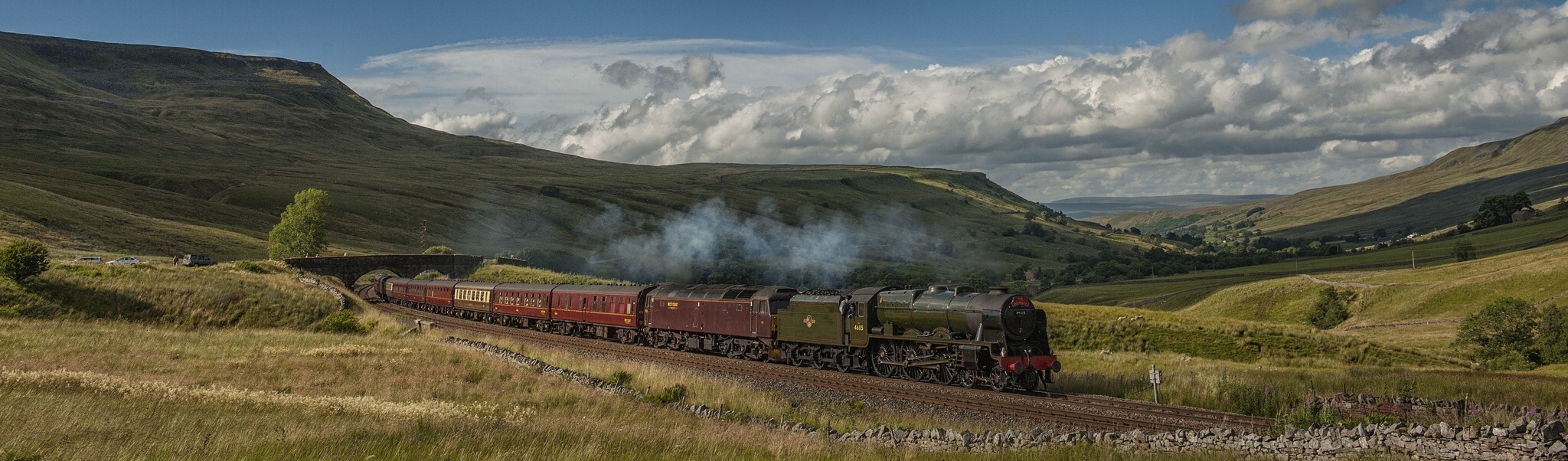



Fairbanks-Morse H-24-66 “Train Master”

As a successor to the Consolidation line, Fairbanks-Morse offered the “Train Master” from 1953. After four-axle road switchers had already been manufactured from 1947, this six-axle locomotive was also designed in this form. As a result, there were now narrow hoods in the highest power class which offered good visibility in both directions of travel. The model designation indicated 2,400 hp and six out of six powered axles.
In 1953, the twelve-cylinder opposed-piston diesel from the most powerful variant of the Consolidation was still the most powerful single diesel engine in a locomotive. It was not until 1958 that EMD was able to offer a locomotive with the same power. At the time of the H-24-66, this power was still considered too high by some railway companies. The increased maintenance requirements of the engine and other shortcomings ultimately meant that Fairbanks-Morse, including the demonstrators, could only produce 107 of these locomotives and the Canadian licensee was only able to sell 20 more.
Technical data
General
- Built
- 1953-1957
- Manufacturers
- Fairbanks-Morse, Canadian Locomotive Co.
- Wheel arrangement
- C-C
- Gauge
- 1,435 mm (Standard gauge)
Dimensions and weights
- Length
- 20.12 m
- Service mass
- 170.1 t
- Adhesion mass
- 170.1 t
- Axle load
- 28.4 t
Power plant
- Engine
- Fairbanks-Morse 38D-8 1/8
- Engine type
- 12-cyl. opposed diesel
Power
- Power source
- diesel-electric
- Indicated power
- 1,790 kW (2,434 PS)
- Top speed
- 129 km/h
- Starting effort
- 498.2 kN
Calculated values
- Factor of adhesion
- 1 : 3.35
- Power-to-weight ratio
- 10.5 kW/t
- Adhesive weight/Total
- 1 : 1.00