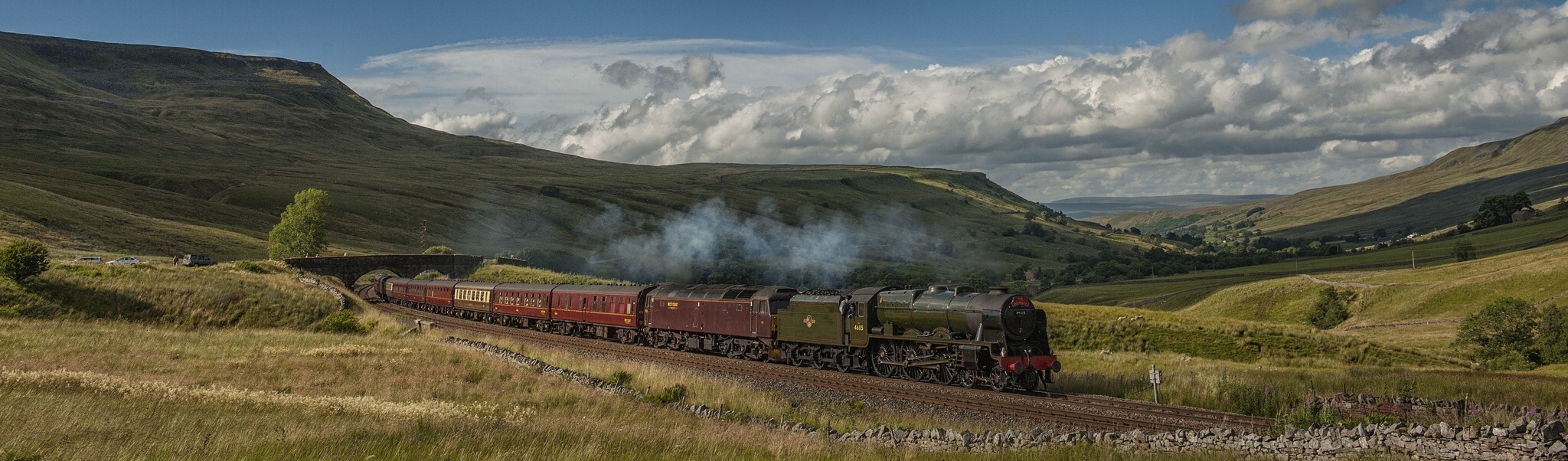



Great Western Railway class 4073 “Castle”

After the First World War, George Churchward had already designed an express locomotive that was intended to complement and surpass his Star class. It was to receive the GWR standard boiler number 7, which was already used on the class 4700 2-8-0 express goods locomotive. However, this plan could not be implemented as it would have exceeded the permitted axle load of 20 long tons.
Only his successor, Charles Benjamin Collett, designed the Castle class in the 1920s. The standard boiler number 8 was developed for this, which was lighter with increased size and had a larger grate area. It was tapered towards the front and had no dome. The associated locomotive was based on the Star class and had an extended frame with the same wheel diameter. This meant that the longer Belpaire firebox could be better accommodated and a larger driver's cab with side windows could now be used. In view of the larger boiler output, the diameter of the four cylinders was increased by one inch.
They replaced the Star class in use in front of the heavier express trains and were able to maintain high average speeds thanks to their 80.5-inch wheels and high boiler output. Shortly after they were put into service, they had competition from the even more powerful King class, which, however, was not as fast due to the smaller wheels. Thus, the heaviest express trains were pulled by the King class, while the Castle class got the faster trains that weren't quite as heavy.
The Castle class was considered Britain's most powerful express locomotive at the time of its introduction, although Gresley's A3 at the LMS was larger and also claimed that title. In comparison runs in 1924, however, the Castle class was able to win in the areas of tractive effort, average speed and fuel consumption. The Cheltenham Flyer, which weighed only 180 long tons, was able to cover the 77.25 mile-long route in 1932 at an average of 81.68 mph. The top speed reached 89 mph.
Over a long period from 1923 to 1950, 155 Castle class locomotives were built. A further 16 examples were created from the conversion of other locomotives. In addition to some examples of the Star class, this also included the Pacific “The Great Bear”, which was unsuccessful and was therefore converted back into a 4-6-0. Most machines were named after castles, but with a few exceptions.
The number 5005 “Manorbier Castle” was streamlined in 1935 and reached 100 mph. However, since this hardly brought any advantages in everyday life, the paneling was soon removed again. Later modifications to the production machines included a higher degree of superheating and, in some cases, a double chimney. In this way, No. 7018 “Drysllwyn Castle” reached a speed of 102 mph in 1958. Eight are still preserved today, six of which had been operational at one point in time. In 2019, only one of these was still operational, while four others were currently being refurbished.
Technical data
General
- Built
- 1923-1950
- Manufacturers
- Swindon
- Wheel arrangement
- 4-6-0 (Ten-wheeler)
- Gauge
- 1,435 mm (Standard gauge)
Dimensions and weights
- Length
- 19.86 m
- Wheelbase
- 8.31 m
- Total wheelbase
- 16.62 m
- Service mass
- 81.1 t
- Adhesion mass
- 59.8 t
- Total mass
- 128.2 t
- Rigid wheelbase
- 4.50 m
- Axle load
- 20 t
- Water capacity
- 13,249 l
- Fuel capacity
- 6.1 t (coal)
Boiler
- Grate area
- 2.728 m²
- Firebox surface
- 15.115 m²
- Tube heating surface
- 172.586 m²
- Evaporative heating surface
- 187.701 m²
- Superheater surface
- 24.396 m²
- Total heating surface
- 212.1 m²
Power plant
- Driver diameter
- 2,045 mm
- Boiler pressure
- 15.5 bar
- Expansion type
- simple expansion
- Cylinders
- four, 406 x 660 mm
Power
- Power source
- steam
- Estimated power
- 1,268 kW (1,724 PS)
- Starting effort
- 140.7 kN
Calculated values
- Factor of adhesion
- 1 : 4.17
- Optimal speed
- 55 km/h
- Power-to-weight ratio
- 15.6 kW/t
- Heating Surface Equivalent
- 312.1 m²
- Cylinder volume/HSE
- 1 : 1,098.03
- Adhesive weight/Total
- 1 : 1.36
- Tractive force/Heating surface
- 1 : 13.85
- Grate area/Heating surface
- 1 : 77.75
- Firebox/Tube surface
- 1 : 11.42
- Total/Superheater
- 1 : 7.69