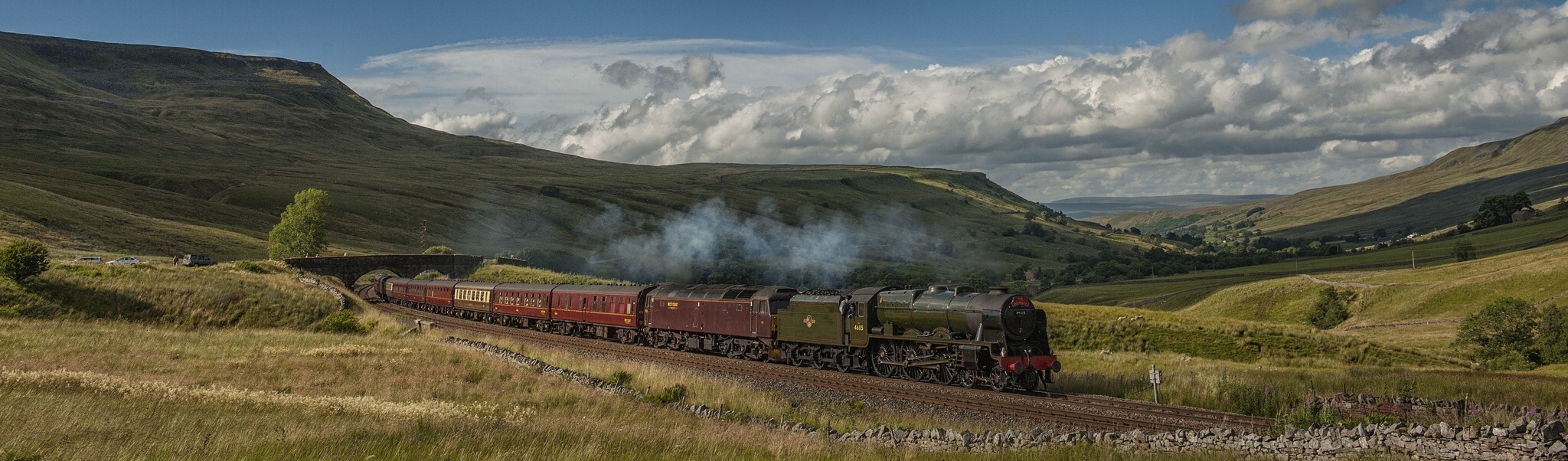



British Rail class 42
originally D800
Great Britain 1958 38 produced

For the mountainous routes in Devon and Cornwall, the Western Region decided to purchase lighter diesel-hydraulic locomotives. Since Germany was the leader in this area, the technology of the V 200 of the Bundesbahn was licensed and packed into the smaller loading gauge. The resulting D800 (later class 42 or “Warship class”) was built in Swindon and had two Maybach engines built at Bristol Siddeley, each mated to a Mekydro gearbox. At the same time, the Class 43 was developed at North British with MAN engines and Voith transmissions. Since those responsible had an aversion to diesel-hydraulic locomotives, both classes were retired by 1972.
Technical data
General
| Property | prototypes | production |
|---|---|---|
| Built | 1958-1961 | |
| Manufacturers | Swindon | |
| Wheel arrangement | B-B | |
| Gauge | 1,435 mm (Standard gauge) | |
Dimensions and weights
| Property | prototypes | production |
|---|---|---|
| Length | 18.29 m | |
| Wheelbase | 14.71 m | |
| Service mass | 79.3 t | |
| Adhesion mass | 79.3 t | |
| Axle load | 19.8 t | |
Power plant
| Property | prototypes | production |
|---|---|---|
| Engine | Bristol Siddeley (Maybach) MD650 | |
| Engine type | 2x V12 diesel | |
Power
| Property | prototypes | production |
|---|---|---|
| Power source | diesel-hydraulic | |
| Indicated power | 1,544 kW (2,099 PS) | 1,693 kW (2,302 PS) |
| Top speed | 145 km/h | |
| Starting effort | 214.4 kN | |
Calculated values
| Property | prototypes | production |
|---|---|---|
| Factor of adhesion | 1 : 3.63 | |
| Power-to-weight ratio | 19.5 kW/t | 21.4 kW/t |
| Adhesive weight/Total | 1 : 1.00 | |