Banner
Navigation
loco-info.com
The reference for locomotives and railcars

French Eastern Railway No. 79 to 90 and 174 to 188

France 1852 27 produced
Railway and Locomotive Engineering, January 1896

After the Nord had already had 100 km/h fast Crampton machines built with a driving wheel diameter of 2,100 mm from 1849, the Est procured similar ones with a diameter of 2,300 mm three years later. The engines of the Est could then even reach 120 km/h, which was beneficial to the Cramptons' reputation as “greyhounds of the rails”. To do this, the maximum speed allowed on the French railway lines had to be increased by decree of Napoleon III.

After the twelve examples numbered 79 to 90 had been delivered by Cail in 1852, another 15 by Schneider-Creusot with numbers 174 to 188 followed in 1855. The first carrying axle had a larger diameter than the second and carried a significantly higher weight. The locomotives could pull up to 15 of the passenger cars of their time and usually reached an average speed of 55 to 75 km/h with nine to ten cars.

Since the adhesive weight of just over ten tonnes later turned out to be insufficient, as with most Cramptons, a rebuild took place from 1881. In order to shift the weight further to the rear, particularly massive and heavy wheel hubs and a smaller boiler were installed. To compensate, the boiler was now operated at a higher pressure. Together with other additions, such as the Westinghouse air brake, the adhesive weight could be increased by about 3.5 tonnes.

It was not until just before the turn of the century that other express locomotives were able to overtake the Cramptons. Number 80 “Le Continent” is the only example that has survived to this day. It was restored to its original condition in 1925 and initially exhibited at the Gare de l'Est in Paris. In 1946 it was made operational again, but has been standing since 1970. Today you can find the theoretically operational machine in the Cité du train in Mulhouse, but no renewed refurbishment is currently planned.
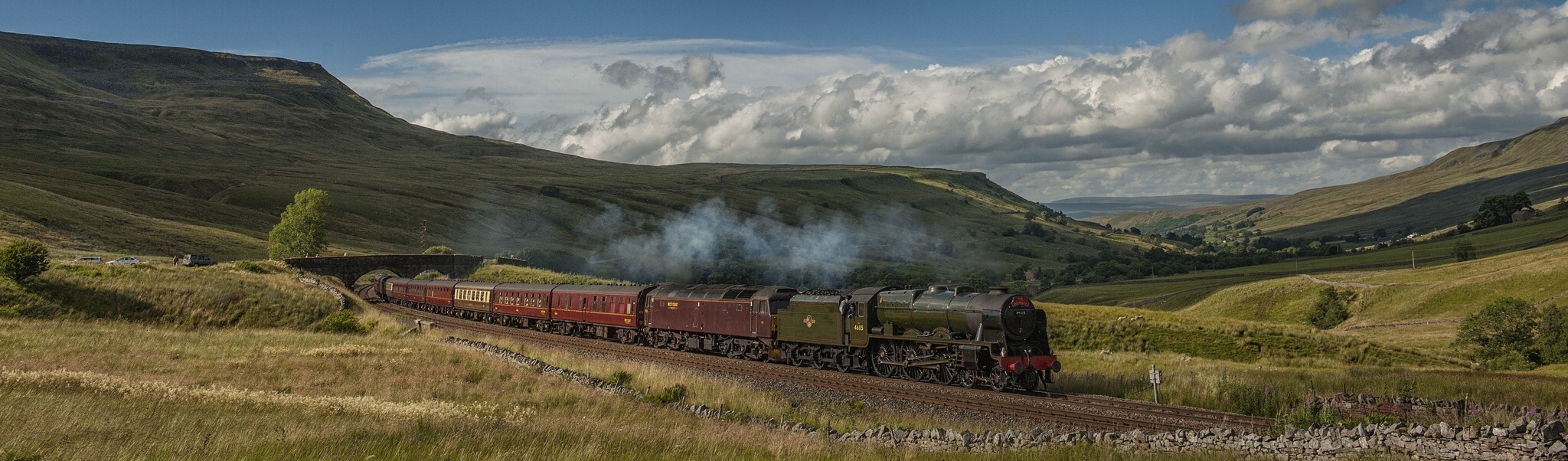
“Le Continent” in the Cité du train, Mulhouse Alf van Beem / CC0
Original condition of No. 79 “Le Globe” Locomotive Magazine, August 1923
No. 184 rebuilt with heavier driving wheels Locomotive Magazine, August 1923

Technical data

General

Property as built rebuilt
Built 1852, 1855 1881
Manufacturers Cail, Schneider Est
Wheel arrangement 4-2-0 (Crampton)
Gauge 1,435 mm (Standard gauge)

Dimensions and weights

Property as built rebuilt
Length 13.51 m
Empty mass 23.6 t 30.5 t
Service mass 26.8 t 34.7 t
Adhesion mass 10.2 t 13.7 t
Total mass 47.6 t
Axle load 10.2 t 13.7 t
Water capacity 6,000 l 8,000 l
Fuel capacity 3.2 t (coal) 4.6 t (coal)

Boiler

Property as built rebuilt
Grate area 1.29 m² 1.3 m²
Firebox surface 7.6 m² 6.65 m²
Tube heating surface 88.92 m² 84.62 m²
Evaporative heating surface 96.52 m² 91.27 m²
Total heating surface 96.5 m² 91.3 m²

Power plant

Property as built rebuilt
Driver diameter 2,300 mm
Boiler pressure 6.8 bar 8 bar
Expansion type simple expansion
Cylinders two, 400 x 560 mm

Power

Property as built rebuilt
Power source steam
Estimated power 170 kW (231 PS) 210 kW (286 PS)
Top speed 120 km/h
Starting effort 22.5 kN 26.5 kN

Calculated values

Property as built rebuilt
Factor of adhesion 1 : 4.44 1 : 5.08
Optimal speed 47 km/h 48 km/h
Power-to-weight ratio 6.3 kW/t 6.1 kW/t
Heating Surface Equivalent 134.5 m² 124.5 m²
Cylinder volume/HSE 1 : 1,046.26 1 : 1,130.29
Adhesive weight/Total 1 : 2.63 1 : 2.53
Tractive force/Heating surface 1 : 4.87 1 : 6.06
Grate area/Heating surface 1 : 74.82 1 : 70.21
Firebox/Tube surface 1 : 11.70 1 : 12.72

Topics

  • steam locomotive
  • express
CompareComment
Last changed: 06/2022

Watch on YouTube

Auf Deutsch umschalten

Settings

Your settings are retained for this browser session only.

Consent to cookies

We use cookies to save your display settings. If you decline, the settings are retained only for the current browser session.