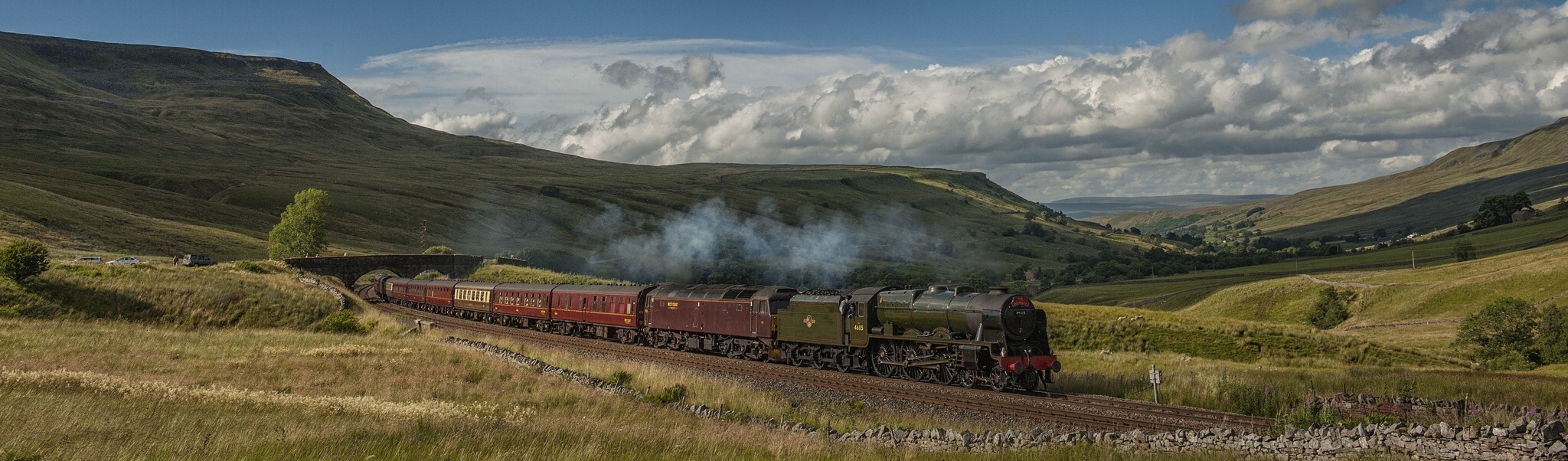
The class 15F was the most numerous steam locomotive class of the SAR. Introduced in 1938 under Chief Mechanical Engineer W.A.J. Day, it represented the final development of the class 15 family of 4-8-2 locomotives that had originated in 1914. Like the class 15E of 1935, it was equipped with the Watson Standard no. 3B boiler, featuring a grate area of 63 square feet and a heating surface exceeding 3,000 square feet. To remain within the restrictive loading gauge and keep the overall height below four metres, the boiler was built without a steam dome.
The most significant difference compared to the class 15E was the adoption of Walschaerts valve gear in place of the rotary-cam poppet valve gear used on its predecessor. Otherwise, the principal dimensions remained unchanged. The 15F retained the five-foot driving wheels, cylinders measuring 24 by 28 inches, and the same wheelbase arrangement. It also featured roller bearings on the leading and trailing axles and the distinctive cab with a slanted front introduced by Watson.
The first 21 locomotives were delivered in 1938 from Germany, with seven built by BMAG and 14 by Henschel. Later that year, North British completed a further 44 locomotives, which entered service in South Africa in 1939. Production was interrupted by the Second World War, but resumed with 30 locomotives built by Beyer, Peacock & Co. in 1944, followed by another 60 from North British in 1945. These later locomotives reflected the influence of the new Chief Mechanical Engineer, M.M. Loubser, and were equipped with smoke deflectors, improved braking systems, and provisions for mechanical stokers, which were installed a few years later. The earlier North British-built locomotives were subsequently retrofitted with stokers as well. The final and largest batch, constructed by North British in 1946 and 1947, incorporated minor boiler modifications and was fitted with mechanical stokers from new.
Depending on the production batch, the locomotives were originally paired with tenders carrying 14 or 15 tons of coal and between 5,620 and 7,250 imperial gallons of water. Remarkably, the entire class remained in service into the early 1970s. In 1978, six locomotives were leased to Rhodesia. Following the withdrawal of the class 23 in the early 1980s, members of the final 15F batch received six-axle EW tenders with capacities of 18 tons of coal and between 9,200 and 9,500 gallons of water. However, the class itself was soon withdrawn thereafter. A considerable number entered preservation, many under the care of the Transnet Heritage Foundation. Around 60 locomotives survived into the new millennium, although several were scrapped in subsequent years.