


Saxon XX HV
German Reichsbahn class 190
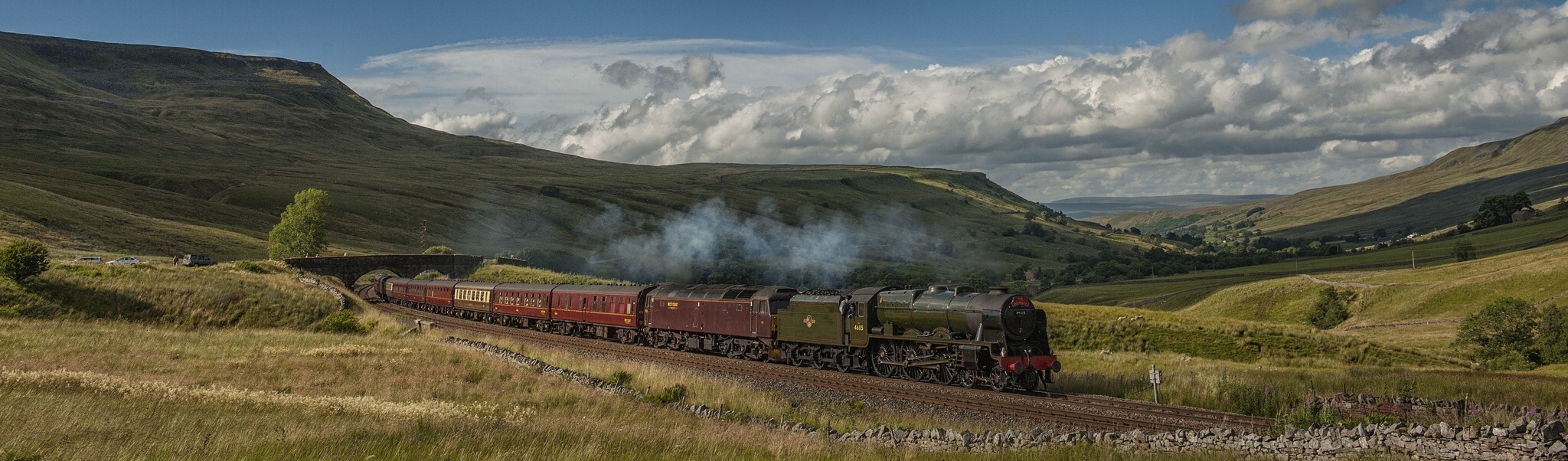
At the time they went into service, the class XX HV locomotives were the heaviest and most powerful express locomotives in Europe. In addition, they were the first and only express locomotives in Germany with the wheel arrangement 2-8-2, also called Mikado.
At that time, the boiler was also the largest of a locomotive in Germany and, with a tube length of 5.8 meters, also anticipated the development of later standard locomotives. The same boiler was used in a slightly weaker version in the sister model XVIII H, which was developed at the same time and had the wheel arrangement 4-6-2. A four-cylinder compound engine was used to poert the engine, the cylinders of which all acted on the second coupled axle. The nominal output was officially 1,800 hp, but there was also talk of higher outputs. For example, the magazine “Die Lokomotive” in 1919 stated "over 2,000 hp". The bar frame also ensured that all cylinders were accessible for maintenance.
With this performance and the not overly large wheels, there was considerable traction that was ahead of all other express locomotives in Europe at the time. The engine was also characterized by good running smoothness, but had a slightly higher coal consumption than other locomotives when driving fast on level track. Due to the properties of the engine and the high adhesive load, the locomotives were particularly suitable for mountain routes, which is why they were primarily used to pull heavy express trains on the Dresden-Hof and Leipzig-Hof routes. The top speed of 100 km/h was initially sufficient there, but it was later increased to 120 km/h.
Deliveries began in 1918 and continued even after the establishment of the Reichsbahn. Due to the special suitability of the machines for routes with many gradients, orders from other group administrations followed, these locomotives were based in Stuttgart and Frankfurt am Main. Shortly thereafter, it was assigned to the new 19 series, and so the 23 machines built were given the numbers 19 001 to 19 023.
Later, all pieces returned to Saxony to the workshops in Dresden and Reichenbach/Vogtland. This was the reason that all 22 remaining engines came into the stock of the Reichsbahn of the GDR after the Second World War. Some of the remaining locomotives were immediately retired as they had suffered severe damage during the war. The rest continued to be used in heavy passenger service and were retired by 1967.
An exception were 19 015 and 19 022, which were rebuilt in the 1960s. They received no nominal increase in performance, but were rebuilt taking into account new manufacturing processes. The first engine initially received the large tender 2'3 T 38, but in 1967 both were converted to oil firing. These two rebuilt engines were mainly used as brake locomotives for measuring runs, but were also used in front of scheduled trains if necessary. They were given computer numbers 04 0015 and 04 0022 in 1970 and retired in 1975 and 1977 respectively.
Technical data
General
| Property | as built | raised top speed |
|---|---|---|
| Built | 1918-1923 | |
| Manufacturers | Hartmann | |
| Wheel arrangement | 2-8-2 (Mikado) | |
| Gauge | 1,435 mm (Standard gauge) | |
Dimensions and weights
| Property | as built | raised top speed |
|---|---|---|
| Length | 22.63 m | |
| Length loco | 14.28 m | |
| Wheelbase | 11.96 m | |
| Empty mass | 90.3 t | |
| Service mass | 99.9 t | |
| Adhesion mass | 68.6 t | |
| Total mass | 162.7 t | |
| Rigid wheelbase | 4.00 m | |
| Axle load | 17.2 t | |
| Water capacity | 31,000 l | |
| Fuel capacity | 7 t (coal) | |
Boiler
| Property | as built | raised top speed |
|---|---|---|
| Grate area | 4.5 m² | |
| Firebox surface | 15.6 m² | |
| Tube heating surface | 211 m² | |
| Evaporative heating surface | 226.6 m² | |
| Superheater surface | 74 m² | |
| Total heating surface | 300.6 m² | |
Power plant
| Property | as built | raised top speed |
|---|---|---|
| Driver diameter | 1,905 mm | |
| Boiler pressure | 15 bar | |
| Expansion type | compound | |
| Cylinders | four, HP: 480 x 630 mm and LP: 720 x 630 mm | |
Power
| Property | as built | raised top speed |
|---|---|---|
| Power source | steam | |
| Indicated power | 1,324 kW (1,800 PS) | |
| Top speed | 100 km/h | 120 km/h |
| Starting effort | 134.5 kN | |
| Starting effort simple | 161.4 kN | |
Calculated values
| Property | as built | raised top speed |
|---|---|---|
| Factor of adhesion | 1 : 5.00 | |
| Optimal speed | 60 km/h | |
| Power-to-weight ratio | 13.3 kW/t | |
| Heating Surface Equivalent | 452.6 m² | |
| Cylinder volume/HSE | 1 : 1,070.50 | |
| Adhesive weight/Total | 1 : 1.46 | |
| Tractive force/Heating surface | 1 : 9.35 | |
| Grate area/Heating surface | 1 : 66.80 | |
| Firebox/Tube surface | 1 : 13.53 | |
| Total/Superheater | 1 : 3.06 | |