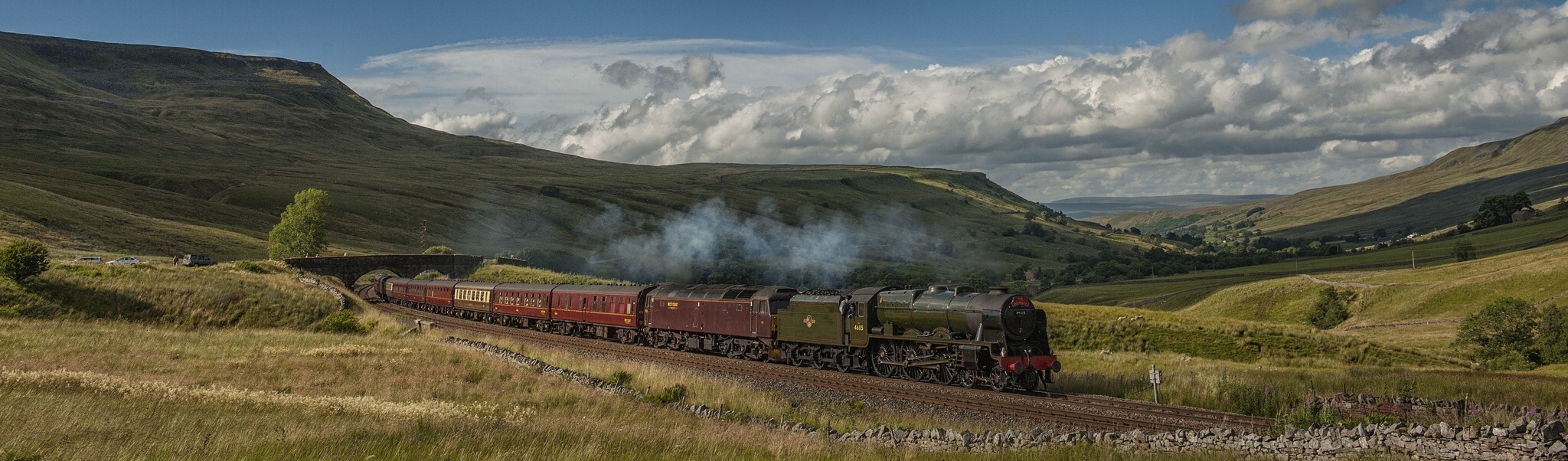




Seaboard Air Line class Q-3
United States 1923 117 produced
After the Seaboard Air Line had already put ten USRA Light Mikados into service as class Q-1, a total of 117 copies were built as the Q-3 from 1923 onwards. They differed from the USRA locomotives primarily in the firebox and had a longer wheelbase between the leading axle and the first driver. They also had a mechanical stoker and a booster on the trailing axle. After the 117 locomotives had been built by ALCO and Baldwin by 1926, the SAL manufactured number 451 in its own workshops in 1930. This was created from the frame of 441, which had fallen victim to a boiler explosion. The last Q-3 disappeared in 1955.
Technical data
General
- Built
- 1923-1926, 1931
- Manufacturers
- ALCO, Baldwin, SAL
- Wheel arrangement
- 2-8-2 (Mikado)
- Gauge
- 1,435 mm (Standard gauge)
Dimensions and weights
- Wheelbase
- 11.53 m
- Total wheelbase
- 22.82 m
- Service mass
- 136.1 t
- Adhesion mass
- 96.2 t
- Total mass
- 222.5 t
- Rigid wheelbase
- 5.11 m
- Axle load
- 24 t
- Water capacity
- 36,340 l
- Fuel capacity
- 14.5 t (coal)
Boiler
- Grate area
- 5.871 m²
- Firebox surface
- 27.035 m²
- Tube heating surface
- 324.696 m²
- Evaporative heating surface
- 351.731 m²
- Superheater surface
- 81.941 m²
- Total heating surface
- 433.7 m²
Power plant
- Driver diameter
- 1,600 mm
- Boiler pressure
- 13.8 bar
- Expansion type
- simple expansion
- Cylinders
- two, 660 x 762 mm
Power
- Power source
- steam
- Estimated power
- 2,163 kW (2,941 PS)
- Starting effort
- 243.4 kN
- Starting effort booster
- 46.706 kN
Calculated values
- Factor of adhesion
- 1 : 3.88
- Optimal speed
- 55 km/h
- Power-to-weight ratio
- 15.9 kW/t
- Heating Surface Equivalent
- 650.8 m²
- Cylinder volume/HSE
- 1 : 802.14
- Adhesive weight/Total
- 1 : 1.42
- Tractive force/Heating surface
- 1 : 11.72
- Grate area/Heating surface
- 1 : 73.87
- Firebox/Tube surface
- 1 : 12.01
- Total/Superheater
- 1 : 4.29