


Baden IX b
German Reichsbahn class 972

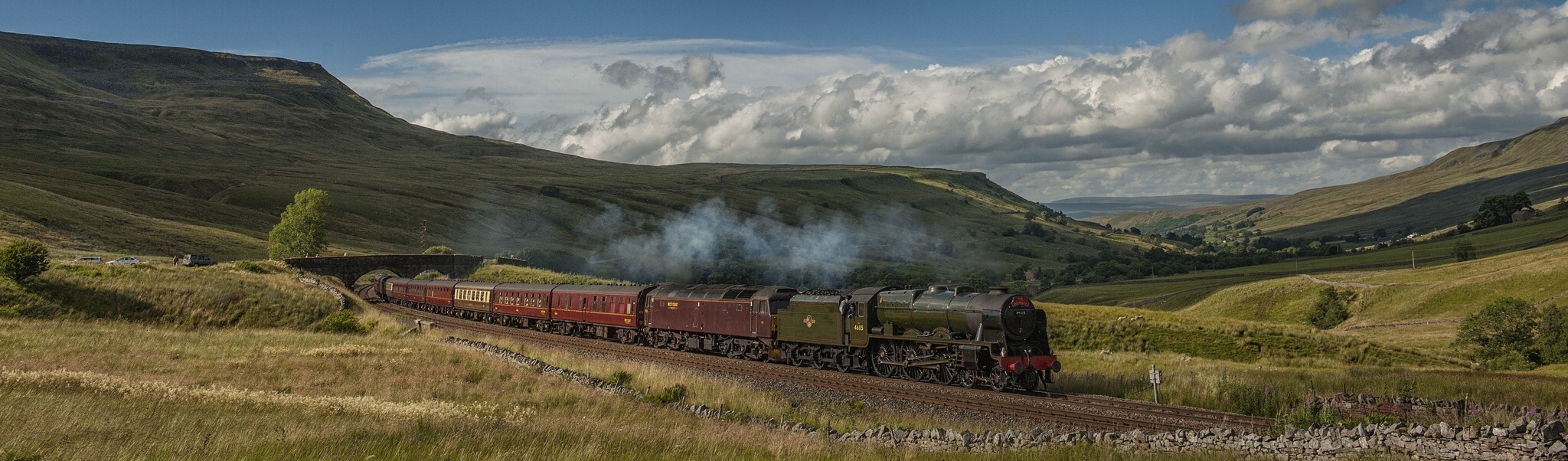
To replace the class IX a rack locomotives, which were no longer up to date in terms of power, the Grand Duchy of Baden State Railways had the IX b developed from 1908. It also had only three coupled axles, but in order to achieve a higher weight it was necessary to add a trailing axle, mainly because of the limited loads of the Ravenna Viaduct. The requirements for the IX b consisted of transporting 150-tonne trains on sections with a gradient of 2.5 percent in adhesion mode at 23 km/h and still achieving 10 km/h on the steepest section at 5.48 percent using the rack and pinion. In order to achieve the required power, the machines were designed with a steam dryer, but this was later removed due to the lack of cost-effectiveness.
As with other rack locomotives, the engine was designed as a four-cylinder compound engine, with the high-pressure cylinders driving the wheels and the low-pressure cylinders driving the rack axle. In adhesion mode, the engine worked like a conventional simple twin locomotive. The chassis could be built without any radial bogies by making the second driving axle laterally shiftable by 24 mm and the trailing axle by 40 mm. The latter also had flange lubrication on the first engines.
Since good braking performance was required on the steep sections of the route despite the relatively low train masses, the locomotives were equipped with three independent braking systems. In addition to the obligatory Westinghouse air brakes on the wheels of the locomotive and the train, a counter-pressure brake was used, which also acted on the rack axle and, for safety, a counterweight brake for the coupled wheels.
After four engines which were built in 1910, another three were procured in 1921. They were classified by the Reichsbahn as class 972 and given the serial numbers 201 to 204 and 251 to 253. However, the service life of the locomotives ended after the conversion of the Ravenna Viaduct, which had begun in 1926, was completed. The old construction from 1885 had been replaced by a brick structure with round arches, on which heavier engines could now also drive. From then on, the class 85, which was specially developed for this route, drove here, which got along with the wheel arrangement 2-10-2 and three cylinders without a rack. Thus, the last example of the former IX b was retired in 1933, only shortly after the last 85 had been put into service.
Technical data
General
| Property | variant 1910 | variant 1921 |
|---|---|---|
| Built | 1910 | 1921 |
| Manufacturers | Esslingen | |
| Wheel arrangement | 0-6-2RT (Webb) | |
| Gauge | 1,435 mm (Standard gauge) | |
Dimensions and weights
| Property | variant 1910 | variant 1921 |
|---|---|---|
| Length | 10.90 m | |
| Wheelbase | 5.05 m | |
| Empty mass | 45.3 t | 45.6 t |
| Service mass | 56.7 t | 57 t |
| Adhesion mass | 42.8 t | |
| Axle load | 14.3 t | |
| Water capacity | 5,000 l | |
| Fuel capacity | 1.5 t (coal) | |
Power plant
| Property | variant 1910 | variant 1921 |
|---|---|---|
| Driver diameter | 1,080 mm | |
| Boiler pressure | 14 bar | |
| Expansion type | compound | |
| Cylinders | four, 450 x 550 mm | |
Power
| Property | variant 1910 | variant 1921 |
|---|---|---|
| Power source | steam | |
| Indicated power | 515 kW (700 PS) | |
| Top speed | 45 km/h | |
| Starting effort | 245.4 kN | |
| Starting effort simple | 294.5 kN | |
Calculated values
| Property | variant 1910 | variant 1921 |
|---|---|---|
| Factor of adhesion | 1 : 1.71 | |
| Optimal speed | 13 km/h | |
| Power-to-weight ratio | 9.1 kW/t | 9.0 kW/t |
| Adhesive weight/Total | 1 : 1.32 | 1 : 1.33 |