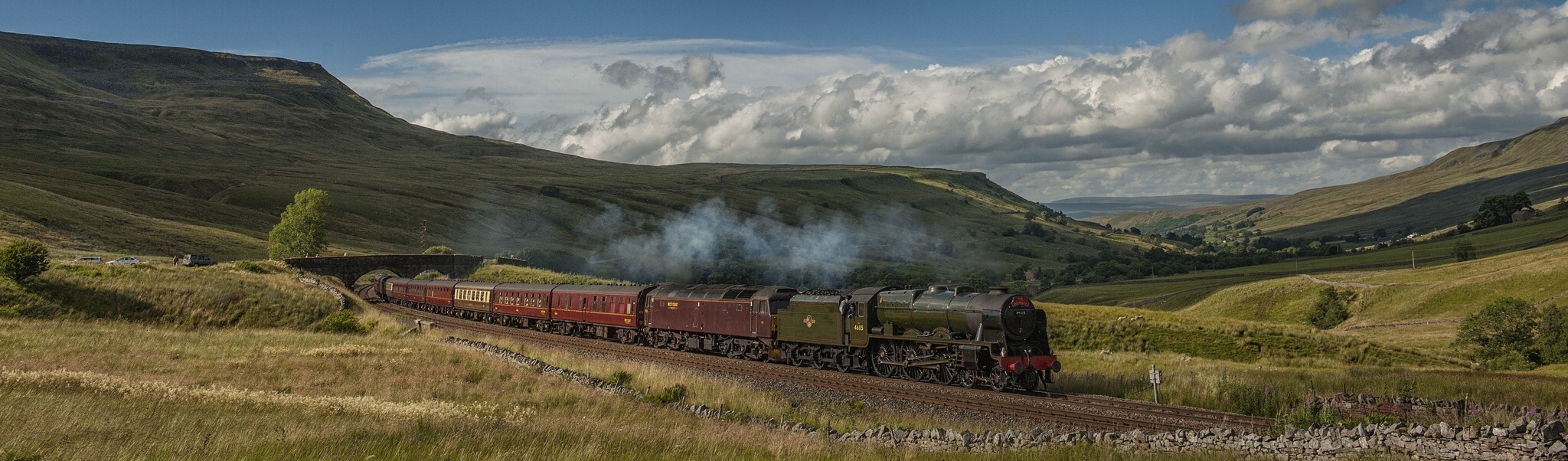



US Railroad Administration Heavy Santa Fe
United States 1918 175 produced
The USRA standard model for heavy, slow coal trains was the Heavy Santa Fé. ALCO-Brooks delivered 135 and Baldwin 40 more. By far the largest number were the 130 members of the Pennsylvania Railroad class N2s. The locomotives were generally considered a successful design that fulfilled their tasks satisfactorily. As early as 1923, the PRR rebuilt them with new boilers with Belpaire fireboxes and renamed them class N2sa. A fundamental problem with the Heavy Santa Fé was the very long frame, which was not cast in one piece. This warped over time, leading to increased maintenance costs.
Technical data
General
- Built
- 1918-1919
- Manufacturers
- ALCO, Baldwin
- Wheel arrangement
- 2-10-2 (Santa Fé)
- Gauge
- 1,435 mm (Standard gauge)
Dimensions and weights
- Length loco
- 16.86 m
- Wheelbase
- 12.85 m
- Total wheelbase
- 25.26 m
- Service mass
- 172.4 t
- Adhesion mass
- 132.9 t
- Total mass
- 265.9 t
- Rigid wheelbase
- 6.81 m
- Axle load
- 26.6 t
- Water capacity
- 45,425 l
- Fuel capacity
- 14.5 t (coal)
Boiler
- Grate area
- 7.73 m²
- Firebox surface
- 39.855 m²
- Tube heating surface
- 439.153 m²
- Evaporative heating surface
- 479.009 m²
- Superheater surface
- 114.271 m²
- Total heating surface
- 593.3 m²
Power plant
- Driver diameter
- 1,600 mm
- Boiler pressure
- 13.1 bar
- Expansion type
- simple expansion
- Cylinders
- two, 762 x 813 mm
Power
- Power source
- steam
- Estimated power
- 2,461 kW (3,346 PS)
- Top speed
- 56 km/h
- Starting effort
- 328.4 kN
Calculated values
- Factor of adhesion
- 1 : 3.97
- Optimal speed
- 45 km/h
- Power-to-weight ratio
- 14.3 kW/t
- Heating Surface Equivalent
- 906.8 m²
- Cylinder volume/HSE
- 1 : 817.50
- Adhesive weight/Total
- 1 : 1.30
- Tractive force/Heating surface
- 1 : 11.56
- Grate area/Heating surface
- 1 : 76.75
- Firebox/Tube surface
- 1 : 11.02
- Total/Superheater
- 1 : 4.19