


Tender Locomotives 4-4-4 “Reading” and 4-4-6 “Thuile”
UIC Classification 2'B2' and 2'B3'

The wheel arrangement 4-4-4 designates a steam locomotive that has a two-axle leading bogie, two coupled axles and a two-axle trailing bogie. With the unique wheel arrangement 4-4-6, the trailing bogie has three axles. In different countries, this wheel arrangement is referred to as follows:
Reading / Thuile
UIC: 2'B2' / 2'B3'
Whyte: 4-4-4 / 4-4-6
Switzerland: 2/6 / 2/7
France: 222 / 223
Turkey: 26 / 27
The 4-4-4 locomotive can be described as an Atlantic with a two-axle trailing truck to allow for a larger firebox. While tank versions could be found in different countries, the tender variant was very rare. These were either built for speed records or for hauling light trains at high speed due to their smaller adhesive weight compared to six-coupled express locomotives.
The first 4-4-4 tender locomotives came from Europe. In Germany, the Prussian State Railways built two prototypes in 1904 which were streamlined cab forwards which attained a speed of 137 km/h or 85 mph. In 1907, the Bavarian S 2/6 set a record with 154 km/h or 96 mph. But despite this, the Prussians completely abandoned this concept and the Bavarians ordered the S 3/6 Pacifics instead. In France, the Nord tested a single 4-4-4 in 1909 which had been rebuilt from an Atlantic and was again rebuilt to a Ten-wheeler after the trials.
In North America, the Philadelphia & Reading was the first to build the 4-4-4 type. These were the four locomotives of the class C-1a and so this wheel arrangement was called “Reading” in the USA. The Baltimore & Ohio was the only other US railroad to build a 4-4-4 tender locomotive in 1934 that was called class J-1 “Lady Baltimore”. Both these classes failed to become a success. In Canada, the 4-4-4 became a greater success with the Canadian Pacific operating a total of 25 semi-streamlined members of the classes F-1a and F-2a.
A similar, but really exotic wheel arrangement was 4-4-6. French engineer Henri Thuile proposed express locomotives with drivers of three meters (9 ft 10 in) and a very huge firebox. He chose 6-4-8 or 6-4-6 as possible wheel arrangements, but the manufacturer Schneider decided to build a 4-4-6 cab-forward variant with drivers of only 2.5 meters (8 ft 2 in) in 1899. This locomotive was tested by the État and demonstrated a speed of 117 km/h (73 mph). The death of Thuile while riding this locomotive ended the program, with no other locomotive of this wheel arrangement ever built.
Locomotives
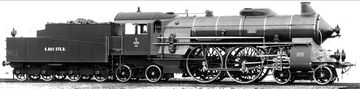
Bavarian S 2/6
Germany
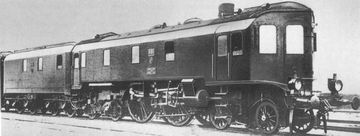
Prussian S 9 Altona 561 and 562
Germany