


Tender Locomotives 2-10-2 “Santa Fe”
UIC Classification 1'E1'
The wheel arrangement 2-10-2 designates a steam locomotive with one leading axle, five coupled axles and one trailing axle. In different countries, this wheel arrangement is referred to as follows:
Santa Fe
UIC: 1'E1'
Whyte: 2-10-2
Switzerland: 5/7
France: 151
Turkey: 57
The 2-10-2 can basically be seen as a further development of the 2-10-0 “Decapod”. By adding a trailing axle, it was possible to support a larger firebox behind the driving wheels and thus increase the sustained steam production. With five driving axles providing a high adhesive weight, these locomotives were primarily intended for hauling very heavy freight trains at low to moderate speeds.
The first locomotives with this wheel arrangement were built for the Atchison, Topeka & Santa Fe Railway in 1903. Originally, their intention had been that pusher locomotives could reverse down the grade again with better running characteristics. So they ordered a batch of their proven 2-10-0 locomotives with an additional trailing axle, what resulted in the class 900. Soon they found out that this also allowed to fit a much larger firebox. This led to the name “Santa Fe” becoming established for the wheel arrangement in North America.
The long wheelbase of the five driving axles presented similar challenges as on the 0-10-0 and 2-10-0. To allow these large locomotives to negotiate curves, lateral play was usually provided on some driving axles and individual wheelsets could have flangeless wheels. The single leading and trailing axles could additionally guide the locomotive into curves and support parts of the boiler and firebox.
In the United States, the Santa Fe became an important type for heavy freight service. Large numbers were built for railroads such as the Santa Fe, PRR, Southern Pacific and Union Pacific. While early examples were relatively conventional heavy freight locomotives, later designs received larger boilers, superheaters and other improvements which considerably increased their power. Nevertheless, the relatively small drivers of many classes and the long coupled wheelbase generally made them more suitable for heavy pulling than for high-speed operation.
The 2-10-2 was also widely used outside North America. Particularly large numbers were built in the Soviet Union, while examples could also be found in other parts of Europe, Asia and Africa. Depending on local axle-load limits, some were considerably lighter than their American counterparts. The combination of five driving axles and a firebox supported by a trailing axle made the 2-10-2 particularly useful where very high tractive effort was required without resorting to an articulated locomotive.
With the development of more powerful articulated locomotives and types with two-axle trailing bogies, the importance of the 2-10-2 declined for the heaviest duties. Nevertheless, it became one of the most widespread wheel arrangements among the ten-coupled variants and was particularly characteristic of heavy freight traffic during the first half of the 20th century.
Locomotives

China Railway class QJ
China
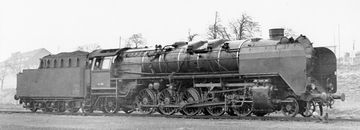
German Reichsbahn class 45
Germany
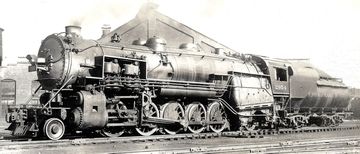
Hocking Valley class F-1
United States
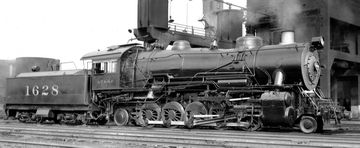
Santa Fe classes 900 and 1600
United States
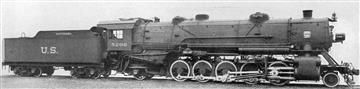
US Railroad Administration Light Santa Fe
United States
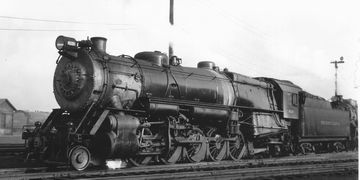
US Railroad Administration Heavy Santa Fe
United States
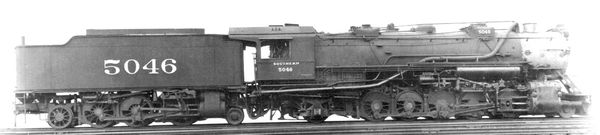
Southern Railway (USA) class Ss
United States
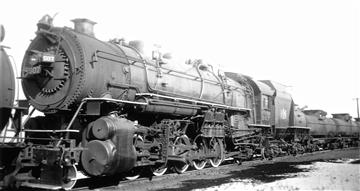
Bessemer & Lake Erie classes D1A and D1B
United States
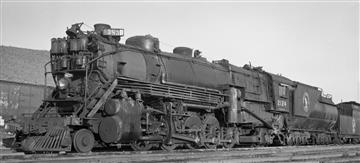
Great Northern (US) class Q-1
United States
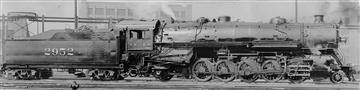
Illinois Central class 2900
United States
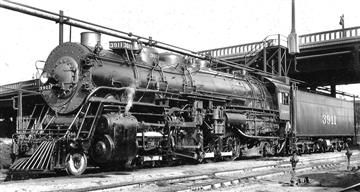
Santa Fe classes 3800 and 3876
United States
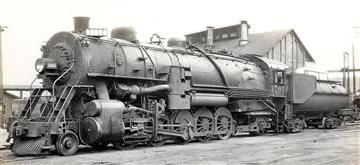
Southern Pacific classes F-3 and F-4
United States
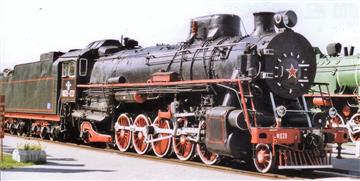
Soviet Railways series ФД (FD)
Soviet Union
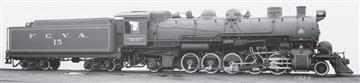
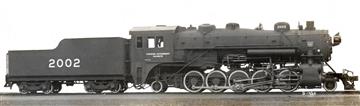
Canadian National class T-1
Canada