


Tender Locomotives 2-10-4 “Texas”
UIC Classification 1'E2'
The wheel arrangement 2-10-4 designates a steam locomotive with one leading axle, five coupled axles and a two-axle trailing bogie. In different countries, this wheel arrangement is referred to as follows:
Texas
UIC: 1'E2'
Whyte: 2-10-4
Switzerland: 5/8
France: 152
Turkey: 58
The 2-10-4 can basically be seen as a further development of the 2-10-2 “Santa Fe”. By replacing the single trailing axle with a two-axle bogie, an even larger firebox could be supported behind the coupled wheels. Together with a large boiler and five coupled axles that provided a high adhesive weight, this allowed for both very high tractive effort and a high sustained power output.
The first locomotives with this wheel arrangement were built by Lima in 1925 for the Texas & Pacific Railway. They were developed according to Lima's “Super Power” principles and were closely related to the contemporary 2-8-4 “Berkshire”. The additional coupled axle increased the adhesive weight and made the new type particularly suitable for very heavy freight trains. Due to their first customer, the wheel arrangement became known as the “Texas”.
As with other locomotives with five coupled axles, the long coupled wheelbase presented a challenge when negotiating curves. Lateral play on individual axles and flangeless wheels were among the measures used to improve flexibility. Compared with the 2-10-2, the two-axle trailing bogie additionally permitted a larger grate and combustion chamber and thus helped to produce enough steam for sustained operation at higher outputs.
Although the Texas was primarily a heavy freight locomotive, later examples were not necessarily restricted to low speeds. Large drivers, improved balancing and increasingly sophisticated running gear allowed some classes to haul heavy freight trains at considerable speeds. This distinguished the most advanced 2-10-4s from many earlier locomotives with five coupled axles, which had primarily been designed for maximum tractive effort at low speeds.
The type reached its greatest development in North America. Particularly well-known examples included the Pennsylvania Railroad class J1, which was based on a Chesapeake & Ohio design, and the exceptionally powerful locomotives of the Atchison, Topeka & Santa Fe. The latter combined drivers of unusually large diameter for a five-coupled locomotive with very large boilers and were among the most powerful non-articulated steam locomotives ever built.
Outside North America, the 2-10-4 remained relatively rare. Examples were built for countries including the Soviet Union and South Africa, where the requirements differed considerably from those of the American railroads. In general, the great size and weight of the type required sufficiently strong track and generous loading gauges, while articulated locomotives often provided an alternative where even greater power or better curve negotiation was required.
The 2-10-4 therefore represented one of the ultimate developments of the non-articulated heavy freight steam locomotive. By combining five coupled axles with the large firebox made possible by a two-axle trailing bogie, the largest examples achieved both enormous tractive effort and high sustained power.
Locomotives
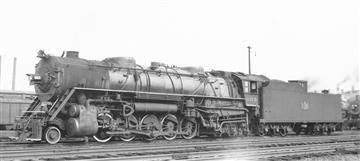
Bessemer & Lake Erie class H1
United States
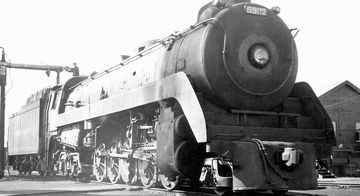
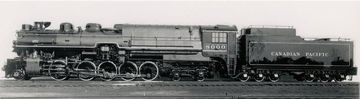
Canadian Pacific class T4a
Canada
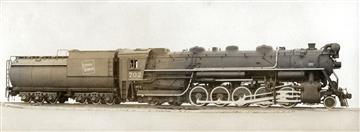
Central Vermont class T-3a
United States
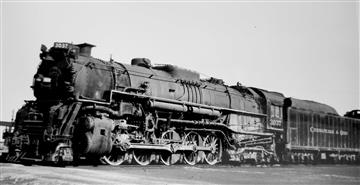
Chesapeake & Ohio class T-1
United States

Kansas City Southern class J
United States
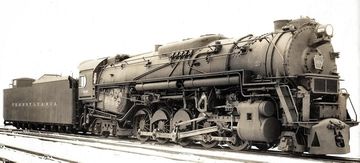
Pennsylvania class J1
United States
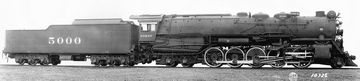
Santa Fe No. 5000
United States
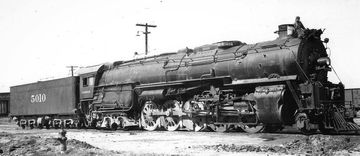
Santa Fe class 5001
United States
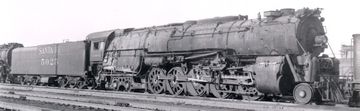
Santa Fe class 5011
United States
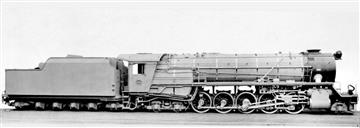
South African class 21
South Africa
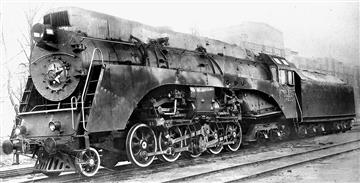
Soviet Railways ОР23 (OR23)
Soviet Union
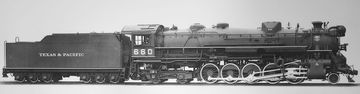
Texas & Pacific class I-1
United States