


Steam Locomotives with Giant Wheels
Wheel Diameter of more than 2.300 mm (7 feet 6 1/2 inches)
With a steam locomotive, the maximum speed that can be achieved depends directly on the wheel diameter. Since the piston speed increases with increasing running speed and the coupling and connecting rods as well as the valve gear linkage move faster, the maximum speed is limited by the diameter of the driving wheels. In the 20th century, the rule was to limit the speed to around 300 to 350 revolutions per minute. With good mass balancing, up to 400 revolutions per minute were also possible. It was only later that the focus was more on the piston speed, which also depends on the piston stroke. Also, the rotational and piston speeds should not be too high at normal track speeds, even within the tolerances, in order to reduce wear.
For this reason, attempts were made early on to reduce the speed of the driving wheels by using a larger diameter. The disadvantage of this was that tractive force decreases with larger diameters. Another problem with very large wheels is that the boiler can normally only be positioned above the axle and a larger wheel diameter thus leads to a higher boiler position. This seemed to be a big problem in the middle of the 19th century, because it was believed that the center of gravity had to be as low as possible for smoother running. A reduction in piston speed due to a shorter stroke also results in less tractive force, which must be compensated for in other ways.
Despite the problems, attempts were made to successfully use steam locomotives with particularly large wheels throughout the steam era. The extreme was already reached in 1838 with the “Hurricane” of the British Great Western Railway. Here the driving wheels measured ten feet or 3,048 mm and mounted on an additional carriage to obviate problems with placement relative to the boiler. In the French “L'aigle” from 1855, the boiler was divided into several chambers in order to better accommodate the axles of the 2,850 mm large driving wheels.
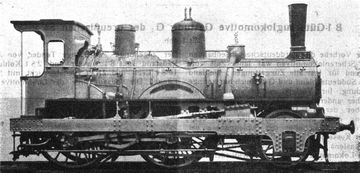
The “Hurricane” and the “L'aigle” were not successful, but there were also more successful designs with a wheel diameter of less than 2,600 mm. Among them were some Cramptons, which already reached sustained speeds of over 100 km/h around 1850. Up until around 1900, the British in particular built locomotives with wheel arrangements 2-2-2 and 4-2-2 with a driving wheel diameter of more than 7 1/2 feet.
Fewer steam locomotives with such large wheels appeared in the 20th century, since even the fastest express trains increasingly required three driving axles. Attempts were now being made to attain speeds of 140 km/h and more with multiple cylinders or a perfected mass balancing, even with wheels only two meters or six and a half feet tall. In the 1930s, the German Reichsbahn built the class 05 tender locomotives and the class 61 tank locomotives, which had 2,300 mm wheels and streamlined casing. Like the 18 201 from the GDR, however, these were only prototypes. The last large US express locomotives of the 1940s with a 4-8-4 wheel arrangement were able to reach speeds of close to or even more than 125 mph due to the general quality of their design and manufacturing even with less than two meter large wheels and only two cylinders.

Locomotives
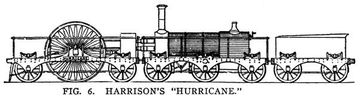
Great Western Railway “Thunderer” and “Hurricane”
Great Britain
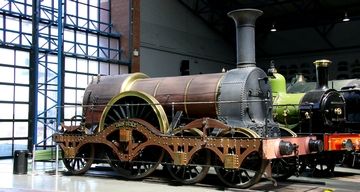
Great Western Railway Iron Duke and Rover class
Great Britain
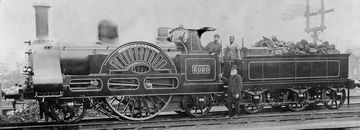
London & North Western No. 3020 “Cornwall”
Great Britain
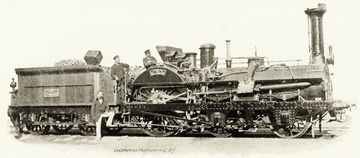
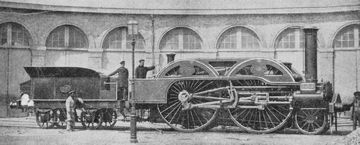
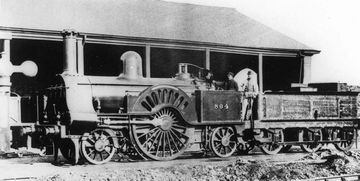
London & North Western Problem or Lady of the Lake class
Great Britain
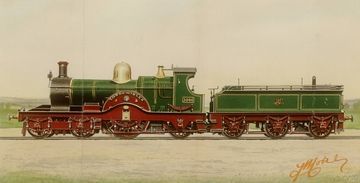
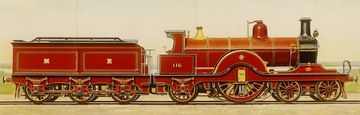
Midland classes 115 and 2601
Great Britain
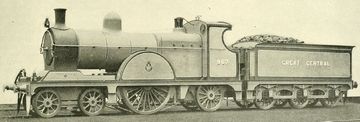
Great Central class 13
Great Britain
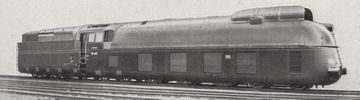
German Reichsbahn class 05
Germany
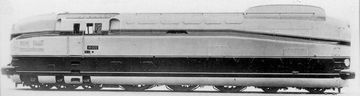
German Reichsbahn class 61
Germany
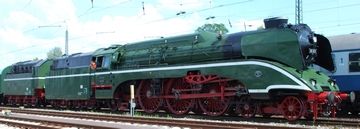
German Reichsbahn 18 201
Germany