


Featured locomotives
Selected locomotives from loco-info.com.
2026-09-28
Paris-Lyon-Méditerranée 242 CE No. 1
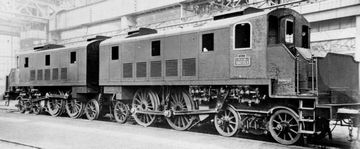
The 242 CE 1 was delivered to the Maurienne line in 1925 by Fives-Lille, which consisted of two halves and was the only one with power transmission by rods. Although the designation “242” is more indicative of a 2-B+B-2 locomotive, it still had a trailing axle at the end of each half. There was a large electric motor in each half, while competing locomotives featured a single or double electric motor per driven axle. The power was not transmitted to a rotating jackshaft, but to a reciprocating lever, which in turn drove the driver and coupled axles. A special approach was also taken with the electrics by dispensing with starting resistors and using a special, self-regulating starting system. Whether the special technical solutions of the 242 CE would have proven themselves in operation could not be determined conclusively, since it fell victim to an electrical fire in 1926 after it had run just 6,889 km and could no longer be repaired. At 164 tonnes, it is still considered the heaviest electric locomotive ever built in France.
2026-09-21
Prussian T 13
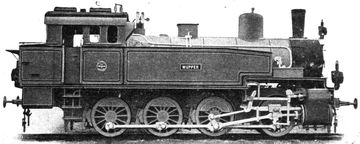
Under the designation T 13, the Prussian State Railways combined various types of tender locomotives for goods train operations, which had four coupled axles and no carrying axles. They were built from 1910 until the early 1920's and most of them used saturated steam to reduce manufacturing costs and maintenance. Only a part were superheated and two other sub-types produced in small numbers had a special chassis to improve the ability to negotiate curves.
2026-09-14
Gotthard Railway A 3/5 No. 201 to 230
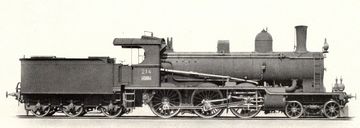
At the beginning of the 1890s, haulage of express trains on the Gotthard line was still separated. In the lowlands from Lucerne to Erstfeld the trains were hauled by light tank locomotives and in the mountains freight locomotives took over. In order to accelerate these trains, new locomotives were needed which combined sufficient tractive power with a higher maximum speed, thus making locomotive changes and double heading superfluous. The requirements were to move an express train of 140 tonnes on the mountain and 250 tonnes on the flat without assistance.
2026-09-07
London & North Western class E
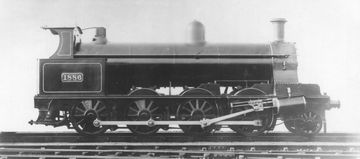
Since the locomotives later designated as LNWR class B had poor running characteristics due to their four cylinders overhanging at the front, George Whale added a leading axle in a Bissel bogie. Although there were no other changes, they were placed in a new class. A total of 26 class E locomotives were built between 1904 and 1908, when the last class B locomotives had just been delivered. Only six were retired as class E by 1927. Two were given a larger boiler and thus became class F. The rest were rebuilt into class G1 between 1917 and 1924, which again had the 0-8-0 wheel arrangement and only two cylinders without compound action.
2026-08-31
Belgian Railway types 6 and 6bis
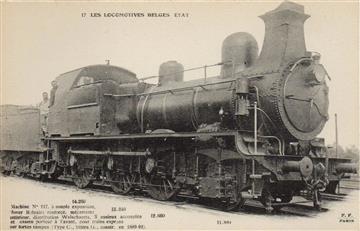
The type 6 was an express locomotive designed for long inclines on the line between Brussels and Luxembourg. The requirements included that it should be able to haul a train of 100 tonnes over long inclines of 1.6 percent with a speed of 65 km/h. Since it had to burn small fragments of coal, the grate had to be extraordinarily large. This led to three prototypes with a very special boiler design and a total of 32 production locomotives which were more conventional. Typical for locomotives designed by Belpaire, they had outside frames and inside cylinders.
2026-08-24
German Reichsbahn E 91
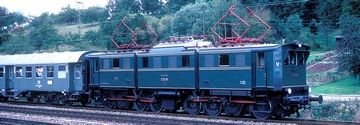
The locomotives of the class E 91 were heavy freight locomotives for use in the mountains, which had been developed on the basis of the E 77 procured from 1924. In contrast, however, the E 91 featured six powered axles, higher power and lower speed for greater pulling power. Like its predecessor, it was a locomotive with a three-part body, which was mounted on only two long bogies. Above each bogie were two motors, which gave their power to the coupled wheels via a common jackshaft. The structure of the bogies was similar to that of the E 77, but instead of the carrying axles there was a third coupled axle.
2026-08-17
Great Western Railway class 4000 “Star”
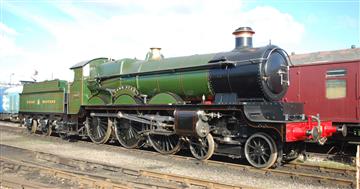
The Star class, introduced in 1906, was the first in a row of four-cylinder 4-6-0 express locomotives of the Great Western Railway. It actually originated in a 4-4-2 when Churchward built the prototype No. 40 “North Star” in 1906. Based on the three French 4-4-2 compound locomotives bought for trials in 1904 and 1905, he decided to use a similar four-cylinder layout. This meant that the inside cylinders were placed beneath the smokebox and drove the first set of drivers, while the outside cylinders were placed next to the rear axle of the bogie and drove the second set of drivers. But in contrast to the French locomotives, Churchward did not make it a compound and used four cylinders of the same size. The tapered boiler was basically the same as the one used in the Saint class.
2026-08-10
North Eastern class D
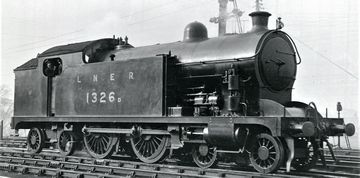
The North Eastern Railway's class D was developed by Vincent Raven for rural passenger trains. In order to achieve equally good running characteristics in both directions of travel, he chose a tank locomotive with a 4-4-4T wheel arrangement. Three cylinders ensured smoother acceleration. Although there were only two axles available for traction, the coefficient of adhesion of more than four indicated that there was enough traction for starting without slipping.
2026-08-03
British Rail class 37 and English Electric type 3
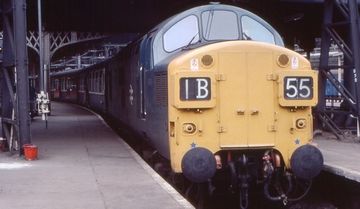
The class 37, known as the English Electric Type 3 until TOPS numbering was introduced in 1968, is one of Britain's best-known diesel locos. Their use began in 1960 with the first production batch of 42 locomotives and by 1965, the total had increased to 309. With the classification into power class 3 from 1,500 to 1,999 hp, it had a low weight for a locomotive with six axles, which made it suitable for use on most branch lines.
2026-07-27
Württemberg K
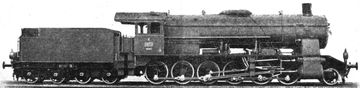
In order to be able to haul the ever heavier freight trains on the Württemberg network without double-heading, the class K with a 2-12-0 wheel arrangement of was procured from Maschinenfabrik Esslingen from 1917 onwards. They were the only twelve-coupled locomotives in Germany. The reason for the large number of wheel sets was that the axle load was limited to 16 tonnes and it would therefore not have been possible to build a sufficiently powerful locomotive with an 0-10-0 or 2-10-0 wheel arrangement.
2026-07-20
Great Western Railway class 7800 “Manor”
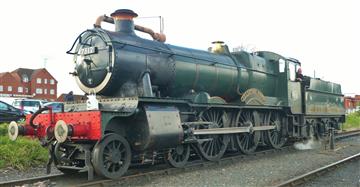
The Manor class was designed in the late thirties when the GWR found out that the axle load of the mixed-traffic Grange class was too high for many lines. Therefore Charles Collett had the lighter Swindon No. 14 boiler designed, combined with a cylinder diameter that had been decreased by half an inch compared to the Grange. As with the Grange, the driving wheels, many motion components and the tenders were taken from old class 4300 Moguls. In the result the axle load had been reduced by more than a ton. After the first batch from 1938 and 1939, British Railways built another batch of ten in 1950. They were numbered 7800 to 7829 and named after Manors in the GWR area.
2026-06-29
South African class 15A
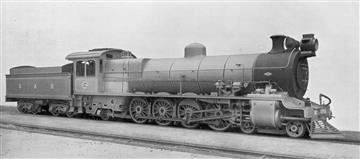
The class 15A was a 4-8-2 mixed traffic locomotive designed by D.A. Hendrie as a successor of the class 15. It was the last plate frame locomotive of this wheel arrangement designed by him and had the goal to address the overly long tubes of the class 15. The solution was to fit the Belpaire firebox with a combustion chamber that decreased the length of the tubes. This also enlarged the heating surface from 155 to 192 square feet.
2026-06-15
British Rail Standard class 6 “Clan”
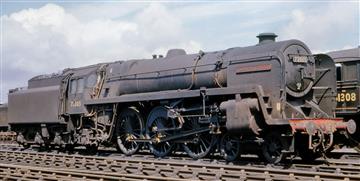
The BR Standard class 6 Pacific was designed after the Standard class 7 “Britannia”. Since the Britannia was too heavy for many lines in Scotland, a new type of locomotives with a better route availability had to be ordered. Trials with the SR Bulleid Light Pacific on the line to Inverness had shown that a light Pacific would be optimal for this task. So Riddles took the frames of the Britannia and mounted a smaller boiler with a pressure of 225 instead of 250 psi and smaller cylinders.
2026-06-13
Emperor Ferdinand Northern Railway IX
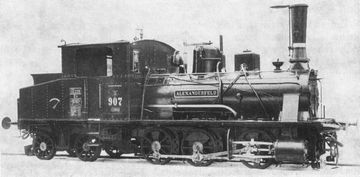
For the local railway between Bielsko-Biała (Bielitz) and Kalwaria, the KFNB required tank locomotives with a maximum axle load of eight tonnes that could negotiate sharp curves while still attaining a top speed of 50 km/h. Two such locomotives were built by Wiener Neustadt in 1888 and were designated class IX.
2026-06-08
French State Railway 160 A
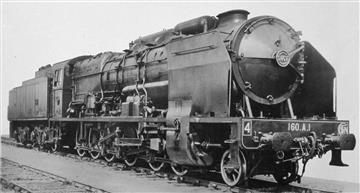
The SNCF 160 A 1 was a single freight locomotive designed by André Chapelon originally for the Paris-Orleans. The PO ordered this locomotive in 1935 when it became clear that the existing 2-10-0 locomotives could only haul 900 tonnes with 20 km/h on an incline of one percent, but the couplers could withstand 1,200 tonnes. The new locomotive had to be optimized for maximum power at low speeds and reach 30 km/h with this train weight on this grade of incline. Chapelon used the PO's series 6001 to 6070 as the basis for his rebuild, more specifically this was No. 6030. To create maximum adhesion and to carry enough weight for a more powerful boiler, he chose to add a sixth driving axle, making it the only 2-12-0 locomotive in France.
2026-06-07
French Eastern Railway series 13 No. 241-001 to 041 and French State Railway (État) 241-001 to -049
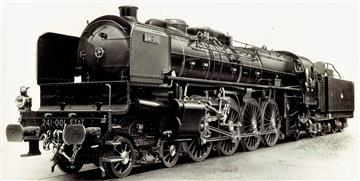
In 1925, the Est was the first railway in Europe to get a 4-8-2 “Mountain” locomotive. This prototype, numbered 41-001, was built in the Épernay workshops to haul heavier express trains than the Pacifics, since more and more cars were built from steel instead of wood. The requirements said that it should haul 700 tonnes at 115 km/h. Designed by Émile Duchâtel, it was a four-cylinder compound with a deep and narrow Belpaire firebox. First tests showed that it produced less than 2,000 hp.
2026-06-01
Seaboard Air Line classes R-1 and R-2
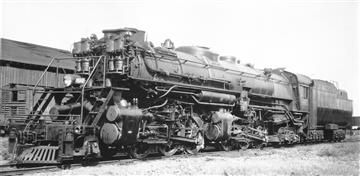
The Seaboard Air Line operated ten 2-6-6-4 articulated locomotives built by Baldwin in two batches of five in 1935 and 1937. Although smaller than the Norfolk & Western class A, they were still substantial locomotives, weighing 480,000 pounds without tender and 790,200 pounds in working order. The boiler featured a 96.3-square-foot grate and a 515-square-foot firebox equipped with two thermic syphons and a long combustion chamber. Heating surface amounted to 4,998 square feet in the tubes and flues and 2,397 square feet in the superheater.
2026-05-25
German Reichsbahn class 03
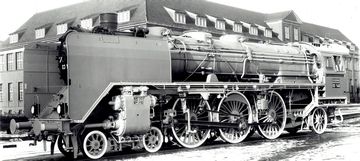
With its 20-tonne axle load, the class 01 could not be used on many lines. Although the plans provided for the upgrading of all main lines for these weight, this project could not be implemented due to the economic crisis, and it could not have been completed within a few years. Thus, the class 03 was developed, which was almost identical in construction to the 01, but lighter.
2026-05-18
Isle of Wight Central No. 3 “Mill Hill”
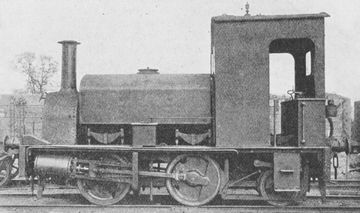
One of the founding members of the Isle of Wight Central was the Cowes and Newport Railway that had been established in 1859 and operated a 4.5 mile line to the north of the line along the River Medina. In 1970 Black, Hawthorn & Co. in Gateshead-on-Tyne built a small tank locomotive with a saddle tank, which was later to be number 3 in the combined railway company.
2026-05-11
New York Elevated classes B and C
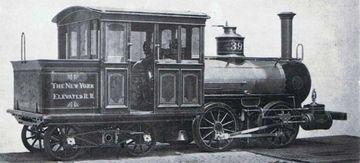
The first New York Elevated Forneys were 45 locomotives built in 1878 and 1879 by Baldwin and the Rhode Island Locomotive Works. There were two designs of different weight, which later became classes B and C. Like all Forneys, they had two coupled axles, the second of which had no flanges, and a trailing bogie that carried the full load of the supplies.