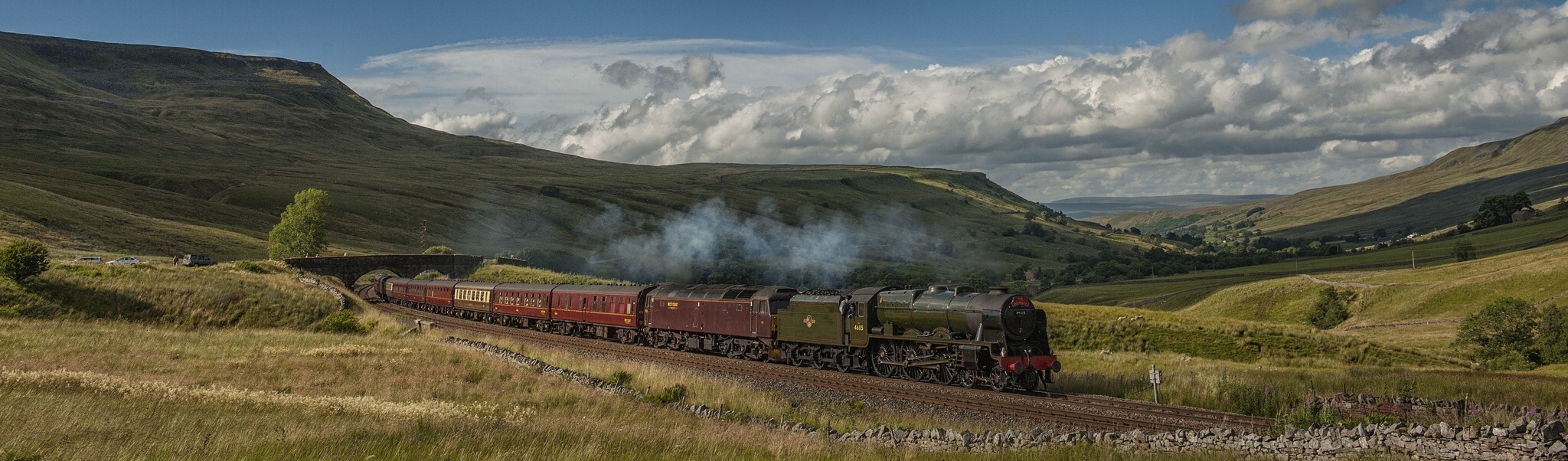



South Australian class 520

The west-east link in South Australia featured long flat stretches with few curves, as well as a 19-mile stretch with a 2.2 percent grade. For the increased train weights during the Second World War, powerful locomotives were needed that could reach high running speeds and had sufficient power for gradients. In addition, the axle load could not be too high in order to allow use on secondary routes.
After all examples of class 500 had already been converted from the wheel arrangement 4-8-2 to 4-8-4, the wheel arrangement 4-8-4 was already used ex works. With this they could achieve a high tractive power, but at the same time, thanks to the four carrying axles, the high weight of a large boiler could be carried better. Inspirations were also found in the 620-class Pacifics.
An externally striking feature of the locomotives was the streamlined fairing. Numbers 520 to 522 were modeled after the Pennsylvania Railroad T1 and the rest were slightly modified. Other modern features included the welded boiler and Timken roller bearings on all eight axles. The coupled wheels were 66 inches and, thanks to special counterweights, allowed a top speed of 70 mph.
The target speed of 78 mph was exceeded on the maiden voyage of the No. 520. They could also haul trains of 500 long tons at 70 mph, giving an indicated power of 2,600 hp. The twelve locomotives were only replaced by diesel locomotives between 1961 and 1971, when major repairs to the boilers were necessary. By then they had clocked up between 380,000 and 612,000 miles. Today, the 520 and 523 are preserved, of which the 523 was in the process of being restored to a working condition in 2019.
Technical data
General
- Built
- 1943-1947
- Manufacturers
- Islington
- Wheel arrangement
- 4-8-4 (Northern)
- Gauge
- 1,600 mm (Irish broad gauge)
Dimensions and weights
- Length
- 26.63 m
- Wheelbase
- 12.52 m
- Total wheelbase
- 23.57 m
- Service mass
- 113.2 t
- Adhesion mass
- 63.5 t
- Total mass
- 203.9 t
- Rigid wheelbase
- 5.41 m
- Axle load
- 16.1 t
- Water capacity
- 40,882 l
- Fuel capacity
- 10 t (coal)
Boiler
- Grate area
- 4.181 m²
- Firebox surface
- 27.035 m²
- Tube heating surface
- 200.949 m²
- Evaporative heating surface
- 227.984 m²
- Superheater surface
- 60.48 m²
- Total heating surface
- 288.5 m²
Power plant
- Driver diameter
- 1,676 mm
- Boiler pressure
- 14.8 bar
- Expansion type
- simple expansion
- Cylinders
- two, 521 x 711 mm
Power
- Power source
- steam
- Indicated power
- 1,939 kW (2,636 PS)
- Starting effort
- 144.9 kN
Calculated values
- Factor of adhesion
- 1 : 4.30
- Optimal speed
- 82 km/h
- Power-to-weight ratio
- 17.1 kW/t
- Heating Surface Equivalent
- 484.1 m²
- Cylinder volume/HSE
- 1 : 625.65
- Adhesive weight/Total
- 1 : 1.78
- Tractive force/Heating surface
- 1 : 10.49
- Grate area/Heating surface
- 1 : 68.99
- Firebox/Tube surface
- 1 : 7.43
- Total/Superheater
- 1 : 3.77