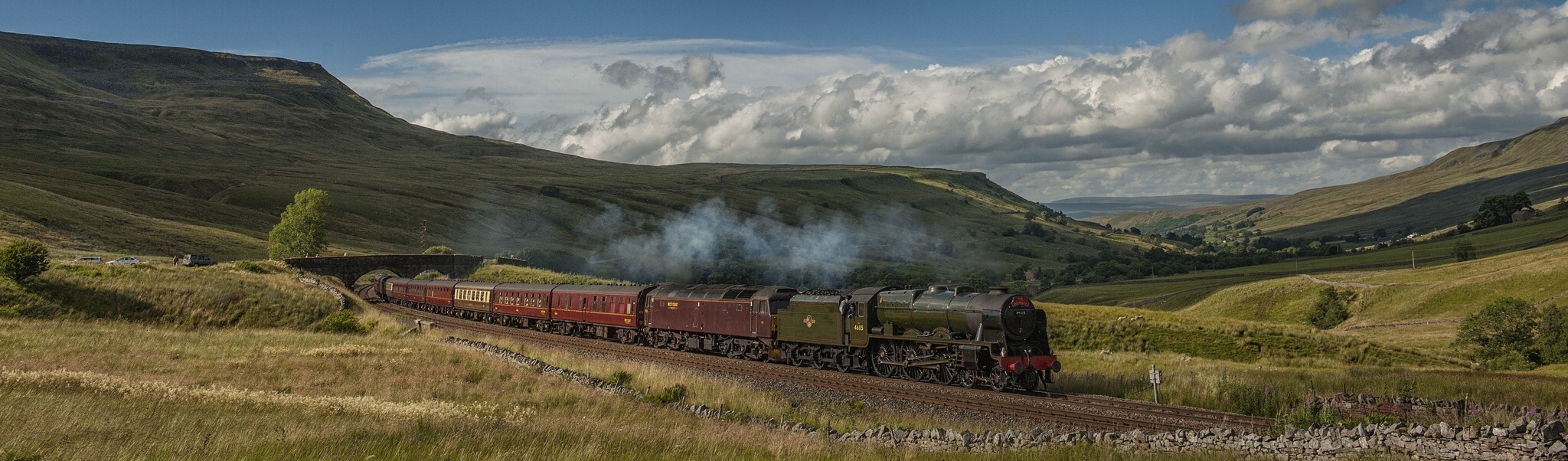




Lancashire & Yorkshire class 25
London, Midland & Scottish class 2F
Directly after his appointment as superintendent of the Lancashire & Yorkshire, William Barton Wright designed the class 25 as a standard goods locomotive. Between 1876 and 1887, different commercial manufacturers and the LYR's own Miles Platting workshops produced a total of 280 of these locomotives also called “Ironclads”. The first 72 had a smaller boiler than the remaining 208.
Between 1891 and 1900, 230 were rebuilt to class 23 saddle tank locomotives. At the LMS, the non-rebuilt locomotives were classed in power class 2F. Withdrawals commenced in 1930, but 23 managed to survive into BR ownership. The last ones were withdrawn in 1959. The only non-rebuilt locomotive that was preserved is BR 52044, former LYR 957 and now running on the Keighley & Worth Valley Railway. Class 23 No. 752 is now running on the East Lancashire Railway, carrying the fictitious BR No. 51456.
Technical data
General
| Property | smaller boiler | larger boiler |
|---|---|---|
| Built | 1876-1887 | |
| Manufacturers | Beyer, Peacock & Co., Vulcan Foundry, Sharp, Stewart & Co., Kitson & Co., Miles Platting | |
| Wheel arrangement | 0-6-0 (Six-coupled) | |
| Gauge | 1,435 mm (Standard gauge) | |
Dimensions and weights
| Property | smaller boiler | larger boiler |
|---|---|---|
| Wheelbase | 4.57 m | |
| Service mass | 37.7 t | 38.7 t |
| Adhesion mass | 37.7 t | 38.7 t |
| Total mass | 65.3 t | 66.2 t |
| Rigid wheelbase | 4.57 m | |
| Axle load | 13 t | 13.6 t |
| Water capacity | 10,228 l | |
Boiler
| Property | smaller boiler | larger boiler |
|---|---|---|
| Grate area | 1.765 m² | 1.812 m² |
| Firebox surface | 8.408 m² | 8.268 m² |
| Tube heating surface | 90.162 m² | 87.886 m² |
| Evaporative heating surface | 98.57 m² | 96.155 m² |
| Total heating surface | 98.6 m² | 96.2 m² |
Power plant
| Property | smaller boiler | larger boiler |
|---|---|---|
| Driver diameter | 1,372 mm | 1,410 mm |
| Boiler pressure | 9.7 bar | 11 bar |
| Expansion type | simple expansion | |
| Cylinders | two, 444 x 660 mm | |
Power
| Property | smaller boiler | larger boiler |
|---|---|---|
| Power source | steam | |
| Estimated power | 336 kW (457 PS) | 354 kW (481 PS) |
| Starting effort | 78.1 kN | 86.8 kN |
Calculated values
| Property | smaller boiler | larger boiler |
|---|---|---|
| Factor of adhesion | 1 : 4.74 | 1 : 4.38 |
| Optimal speed | 26 km/h | |
| Power-to-weight ratio | 8.9 kW/t | 9.1 kW/t |
| Heating Surface Equivalent | 140.6 m² | 137.5 m² |
| Cylinder volume/HSE | 1 : 1,457.65 | 1 : 1,490.69 |
| Adhesive weight/Total | 1 : 1.00 | |
| Tractive force/Heating surface | 1 : 16.54 | 1 : 18.85 |
| Grate area/Heating surface | 1 : 55.85 | 1 : 53.07 |
| Firebox/Tube surface | 1 : 10.72 | 1 : 10.63 |