

Banner
Navigation
loco-info.com
The reference for locomotives and railcars
Navigation
Explore
Search
Compare
Settings
Appenzell Tram HG 2/4
go back
Switzerland | 1904
4 produced
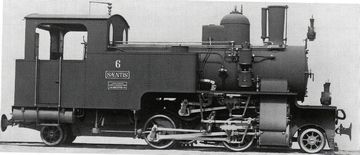
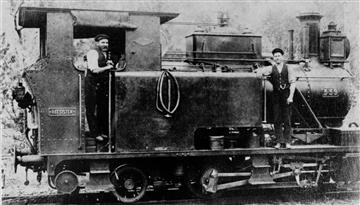
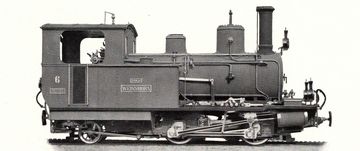
No. 6 “Säntis”
No. 6 “Säntis”
Alfred Moser & al., „Der Dampfbetrieb der Schweizerischen Eisenbahnen 1847—2006”

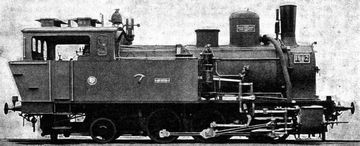
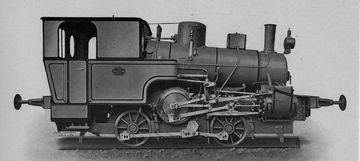
The HG 2/4 was a combined rack and adhesion locomotive of the meter-gauge Appenzell Tramway introduced in 1904. Since the HG 2/3 introduced in 1889 had a too complex Klose steering mechanism, the new locomotives were to be simpler in construction. The requirement was that they still could run the flatter sections in pure adhesion mode and engage the combined mode on the rack sections.

They were designed after the Winterthur system that combines the adhesion and rack drive with compound working. This meant that the high pressure cylinders were at the bottom and drove the wheels, while the low pressure cylinders at the top drove the crank axle for the rack drive. The crank axle worked onto the rack wheels via a 1 to 2,21 reduction gear, what meant that the low pressure cylinders moved at more than twice the speed of the high pressure cylinders, enabling all to be of the same size.

Numbers 5 and 6 were completed in 1904, followed by 7 and 8 in 1909 which were heavier. In adhesion mode they reached a top speed of 30 km/h. On the rack section, the maximum was 24 km/h when running uphill and 18 km/h when running downhill. In 1918, No. 6 was the only one to receive a superheater. Despite this it was one of the two which were retired first in 1931, while the others followed in 1932 and 1934-

Variant5-67-8
General
Built19041909
ManufacturerSLM
Wheel arr.2-4-2RT (Columbia) 
Gauge3 ft 3 3/8 in (Meter gauge)
Dimensions and Weights
Length27 ft 8 11/16 in
Service weight74,296 lbs77,603 lbs
Adhesive weight50,486 lbs52,911 lbs
Fuel capacitycoal
Boiler
Grate area13.6 sq ft
Evaporative heating area754.5 sq ft
Total heating area754.5 sq ft
Variant5-67-8
Power Plant
Driver diameter32.1 in
Boiler pressure203 psi
Expansion typesimple
Cylindersfour, adhesion: 14 9/16 x 15 3/4 in
rack: 14 9/16 x 15 3/4 in
Power
Power sourcesteam
Indicated power345 hp (257 kW)
Top speed19 mph
Starting effort24,729 lbf
with start valve29,675 lbf
Calculated Values
steam locomotive
passenger
tram
tank locomotive
rack railway
narrow gauge
last changed: 11/2024
Arica-La Paz No. 21 to 23
go back
Chile | 1913
3 produced
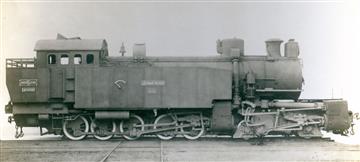
No. 22 “Jermán Riesco”
Martin Coombs / www.railwaysofthefarsouth.co.uk

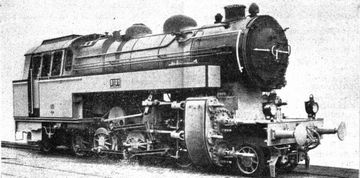
In 1913, the Esslingen machine works built three rack locomotives for the Arica-La Paz in their subsidiary at Sarrono, Italy. Their numbers were 21 to 23 and their names “José Manuel Balmaceda”, “Jermán Riesco” and “Domingo Santa María”. Basically they were built like Mallets, but the leading bogie only had two carrying axles and the rack drive. The rear group of five driving axles was mounted in the frames.

They were only used on the Chilean part of the line, starting at Central station at an altitude of 1,480 metres (4,855 feet) and running to Puquios at an altitude of 3,728 metres (12,230 feet). On this stretch, there was an incline of 43 km that had a gradient of up to six percent. Although it was found out that they did not wear out the tracks much faster than other locomotives, they were withdrawn in 1923.

General
Built1913
ManufacturerEsslingen-Saronno
Wheel arr.4-10-0RT
Gauge3 ft 3 3/8 in (Meter gauge)
Dimensions and Weights
Fuel capacitycoal
Boiler
Power Plant
Driver diameter35.8 in
Expansion typecompound
Cylindersfour, HP: 15 3/8 x 19 11/16 in
and LP: 21 1/4 x 17 11/16 in
Power
Power sourcesteam
Calculated Values
steam locomotive
tank locomotive
freight
rack railway
last changed: 07/2025
Austrian Federal Railways class 297
German Reichsbahn class 974
go back
Austria | 1942
2 produced
ÖBB 297.401 as a memorial in Vordernberg, Styria
Simon Legner

In order to be able to increase the weight of the ore trains on the Erzbergbahn, two heavy rack locomotives with a 2-12-2RT wheel arrangement were put into service in 1942. They were initially planned as class 369 of the BBÖ, but were now incorporated directly into the Reichsbahn as class 974. At that time they were the most powerful rack locomotives in the world, but due to the lack of reinforcement of the rack rail on the north ramp of the Erzbergbahn they could only be used on the south ramp. The 97 402 was put out of service in 1949. The 97 401 became the 297.401 at the BBÖ in 1953. It received a Giesl ejector in 1958 and was retired in 1968. So far there is only a short text for this vehicle. In the future it will be described in more detail.

General
Built1942
ManufacturerFloridsdorf
Wheel arr.2-12-2RT (Javanic) 
Gauge4 ft 8 1/2 in (Standard gauge)
Dimensions and Weights
Length48 ft 6 11/16 in
Wheelbase37 ft 6 13/16 in
Service weight275,578 lbs
Adhesive weight216,053 lbs
Water capacity925 us gal
Fuel capacitycoal
Boiler
Grate area42 sq ft
Firebox area169 sq ft
Tube heating area2,101.1 sq ft
Evaporative heating area2,270.1 sq ft
Superheater area780.4 sq ft
Total heating area3,050.5 sq ft
Power Plant
Driver diameter41.3 in
Boiler pressure232 psi
Expansion typesimple
Cylindersfour, adhesion: 24 x 20 1/2 in
rack: 15 3/4 x 19 11/16 in
Power
Power sourcesteam
Estimated power1,743 hp (1,300 kW)
Top speed19 mph
Calculated Values
steam locomotive
freight
rack railway
tank locomotive
last changed: 08/2023
Baden IX b
German Reichsbahn class 972
go back
Germany | 1910
7 produced
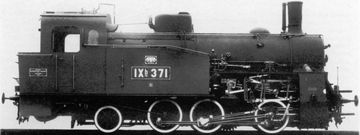
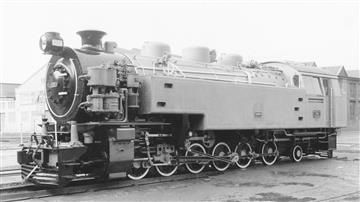
IX b No. 371 on a works photo of Maschinenfabrik Esslingen

To replace the class IX a rack locomotives, which were no longer up to date in terms of power, the Grand Duchy of Baden State Railways had the IX b developed from 1908. It also had only three coupled axles, but in order to achieve a higher weight it was necessary to add a trailing axle, mainly because of the limited loads of the Ravenna Viaduct. The requirements for the IX b consisted of transporting 150-tonne trains on sections with a gradient of 2.5 percent in adhesion mode at 23 km/h and still achieving 10 km/h on the steepest section at 5.48 percent using the rack and pinion. In order to achieve the required power, the machines were designed with a steam dryer, but this was later removed due to the lack of cost-effectiveness.

As with other rack locomotives, the engine was designed as a four-cylinder compound engine, with the high-pressure cylinders driving the wheels and the low-pressure cylinders driving the rack axle. In adhesion mode, the engine worked like a conventional simple twin locomotive. The chassis could be built without any radial bogies by making the second driving axle laterally shiftable by 24 mm and the trailing axle by 40 mm. The latter also had flange lubrication on the first engines.

Since good braking performance was required on the steep sections of the route despite the relatively low train masses, the locomotives were equipped with three independent braking systems. In addition to the obligatory Westinghouse air brakes on the wheels of the locomotive and the train, a counter-pressure brake was used, which also acted on the rack axle and, for safety, a counterweight brake for the coupled wheels

After four engines which were built in 1910, another three were procured in 1921. They were classified by the Reichsbahn as class 972 and given the serial numbers 201 to 204 and 251 to 253. However, the service life of the locomotives ended after the conversion of the Ravenna Viaduct, which had begun in 1926, was completed. The old construction from 1885 had been replaced by a brick structure with round arches, on which heavier engines could now also drive. From then on, the class 85, which was specially developed for this route, drove here, which got along with the wheel arrangement 2-10-2 and three cylinders without a rack. Thus, the last example of the former IX b was retired in 1933, only shortly after the last 85 had been put into service.

Variantvariant 1910variant 1921
General
Built19101921
ManufacturerEsslingen
Wheel arr.0-6-2RT (Webb) 
Gauge4 ft 8 1/2 in (Standard gauge)
Dimensions and Weights
Length35 ft 9 1/8 in
Wheelbase16 ft 6 13/16 in
Empty weight99,869 lbs100,531 lbs
Service weight125,002 lbs125,663 lbs
Adhesive weight94,358 lbs
Axle load31,526 lbs
Water capacity1,321 us gal
Fuel capacity3,307 lbs (coal)
Boiler
Variantvariant 1910variant 1921
Power Plant
Driver diameter42.5 in
Boiler pressure203 psi
Expansion typecompound
Cylindersfour, 17 11/16 x 21 5/8 in
Power
Power sourcesteam
Indicated power691 hp (515 kW)
Top speed28 mph
Calculated Values
steam locomotive
rack railway
tank locomotive
freight
last changed: 01/2022
Bernese Oberland Railway HG 3/3 No. 1-6
go back
Switzerland | 1890
6 produced
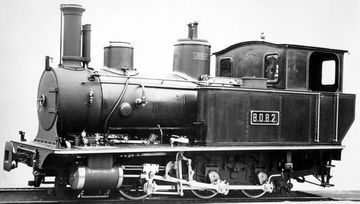
No. 2 around 1890
No. 2 around 1890
„Bilddatenbank Nostalgie der Jungfraubahnen”

During the construction of the Bernese Oberland Railway (BOB), it was planned to purchase one type of adhesion locomotive for the less steep section and one type of purely rack locomotive for the steeper section. By the time the line opened in 1890, the decision was made to purchase only one type with a combined adhesion and reck drive. The first three HG 3 were delivered in 1890 and three more in 1893. They later became HG 3/3 according to the Swiss system.

These were 0-6-0RT tank locomotives and had outside frames. The rack drive was mounted on the driving axles to avoid problems with the suspension. Of the two rack gears under the locomotive, one was used for driving and one for braking. The boiler was inclined by five percent compared to the frame.

After the BOB was electrified in 1914, these locomotives were no longer needed in daily operations and five of them were sold. Three were converted from the gauge of 1,000 mm to 950 mm and sold to the Italian Mediterranea-Calabro-Lucane. Two went to the Arosa Railway, but were sold to industry after a short time. The sixth locomotive remained with the BOB as a reserve. So far there is only a short text for this vehicle. In the future it will be described in more detail.

General
Built1890, 1893
ManufacturerSLM
Wheel arr.0-6-0RT (Six-coupled) 
Gauge3 ft 3 3/8 in (Meter gauge)
Dimensions and Weights
Length24 ft 0 1/2 in
Wheelbase8 ft 10 5/16 in
Rigid wheelbase8 ft 10 5/16 in
Service weight62,832 lbs
Adhesive weight62,832 lbs
Water capacity660 us gal
Fuel capacity1,653 lbs (coal)
Boiler
Grate area9.9 sq ft
Evaporative heating area656.6 sq ft
Total heating area656.6 sq ft
Power Plant
Driver diameter35.8 in
Boiler pressure174 psi
Expansion typesimple
Cylindersfour, adhesion: 12 5/8 x 17 11/16 in
rack: 12 5/8 x 15 3/4 in
Power
Power sourcesteam
Estimated power228 hp (170 kW)
Top speed19 mph
Calculated Values
steam locomotive
passenger
tank locomotive
narrow gauge
rack railway
last changed: 04/2024
Bosnian-Herzegovinian Railway class IIIc5 No. 701 to 721
Yugoslav State Railway class 97
go back
Bosnia Herzegovina | 1894
38 produced
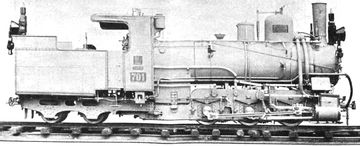
No. 701 on a works photo
Österreichische Ingenieur- und Architekten-Zeitschrift, May 1898

When the Bosnian-Herzegovinian State Railways put the route over the Komar Pass into operation as the next 2 ft 6 in rack railway after the Narenta railway in 1894, more powerful rack locomotives based on the Abt system were needed. The basis for the development was the class IIIb4, which had three coupled axles and a single-axle Klose supporting tender and was already in use on the Narenta railway. Adding a second axle under the supporting tender allowed not only to increase the supplies, but also to carry the load of a heavier boiler.

Technically, the locomotives shared many similarities with their predecessors. Due to the small gauge, an outer frame was still used, and the cylinders of the rack drive were still on the inside. In adhesion mode, still the the third coupled axle was powered. There were minor differences between the individual production series, for example the grate surface was initially reduced from 1.66 to 1.58 square meters. Also, some engines were oil-fired to improve visibility in tunnels. Compared to the 60 tonnes of the IIIb4, it was now possible to tow 80 to 90 tonnes on the six percent gradient, since the power was now 300 hp instead of 250 hp. With two pusher locomotives, train weights of 240 tonnes were even possible.

They replaced the IIIb4 on the Narenta railway, so that these were relocated to the route over the Komar Pass. But the IIIc5 was soon used there too. Since the two Mallet locomotives IIIb5 Nos. 751 and 752 had not proven themselves, additional engines with Klose supporting tenders were purchased in the years 1911 to 1919. This brought the number to 38, making it the most built rack locomotive. At the Yugoslav State Railways they were listed as class 97. The use of these locomotives ended there with the gauge change on the Narenta railway. The route over the Komar Pass was finally closed in 1975, which meant the end of the service life of the IIIc5. Four pieces are still existing today.

General
Built1894-1919
ManufacturerFloridsdorf
Wheel arr.0-6-4RT 
Gauge2 ft 5 15/16 in (Bosnian gauge)
Dimensions and Weights
Length33 ft 3 5/16 in
Empty weight59,966 lbs
Service weight82,585 lbs
Adhesive weight52,911 lbs
Water capacity925 us gal
Fuel capacity5,512 lbs (coal)
Boiler
Grate area17 sq ft
Firebox area75.3 sq ft
Tube heating area872.8 sq ft
Evaporative heating area948.2 sq ft
Total heating area948.2 sq ft
Power Plant
Driver diameter31.5 in
Boiler pressure174 psi
Expansion typesimple
Cylindersfour, adhesion: 13 3/8 x 17 11/16 in
rack: 14 3/16 x 17 11/16 in
Power
Power sourcesteam
Indicated power295 hp (220 kW)
Top speed19 mph
Calculated Values
steam locomotive
passenger
freight
tank locomotive
narrow gauge
rack railway
supporting tender
Klose supporting tender
last changed: 10/2022
Sectional drawing with dimensions
Die Lokomotive, August 1940
Brig-Furka-Disentis Railway HG 3/4
go back
Switzerland | 1913
10 produced
No. 1 in the SLM data sheet
SBB Historic

The Brig-Furka-Disentis railway ordered ten rack locomotives from SLM while under construction, the first three of which were delivered directly to the construction sites. They were based on the HG 2/3 of the Visp-Zermatt railway, but had significantly more power thanks to superheated steam. The four cylinders worked in compound, with the gearwheels driven by the low-pressure cylinders and always operated together with the adhesion drive. With the electrification of the railway, the locomotives were retired there in 1940. One was sold to France and four to French Indochina (Vietnam). The latter four came back to Switzerland in 1990 and two of them are now running on the Furka mountain line after being refurbished.So far there is only a short text for this vehicle. In the future it will be described in more detail.

General
Built1913-1914
ManufacturerSLM
Wheel arr.2-6-0RT (Mogul) 
Gauge3 ft 3 3/8 in (Meter gauge)
Dimensions and Weights
Length28 ft 8 1/2 in
Wheelbase17 ft 5 5/8 in
Rigid wheelbase11 ft 1 7/8 in
Empty weight74,516 lbs
Service weight92,638 lbs
Adhesive weight79,234 lbs
Axle load26,411 lbs
Water capacity845 us gal
Fuel capacity2,271 lbs (coal)
Boiler
Grate area15.1 sq ft
Firebox area73.5 sq ft
Tube heating area643.5 sq ft
Evaporative heating area717 sq ft
Superheater area185.1 sq ft
Total heating area902.1 sq ft
Power Plant
Driver diameter35.8 in
Boiler pressure203 psi
Expansion typecompound
Cylindersfour, HP: 16 9/16 x 18 7/8 in
and LP: 22 1/16 x 17 11/16 in
Power
Power sourcesteam
Indicated power590 hp (440 kW)
Top speed28 mph
Calculated Values
steam locomotive
tank locomotive
narrow gauge
rack railway
passenger
last changed: 05/2023
Watch on YouTube
Central South African Rack 4-6-4RT
go back
South Africa | 1905
2 produced
Image of locomotive
flickr/Historical Railway Images

Numbers 995 and 996 of the CSAR were two 4-6-4T rack locomotives specified by P.A. Hyde and built by Vulcan Foundry in 1905. They were intended for the section between Waterval Onder and Waterval Boven that also included a tunnel, so that they also required condensing apparatus. The specification called for bar frames and only two 18-inch cylinders with a long stroke of 30 inches which powered the adhesion wheels and the two rack wheels at the same time.

As opposed to the specifications, Vulcan Foundry chose to use a total of four cylinders with a stroke of only 20 inches for independent rack and adhesion drive. The driving axles were mounted in outside plate frames to provide space for a frame that held the two rack wheels. This was also the cause for the long wheelbase between the first and second driving axles. For stopping on the downward runs, they had a Le Chatelier counter-pressure air brake.

As the dimensions of the boilers had originally been specified for only two cylinders, they quickly reached their limits when both sets of cylinders were used at the same time. In the result, the CSAR continued to use older rack locomotives on this line and as early as 1906, the inside cylinders and the rack wheels were removed. Now, their wheel arrangement meant that they had a small adhesive weight compared to the total locomotive weight. The SAR integrated them into their roster, but withdrew both in 1915.

General
Built1905
ManufacturerVulcan Foundry
Wheel arr.4-6-4RT
Gauge3 ft 6 in (Cape gauge)
Dimensions and Weights
Length41 ft 5 in
Wheelbase33 ft 7 in
Rigid wheelbase12 ft 9 in
Service weight188,720 lbs
Adhesive weight105,840 lbs
Axle load42,560 lbs
Water capacity1,441 us gal
Fuel capacity5,000 lbs (coal)
Boiler
Grate area33.5 sq ft
Firebox area140.2 sq ft
Tube heating area1,298.1 sq ft
Evaporative heating area1,438.3 sq ft
Total heating area1,438.3 sq ft
Power Plant
Driver diameter42.3 in
Boiler pressure200 psi
Expansion typesimple
Cylindersfour, 18 x 20 in
Power
Power sourcesteam
Estimated power900 hp (671 kW)
Starting effort26,073 lbf
Calculated Values
steam locomotive
passenger
freight
rack railway
tank locomotive
condensator
last changed: 09/2026
General Belgrano class E24
go back
Argentina | 1955
2 produced
Image of locomotive
flickr/Historical Railway Images

At the beginning of the fifties, the General Belgrano Railway in Argentina still used three 0-8-2 rack locomotives built by Maschinenfabrik Esslingen in Germany in 1905. In 1955, these three were replaced by two locomotives of the new class E24, again built in Esslingen. These again had a combined rack and adhesion drive, but now six driving axles and were oil-fired.

Although the inside cylinders were fairly small, the rack wheels were driven by a 2.44 to 1 ratio what greatly increased tractive power. Sadly, they were too complex for their area of operation and suffered from cracks in frames and cylinders. For these reasons they were quickly replaced by diesels and used as stationary steam generators.

General
Built1955
ManufacturerEsslingen
Wheel arr.0-12-2RT 
Gauge3 ft 3 3/8 in (Meter gauge)
Dimensions and Weights
Length43 ft 4 11/16 in
Wheelbase25 ft 10 in
Rigid wheelbase14 ft 11 in
Service weight242,508 lbs
Adhesive weight218,257 lbs
Axle load38,140 lbs
Water capacity2,695 us gal
Fuel capacity977 us gal (oil)
Boiler
Grate area37.7 sq ft
Evaporative heating area2,281.9 sq ft
Superheater area931.1 sq ft
Total heating area3,213 sq ft
Power Plant
Driver diameter37 in
Boiler pressure203 psi
Expansion typesimple
Cylindersfour, adhesion: 26 3/4 x 19 1/2 in
rack: 15 3/4 x 15 3/4 in
Power
Power sourcesteam
Estimated power1,475 hp (1,100 kW)
Starting effort65,141 lbf
Calculated Values
steam locomotive
freight
tank locomotive
rack railway
last changed: 04/2024
Imperial-Royal State Railways class 69
German Reichsbahn class 972
go back
Austria-Hungary | 1890
18 produced
97.208 with Giesl ejector at the Heizhaus Strasshof
Walter Koprolin

The class 69 of the kkStB was a 0-6-2 rack locomotive designed for iron ore traffic on the Erzberg Railway. This line had an incline of up to 7.1 percent and an Abt rack system. Although the mining operations were carried out by a private company, the state railway was tasked with the transport of the ore. A total of 18 locomotives of this class were built at Floridsdorf between 1890 and 1908.

The rack wheels were mounted in a separate frame what was suspended from two driving axles. It was powered by two smaller cylinders which could be engaged on rack sections. Initially they were limited to a speed of 12 km/h on rack sections, but this was later improved to 20 km/h after the braking systems had been improved. In pure adhesion mode, they reached 30 km/h.

Five locomotives got a Giesl ejector that increased power. In 1938, the Reichsbahn numbered them 97 201 to 97 217 and in World War II, two came to Germany and Hungary. Later the ÖBB didn't change their numbers. They were retired in 1978 when rack operations on the Erzberg Railway were stopped. Five are still existing, with 97.208 still operational at the museum in Strasshof.

General
Built1890-1908
ManufacturerFloridsdorf
Wheel arr.0-6-2RT (Webb) 
Gauge4 ft 8 1/2 in (Standard gauge)
Dimensions and Weights
Length34 ft 5 11/16 in
Wheelbase16 ft 4 7/8 in
Service weight130,073 lbs
Adhesive weight97,224 lbs
Water capacity1,717 us gal
Fuel capacity5,512 lbs (coal)
Boiler
Grate area22.6 sq ft
Evaporative heating area1,560.8 sq ft
Total heating area1,560.8 sq ft
Power Plant
Driver diameter40.6 in
Boiler pressure160 psi
Expansion typesimple
Cylindersfour, adhesion: 18 7/8 x 19 11/16 in
rack: 16 9/16 x 17 11/16 in
Power
Power sourcesteam
Indicated power416 hp (310 kW)
Top speed19 mph
Calculated Values
steam locomotive
tank locomotive
rack railway
freight
last changed: 11/2024
97.217 of the Erzbergbahn as a memorial in Vordernberg
Herbert Ortner
Schematic drawing
Schematic drawing
Watch on YouTube
Showing 1 to 10 of 27
Search
loadding loading...

We use cookies to save the following settings:

  • selected navigation structure
  • selected language
  • preferred units
  • spelling of railway company names

If you refuse the use of cookies, the settings will only be retained for the current session and will be reset to the default values the next time you visit the site.

Display of units

Here you can set the desired unit system for the technical data.

  • Metric: Lengths in meters, weights in tonnes, and volumes in cubic meters
  • Imperial (UK): Lengths in feet/inches, weights in long tons and volumes in imperial gallons
  • Imperial (US): Lengths in feet/inches, weights in pounds, and volumes in US gallons
  • Individual: Depends on the country of origin of each locomotive
Operator names

Here you can set the display of railway company names.

  • Short: Abbreviation or short form of the name
  • Standard: commonly used name, partially translated to English
  • Complete: full name in local language